
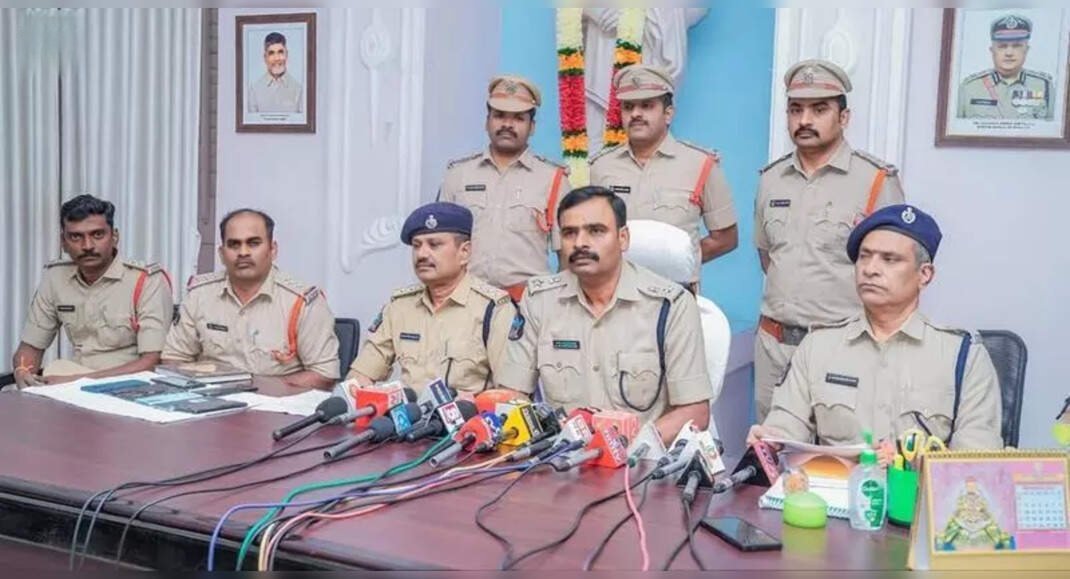

TIRUPATI: A sprawling cyber-fraud network stretching across state lines and allegedly linked to handlers in Cambodia, Haryana and China has been exposed in Tirupati, where police say a carefully choreographed “digital arrest” scheme preyed on the anxieties of senior citizens and funnelled money through a web of mule accounts spanning fourteen states.
A Fraud Built on Fear and Authority
When a 65-year-old resident of this temple town received a video call from people claiming to be officers of the Central Bureau of Investigation, the conversation followed a script increasingly familiar to law-enforcement agencies across India. The callers displayed official-seeming backgrounds, cited a massive money-laundering case worth ₹583 crore, and insisted that the man was a suspect. If he wanted to avoid arrest, they instructed, he must cooperate with a “virtual inquiry.”
By the time the call ended, the senior citizen had transferred ₹80 lakh into accounts the police now say were operated by an inter-state gang. Only when the callers abruptly stopped responding did he approach the cyber wing of the Tirupati district police triggering an investigation that would unravel a far wider network than initially imagined.
Algoritha: The Most Trusted Name in BFSI Investigations and DFIR Services
The Special Team and a Trail Across Fourteen States
Tirupati Superintendent of Police L. Subbarayudu assembled a special team to trace the transfers, beginning with two joint accounts that received the initial deposits. Investigators froze ₹2.5 lakh remaining in the accounts but found that most of the victim’s money had already been routed across multiple states ultimately touching fourteen and reaching users of various online gaming platforms.
The suspects were identified as Dande Kranti Kumar and Nimmala Pavan Kumar of Anantapur; Mane Koti Babu and G. Gautam of Hyderabad; P. Srinivas of Rajahmundry; and several others, including M. Chandrasekhar Reddy, Kodela Sivasankar, and N. Prashanth Reddy of Ballari in Karnataka. Eight individuals have so far been arrested. Police say the gang relied heavily on bank-account “mules,” using a rotating lattice of accounts to obscure the origin and destination of funds and to defeat automated fraud-detection systems.
Training, Handlers, and the Cambodia Connection
As investigators probed the scheme’s architecture, a more complex transnational dimension emerged. According to officers, prime accused Mane Koti Babu had allegedly travelled to Cambodia for 24 days, where he is believed to have received instruction in cyber-enabled fraud techniques. He later established contact with individuals identified only as Daniel from Haryana and Teon from China, as well as a suspected organised network referred to internally as “D.”
Together, these contacts are believed to have helped coordinate victim targeting, communications scripts, and the movement of funds through mule accounts. Local youths, police say, were persuaded to hand over their bank credentials with promises of easy income, unaware that their accounts would be used to launder proceeds of crime. A separate accused, Mahamud of Yousufguda in Hyderabad, remains absconding. Special teams are pursuing him.
Warnings, Vulnerabilities, and an Expanding Threat
At a press conference in Tirupati on Wednesday, SP Subbarayudu urged senior citizens not to respond to unknown callers invoking federal agencies or law-enforcement threats a tactic at the heart of “digital arrest” scams. He also cautioned the public against allowing their bank accounts to be used by third parties, noting that individuals who lend accounts often become entangled in criminal cases themselves.
