

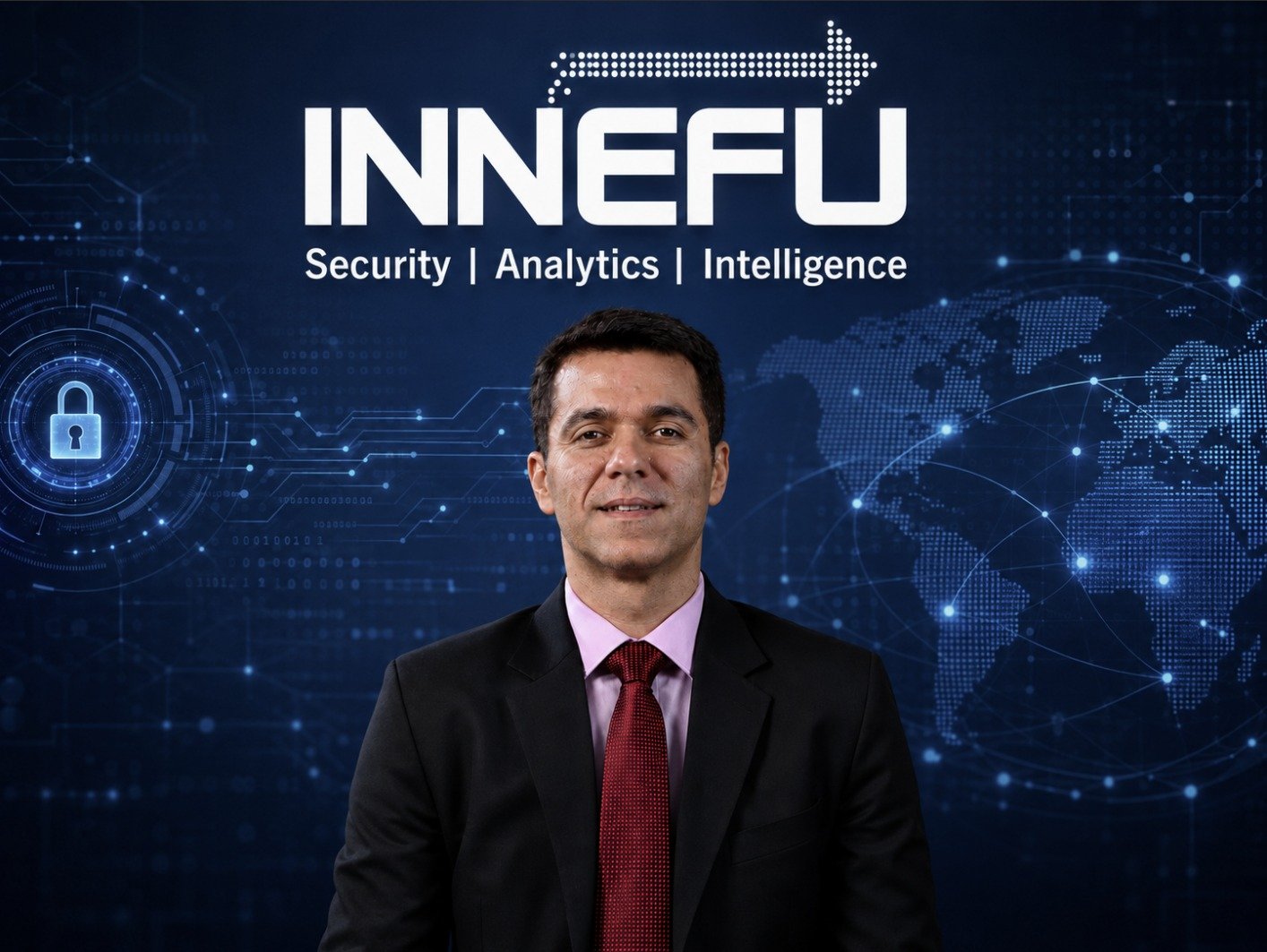

Innefu Labs, a New Delhi-headquartered artificial intelligence company working in the national security and cyber intelligence space, has raised $30 million, about ₹286 crore, in a Series B funding round led by Singapore-based Panthera Growth Partners.
The investment, completed through a combination of primary and secondary transactions from Panthera’s second fund, comes at a time when governments, intelligence agencies and large enterprises are increasingly turning to AI-driven systems for security, data fusion, predictive policing, open-source intelligence and cyber defence.
For Innefu, the new capital is expected to accelerate global market expansion, deepen its research and development efforts and support its ambitions around sovereign AI infrastructure. The company has said the funding also positions it for a possible initial public offering.
Founded in 2010 by Tarun Wig and Abhishek Sharma, Innefu has built itself around a specific and high-stakes market: AI-powered systems for national security agencies, defence organisations, law enforcement bodies, financial intelligence units and large enterprises.
A Funding Round Built Around Security and Sovereign AI
The Series B round places Innefu in a category of Indian AI companies that are not simply building general-purpose tools, but are working in security-sensitive domains where trust, localisation and domain expertise carry unusual importance.
The company said the proceeds will be used for global market expansion and deep-tech research and development. Its plans include advancing its proprietary agentic AI platform, establishing a dedicated Physical AI and robotics wing, and developing sovereign AI infrastructure with secure, domain-specialised language models for high-trust environments.
That phrase — sovereign AI — has become increasingly important in national security and government technology circles. It refers to AI systems, data architectures and models that can be developed, controlled or deployed in ways that reduce dependence on foreign platforms, particularly in areas involving defence, intelligence, policing and critical infrastructure.
For countries like India, which are attempting to build domestic capacity in strategic technologies, companies such as Innefu occupy a sensitive space between private enterprise and national capability. Their products are not merely commercial software; they often sit inside systems used for intelligence fusion, surveillance, cyber response, investigation and operational decision-making.
From Data Fusion to Predictive Policing
Innefu describes itself as an AI company committed to strengthening national and cyber security. It says it has more than 100 installations across the Indian subcontinent, the Middle East and Southeast Asia.
The company’s deployments include national-scale AI intelligence fusion centres, national terrorism data fusion centres, operational intelligence fusion centres, revenue intelligence platforms, predictive policing systems, and open-source intelligence and deep-web fusion platforms for law enforcement and defence agencies.
Its client base includes defence and intelligence organisations, law enforcement agencies, financial intelligence units, BFSI clients and Fortune 500 companies.
This places Innefu in a rapidly expanding market where security agencies are trying to process enormous volumes of structured and unstructured data: financial records, open-source intelligence, case data, communication patterns, watchlists, field inputs, cyber indicators and public digital footprints.
The attraction of AI in this environment is obvious. It can help analysts connect patterns, identify anomalies, prioritise leads and build decision-support systems. But the stakes are also high. AI tools used in policing and intelligence require accuracy, auditability, safeguards and governance because errors can affect investigations, civil liberties and institutional trust.
Investor Confidence and the Road to IPO
Panthera Growth Partners’ investment appears to be based not only on India’s AI opportunity but also on Innefu’s domain-specific positioning.
Shilpa Kulkarni, Founder and Managing Partner of Panthera Growth Partners, said Innefu had built native, AI-powered software to solve critical challenges in national defence and enterprise security infrastructure. She cited the company’s proprietary technology, deep domain expertise and track record in mission-critical environments as reasons for the investment.
Innefu has also reported improving financial performance. The company recorded a net profit of ₹34.2 crore in FY25, up nearly 90 percent from ₹18 crore in the previous fiscal year. Its revenue from operations rose to ₹103 crore in FY25, compared with ₹62.7 crore in FY24.
The company has also said it holds a growing pool of contracts exceeding ₹100 crore across defence, intelligence, law enforcement and revenue intelligence operations.
These numbers matter because many AI companies remain in a high-growth but loss-making phase. Innefu’s reported profitability gives it a different investor narrative: a specialised AI company operating in high-trust sectors, with government and enterprise deployments, international expansion ambitions and a potential IPO pathway.
India’s AI Security Market Enters a New Phase
The funding also reflects a broader shift in India’s technology ecosystem. The first wave of AI excitement was often consumer-facing or enterprise-productivity focused. But the next wave is increasingly linked to security, defence, intelligence, fraud detection, governance and sovereign infrastructure.
Innefu’s raise comes at a moment when Indian policymakers and security agencies are paying closer attention to AI’s dual role: as a tool for national capability and as a source of new risk. AI can strengthen investigation, intelligence analysis and cyber defence, but it can also accelerate fraud, disinformation, cyberattacks and surveillance concerns.
That tension makes companies in this sector both valuable and closely watched. Their growth depends not only on technological performance but also on trust, institutional relationships, compliance and the ability to operate in environments where failure can carry national consequences.
For Innefu, the $30 million round is therefore more than a financial milestone. It is a signal that investors are willing to back Indian AI companies working in complex, security-heavy markets that require long sales cycles, deep domain knowledge and credible deployment histories.
The company’s next phase will test whether it can expand internationally while retaining the trust that national security clients demand. In a world where AI is becoming central to both defence and disruption, Innefu’s growth story points to a larger question: whether India can build globally relevant AI companies in the most sensitive layers of digital security.
Follow for daily updates on cybercrime, corporate fraud, DFIR, hacking, investigations, and digital forensics
