
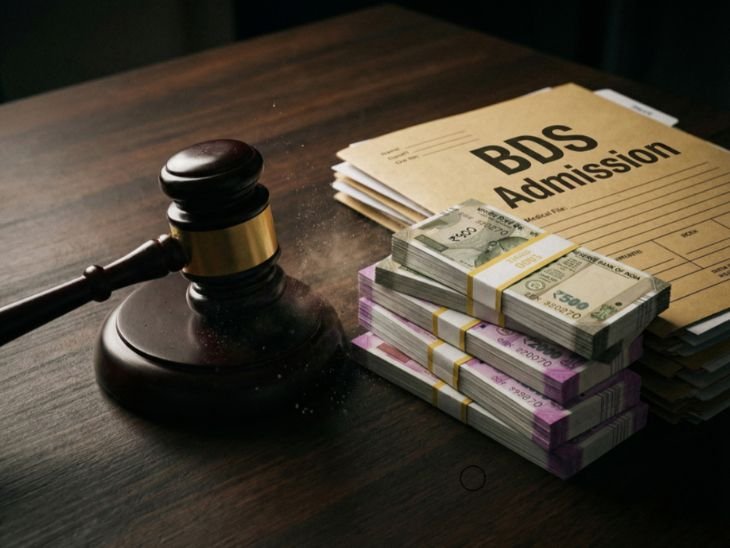

New Delhi: Taking a firm stand against violations in medical and dental education, the Supreme Court has imposed a ₹100 crore penalty on 10 private dental colleges in Rajasthan for admitting students to the BDS course despite their failure to meet the minimum NEET 2016–17 eligibility criteria. The court termed the admissions a clear breach of statutory norms and said such practices amount to compromising the quality of professional education.
The apex court reiterated that NEET is the sole legally mandated entrance examination for admission to medical and dental courses across the country. Any deviation from its eligibility criteria, the court observed, undermines both the credibility of the admission process and the standards of healthcare education.
Deliberate Violation of Admission Rules
The court found that despite clear provisions under the 2007 admission regulations, the concerned colleges proceeded to enroll students who had failed to secure the prescribed minimum marks in NEET. These admissions were made knowingly, the bench noted, even as the legal framework left no scope for relaxation.
Colleges Penalised, State Government Pulled Up
The bench held that each of the 10 dental colleges must deposit ₹10 crore each with the Rajasthan State Legal Services Authority. The court also directed the Rajasthan government to deposit ₹10 lakh, pointing to administrative lapses and the grant of permissions without statutory backing.
The court made it clear that institutional autonomy cannot be used as a shield to bypass binding regulations, especially in sectors impacting public health.
Penalty to Be Used for Social Welfare
In a significant direction, the Supreme Court ordered that the ₹100 crore penalty amount be placed in fixed deposits, with the interest generated to be used for social welfare initiatives in Rajasthan. These include the upkeep and strengthening of one-stop crisis centres, women’s shelters, old-age homes and child care institutions.
The court said the approach ensures that penalties imposed for regulatory violations serve a larger public purpose, rather than remaining purely punitive.
Conditional Relief for Students
Invoking its extraordinary powers under Article 142 of the Constitution, the Supreme Court granted relief to students who had already completed the BDS course despite their admissions being irregular. Their degrees have been regularised, but only subject to strict conditions.
Such students are required to submit affidavits before the Rajasthan High Court, committing to provide free professional services to the state during emergencies, including pandemics, natural disasters or other public crises.
The court clarified that this relief is exceptional and case-specific, and must not be treated as a precedent for future violations.
High Court Committee to Monitor Fund Utilisation
To ensure transparency, the Supreme Court requested the Chief Justice of the Rajasthan High Court to constitute a five-judge committee, including at least one woman judge, to oversee the utilisation of interest earned from the fixed deposits.
The committee will be responsible for monitoring whether the funds are being used effectively and strictly for the intended social objectives.
Concern Over Declining Educational Standards
The judgment reflects deep concern over the erosion of standards in medical and dental education. The court warned that unlawful admissions not only weaken regulatory discipline but also raise serious questions about the competence of future healthcare professionals.
The bench cautioned that any recurrence of such practices would invite even stricter consequences, making it clear that regulatory compliance is non-negotiable.
Time Limit for Degree Completion Reinforced
The court also clarified that students who have failed to complete the BDS course within nine years will no longer be eligible to continue. As per the 2007 regulations, a five-year BDS programme must be completed within a maximum of nine years, with no scope for extension.
