

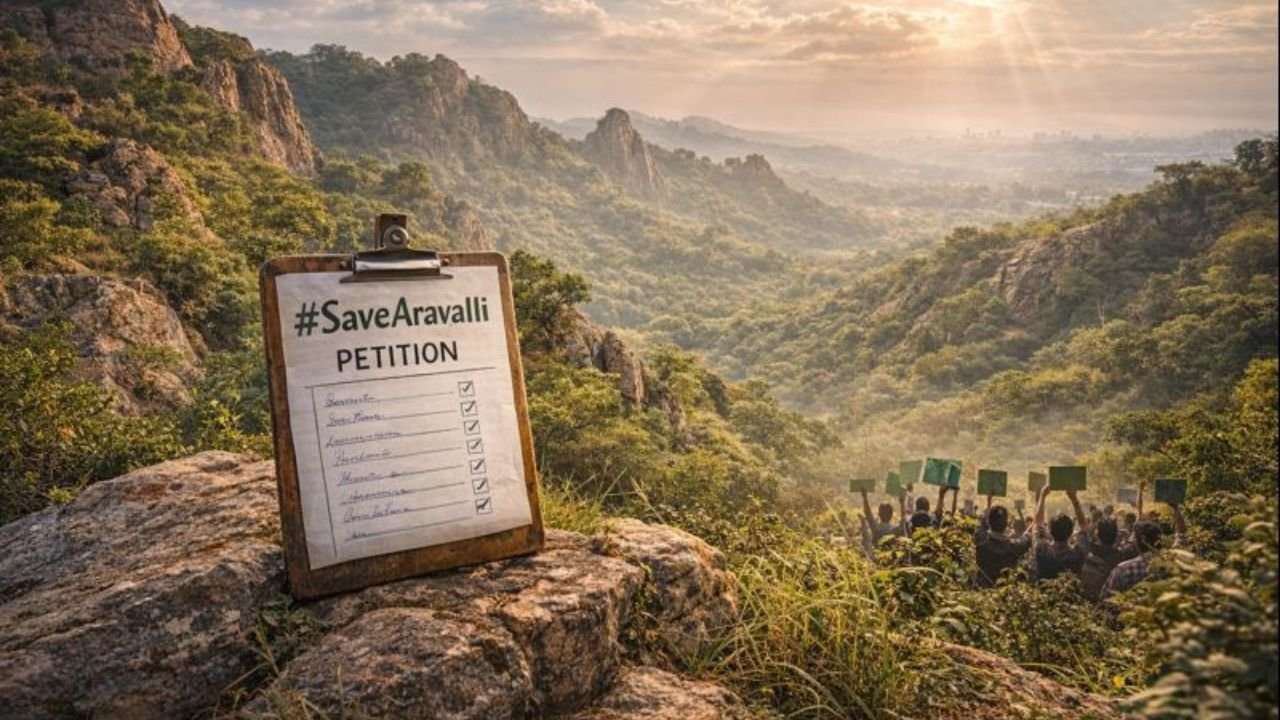

New Delhi | A recent ruling by the Supreme Court of India on the classification of the Aravalli Range has triggered an intense debate among environmentalists, policymakers and citizens. The verdict—now widely referred to as the “100-metre decision”—clarifies that hills with a height of less than 100 metres in the Aravalli region cannot automatically be classified as ‘forest land’.
Following the ruling, protests have erupted in parts of Haryana and Delhi-NCR, while the hashtag #SaveAravalli has gained momentum across social media platforms.
Why environmentalists are concerned
Experts associated with the Save Aravalli Trust, including environmentalists Vijay Beniwal and Neeraj Shrivastava, have raised serious concerns over the implications of the judgment. They point out that in Haryana, only two peaks exceed the 100-metre mark—Tosham (Bhiwani district) and Madhopur (Mahendragarh district).
According to them, this could potentially leave large parts of the Aravalli system outside effective legal protection, increasing vulnerability to mining, construction and land-use change.
They warn that weakening protection of the Aravalli could have cascading ecological consequences:
- Rise in dust and air pollution, worsening Delhi’s already severe air quality
- Decline in groundwater recharge, leading to drying borewells
- Intensification of heatwaves and urban heat island effect
- Increase in respiratory and heat-related health issues
- Long-term migration pressures as areas become less livable
Natural shield against desertification
Environmentalists stress that the Aravalli acts as a natural barrier preventing the expansion of the Thar Desert towards northern India. If this shield weakens, desertification could accelerate.
They argue that while cities like Dubai face fewer dust storms due to strong natural and artificial barriers, Delhi’s worsening dust problem is closely linked to the degradation of the Aravalli hills.
Industry vs ecology debate
Activists allege that the ruling could indirectly benefit mining and real estate interests, making clearances easier, while ordinary citizens bear the environmental cost. They emphasise that the risk lies not in the clarification itself, but in how the ruling may be interpreted and implemented by state governments.
Why Delhi’s ecological balance matters
Historians and environmental planners note that during British rule, Delhi was chosen as the capital partly because it was flanked by the Aravalli hills on one side and the Yamuna river on the other—both acting as natural stabilisers of climate and water systems.
Experts argue that such a complex ecological issue required deeper environmental assessment, and caution that courts, by nature, have institutional limits in resolving long-term ecological trade-offs without comprehensive scientific input.
Save Aravalli campaign gains ground
The Save Aravalli campaign has announced plans to submit memorandums to district magistrates in over 150 districts. An online petition linked to the movement has already garnered over 41,000 signatures.
Campaigners say the objective is not confrontation, but to ensure the ruling is not misused to dilute environmental safeguards. They describe the Aravalli as “North India’s lifeline”, warning that any erosion of protection could have irreversible regional consequences.
Dust barrier, water security and climate risks
Scientific studies cited by activists show that exposed sections of the Aravalli significantly contribute to winter smog and PM10–PM2.5 pollution levels in Delhi-NCR.
The hill range also plays a crucial role in rainwater retention and groundwater recharge across Haryana–Rajasthan belts, regions already facing acute water stress. Increased deforestation or mining could push borewells deeper and dry up aquifers faster.
Additionally, experts warn that weakening the Aravalli would reduce its natural cooling effect, intensifying urban heat island conditions and making summers more extreme.
Not the verdict, but its misuse
Some voices on social media argue that the ruling does not mandate deforestation, but merely clarifies classification norms. However, even critics of the movement acknowledge that the real risk lies in misuse, such as manipulation of land records, diluted environmental impact assessments, or unchecked construction in the name of development.
Ultimately, the responsibility now shifts to state governments and regulatory agencies to strike a balance between development and conservation.
