

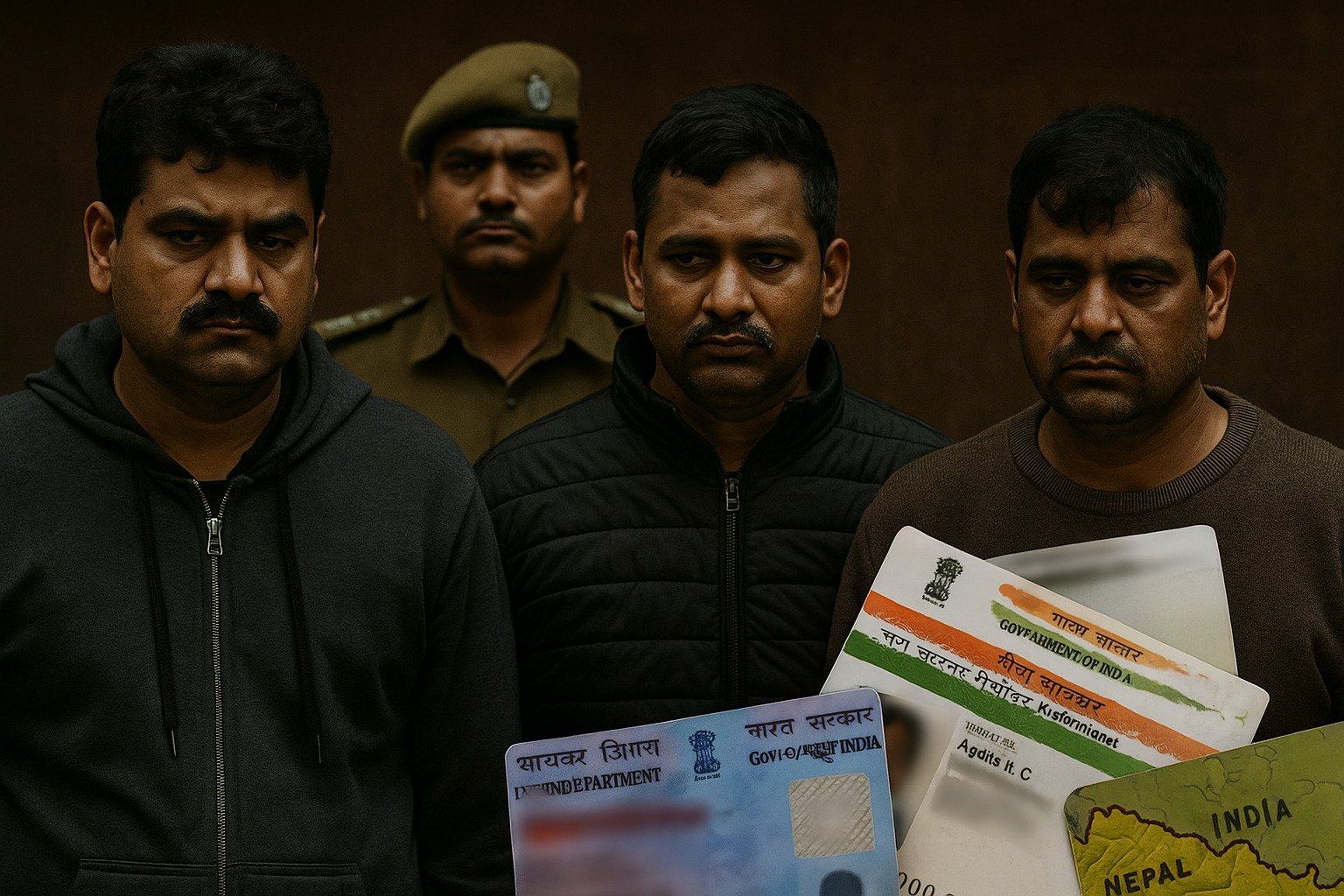

STF arrests five gang members, including mastermind with prior criminal record; forged documents enabled bank accounts, property registrations, and cross-border identity fraud.
Key Points
STF arrested five individuals involved in producing and distributing fake Indian identity documents to Nepalese nationals.
- Fake “citizenship package” priced ₹20,000–25,000 included birth/residence certificates, Aadhaar, and PAN cards.
- Mastermind Ravi Verma, previously jailed for similar crimes, facilitated cross-border operations across multiple UP districts.
- Forged documents were used to open bank accounts and purchase property in sensitive border districts.
- Officials investigating potential local administrative collusion and document transport to Nepal.
- Experts warn network poses risks to national security, property laws, and governance along border areas.
Detailed Narrative
A sophisticated network operating in Gonda, Uttar Pradesh, has been dismantled by the Special Task Force (STF), revealing the sale of Indian citizenship packages to Nepalese nationals for ₹20,000–25,000. The network provided a complete suite of forged documents, including birth and residence certificates, Aadhaar cards, and PAN cards. Authorities say these documents enabled recipients to open bank accounts, register property, and establish a credible legal identity in India.
The STF arrested five accused: Gram Panchayat officer Lal Bihari Pal of Ahirouli, Hardoi, and Gonda residents Ravi Verma, Sonu Verma, Banshraj Verma, and Satyarohan Verma. Ravi Verma, identified as the mastermind, has a prior criminal record for producing fake birth certificates and has been operating this illicit trade for years, establishing a network across multiple border districts, including Bahraich, Shravasti, Balrampur, Maharajganj, Siddharthnagar, and Lakhimpur Kheri.
STF officials described the operation as highly organized.
“The gang didn’t just create fake documents; they made them functional,” said a senior officer. “Accounts were opened, property transactions executed — all using forged identity documents.”
Former Intelligence Bureau officer Santosh Singh highlighted the broader implications: “In multiple border tehsils, including Nanpara (Bahraich), Bhigna (Shravasti), Dumriaganj (Siddharthnagar), and Palia Kalan (Lakhimpur Kheri), Nepalese nationals attempted to acquire property using forged identities. One case in Shravasti has already led to legal proceedings.”
Authorities are investigating the logistics of document distribution to Nepal and the possibility of local administrative collusion. The STF is also tracing all recipients of fake documents and verifying recovered records.
Experts warn that such networks threaten not only property and financial regulations but also national security. Border districts in Uttar Pradesh are sensitive zones, and infiltration of fake identities could have far-reaching consequences for governance, law enforcement, and even electoral processes.
The STF’s action has prompted heightened surveillance and coordination between registration offices, banks, and border authorities. Analysts say this case underscores the need for rigorous verification protocols and proactive monitoring to prevent the spread of similar operations.
“The sophistication of this network highlights systemic vulnerabilities,” said one security analyst. “Without stronger checks at multiple levels — administrative, financial, and border security — such operations could continue to exploit loopholes with serious consequences for both governance and national security.”
As investigations continue, officials are expected to reveal further findings, including potential links to additional perpetrators and detailed mechanisms of cross-border document distribution. For residents and authorities alike, the Gonda case serves as a stark reminder of the complex challenges posed by identity fraud along India’s northern border.
