

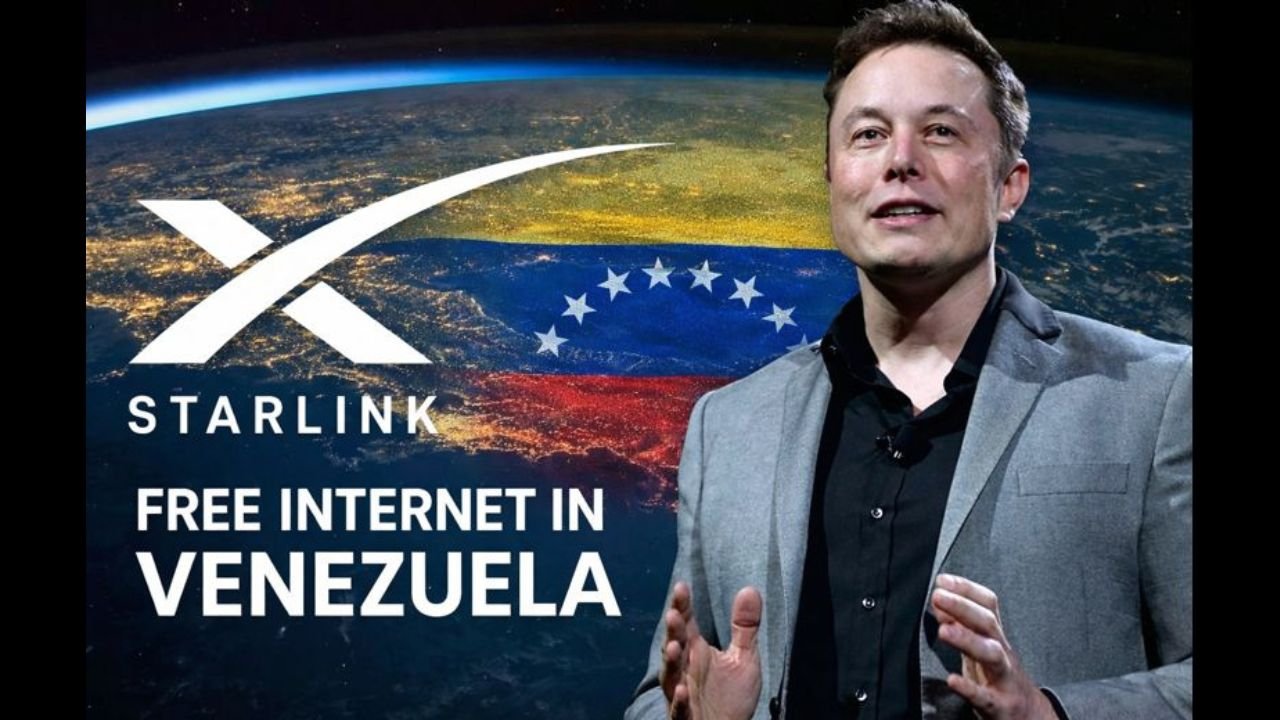

Washington | January 4, 2026 | Venezuela is navigating one of the most turbulent political transitions in its recent history. Against this backdrop, billionaire entrepreneur Elon Musk announced that Starlink, the satellite broadband arm of SpaceX, will provide free internet access across Venezuela until February 3. The decision comes at a time of heightened uncertainty marked by regime change, administrative flux, and fears over information blackouts.
“In support of the people of Venezuela,” Musk wrote on social media platform X, reposting Starlink’s official announcement. The company said the temporary free service aims to ensure uninterrupted broadband connectivity, even as political upheaval threatens communications within and beyond the country.
The announcement followed dramatic scenes released by US authorities showing former president Nicolás Maduro being led away in handcuffs. In the footage, Maduro is seen wishing reporters and Drug Enforcement Administration (DEA) agents a “Happy New Year”—images widely interpreted as symbolising the abrupt and dramatic end of his rule.
Why Connectivity Matters During Political Shock
Starlink’s move is being viewed not merely as a humanitarian gesture, but as a strategic intervention. Venezuela has for years struggled with a fragile telecommunications network, frequent power outages, and tight state control over information flows. During periods of unrest, internet disruptions have been common.
Analysts say free satellite internet could offer uncensored and reliable communication to citizens, journalists, human rights groups, and international agencies during the transition. In such moments, connectivity is critical—not only for the flow of information, but also for monitoring ground realities and coordinating administrative and humanitarian responses.
Leadership Vacuum and Constitutional Response
Within hours of Maduro’s removal, Venezuela’s Supreme Court moved to address the leadership vacuum. Citing constitutional provisions, the court ordered Vice President Delcy Rodríguez to assume the powers of acting president, declaring that Maduro was in a “material and temporary impossibility” to perform his constitutional duties.
In an order broadcast on state television channel VTV, the court said Rodríguez would exercise all presidential powers to ensure administrative continuity and the comprehensive defence of the nation. Under Venezuela’s constitution, the vice president is mandated to step in when the president is absent or incapacitated.
US Action and the Politics of Oil
The developments have also reignited debate in Washington over US motivations. Former US National Security Advisor John Bolton told CNN that plans to remove Maduro had been discussed during President Donald Trump’s first term, but did not advance at the time.
According to Bolton, Trump had a long-standing interest in Venezuela’s vast oil reserves, though competing global priorities prevented sustained focus. He added that Venezuela’s opposition once believed economic pressure alone would fracture Maduro’s regime—a calculation that later shifted as circumstances changed.
Internet as a Geopolitical Instrument
Starlink’s intervention underscores how private satellite networks are becoming influential players in geopolitical crises. In recent years, Starlink has been deployed in conflict zones and disaster-hit regions to maintain connectivity when terrestrial networks fail or are deliberately shut down.
Although the free service in Venezuela is limited until February 3, experts say its short-term impact could be substantial—especially if protests intensify, administrative disruptions grow, or information blackouts are imposed. The move also places Starlink at the centre of a sensitive political moment, blurring the line between commercial technology services and geopolitical influence.
An Uncertain Road Ahead
As Venezuela adjusts to a new power structure, international reactions continue to mount. Some governments are calling for restraint and dialogue, while others are closely watching the implications for regional stability and global energy markets.
For now, Starlink’s announcement provides a rare constant in a rapidly shifting landscape: connectivity. In 2026, it is increasingly clear that internet access is no longer just a technological convenience, but a strategic asset—one capable of shaping political outcomes on the ground.
About the author — Suvedita Nath is a science student with a growing interest in cybercrime and digital safety. She writes on online activity, cyber threats, and technology-driven risks. Her work focuses on clarity, accuracy, and public awareness.
