
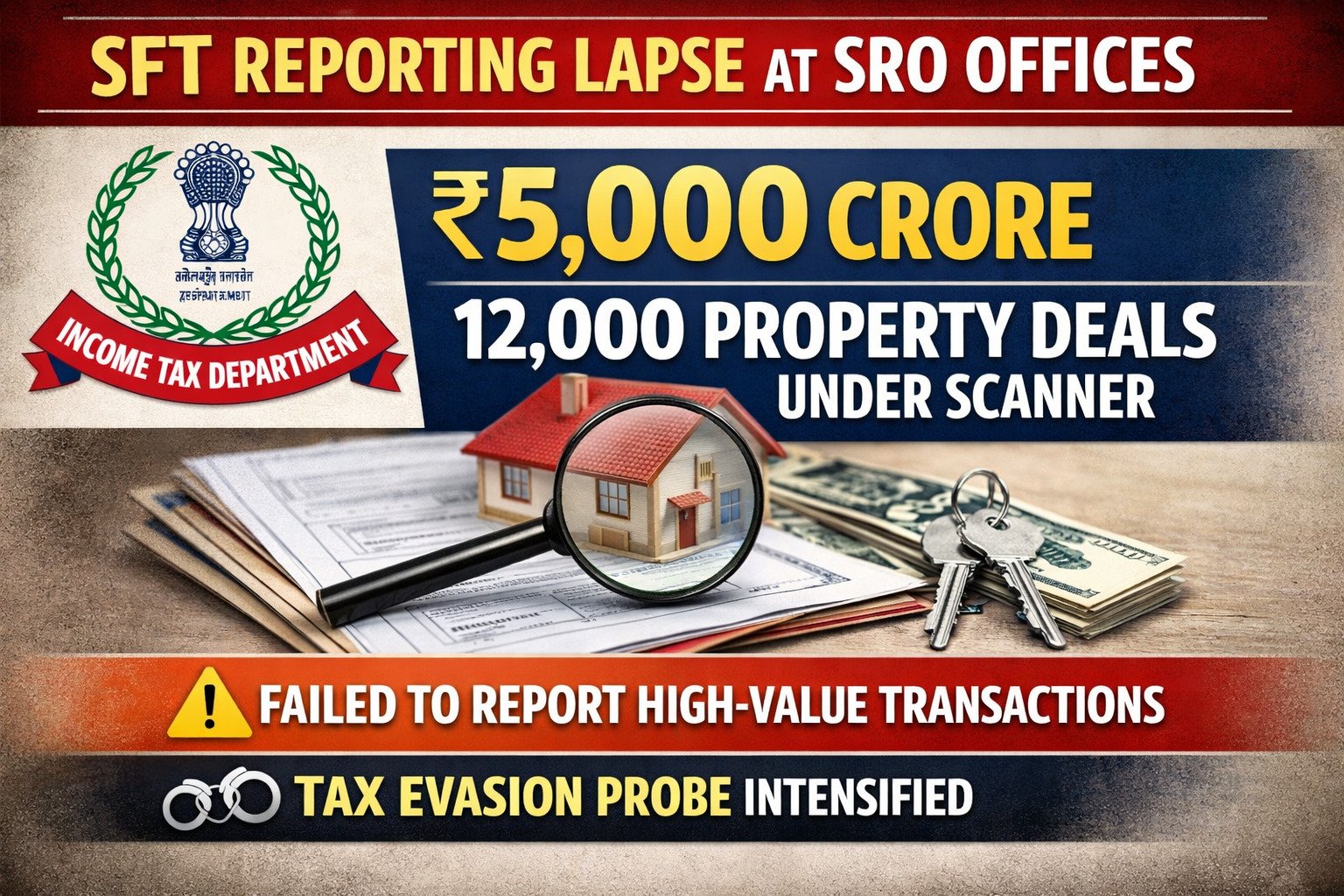
Serious allegations of negligence have surfaced against Sub-Registrar Offices (SROs) over lapses in Statement of Financial Transactions (SFT) reporting. Owing to this lapse, the Income Tax Department has placed nearly 12,000 property registrations worth about ₹5,000 crore under scrutiny. According to departmental assessments, details of high-value property transactions carried out during FY 2024–25 were not shared with the Income Tax Directorate (Intelligence & Criminal Investigation) within the prescribed timeline.
Final Call: FCRF Opens Last Registration Window for GRC and DPO Certifications
Details Still Pending Despite May 31 Deadline
As per regulations, property registrations valued at ₹30 lakh or more must be reported to the Income Tax Department under SFT. Concerned SROs were required to submit these reports in the prescribed format by May 31, 2025. However, the information has still not been furnished. Officials note that the district records 10,000–12,000 such high-value registrations annually, and estimates suggest that information on transactions worth at least ₹5,000 crore has yet to reach the department.
SFT: A Critical Source of Tax Intelligence
Tax experts emphasize that SFT reporting is not merely a procedural formality but a crucial tax intelligence tool used to detect evasion.
Income tax expert Deependra Mohan said,
“The Income Tax Department treats SFT with utmost seriousness because it provides comprehensive visibility into major financial transactions. Delays or incomplete disclosures can invite penalties against the concerned departments or institutions.”
TDS and Monitoring Rules for Property Deals
Under the Income Tax Act:
- For property deals of ₹50 lakh or more, buyers must deduct 1% TDS from the seller.
- Transactions of ₹10 lakh or more also attract monitoring by tax authorities.
- If the buyer or seller does not have a PAN, filing Form 60 is mandatory; failure can lead to hefty penalties.
Which Transactions Must Be Reported to the Income Tax Department
SFT covers not only property registrations but several other high-value financial activities:
Bank Transactions:
- Cash deposits of ₹10 lakh or more in a financial year.
- For current accounts, the threshold is ₹50 lakh.
- Cash deposits or withdrawals of ₹50 lakh or more must be reported.
- Multiple accounts linked to the same ID are aggregated; the rule also applies to Fixed Deposits (FDs).
Credit Card Transactions:
- Cash deposits of ₹1 lakh, or
- Payments of ₹10 lakh or more via cheque/online in a financial year.
- Banks and card issuers must report such cases.
Equity and Mutual Fund Investments:
- Investments of ₹10 lakh or more in shares or mutual funds during a financial year must be reported by the respective company or financial institution.
Land and Property Deals:
- Purchase or sale of property valued at ₹30 lakh or more must be reported by the SRO.
- Circle rates are also taken into account for valuation.
Cash Payments:
- Cash payments exceeding ₹2 lakh for goods or services must be reported by audit-covered entities.
Tightened Action Against SRO Offices
Sources indicate that SROs failing to submit SFT data on time may face explanations, disciplinary action, and penalties. The department is preparing to intensify oversight of high-value property transactions and cash dealings in the coming months.
Experts caution that strict adherence to reporting norms is now essential—not just for authorities, but also for citizens involved in large financial transactions—to avoid legal and financial consequences.
About the author – Ayesha Aayat is a law student and contributor covering cybercrime, online frauds, and digital safety concerns. Her writing aims to raise awareness about evolving cyber threats and legal responses.
