
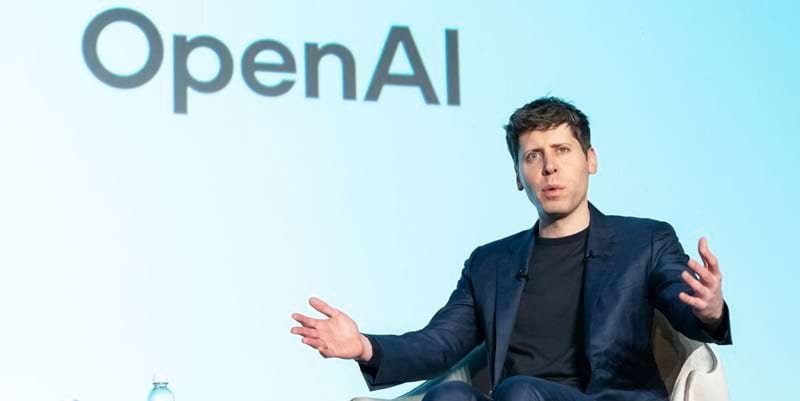
OpenAI chief executive Sam Altman has signalled the most ambitious expansion phase yet for the artificial intelligence major, outlining business and infrastructure bets that could reshape global technology, energy and capital markets. With OpenAI now valued at an estimated ₹41 lakh crore and talks underway for a fresh funding round that could push valuations beyond ₹62 lakh crore, Altman is positioning the company at the centre of what he believes will be the next industrial-scale transformation.
Certified Cyber Crime Investigator Course Launched by Centre for Police Technology
ChatGPT, OpenAI’s flagship product, now counts over 80 crore weekly users, making it one of the fastest-adopted consumer technologies in history. The company generated an estimated ₹10.8 lakh crore in revenue last year, underscoring the speed at which AI has moved from experimental labs to mainstream economic infrastructure.
Altman’s strategy, however, extends far beyond consumer software. OpenAI and its partners are preparing for an unprecedented capital outlay on AI chips, data centres and energy systems, with industry-wide investments expected to cross ₹41 lakh crore in the coming year alone. At the core of this push is the belief that future AI models will demand computing power and electricity at a scale rivaling entire nations.
To meet these demands, Altman has backed parallel ventures in energy. These include nuclear fusion startup Helion and small modular reactor developer Oklo—projects aimed at ensuring stable, long-term power supply for AI workloads. The logic is simple, according to those familiar with the strategy: without energy security, AI growth hits a hard ceiling.
OpenAI is also expanding into hardware. In a landmark move, the company acquired a design firm founded by a former Apple design chief in a deal valued at ₹54,000 crore, marking OpenAI’s entry into consumer devices. The aim is to move AI beyond text interfaces and smartphones into a new category of context-aware devices capable of assisting users throughout the day.
Altman believes that interface innovation will be as important as model performance. The company is reportedly working on devices designed to understand environment, intent and behaviour in real time—an attempt to define a new computing paradigm rather than compete within existing ones.
At the policy and geopolitics level, OpenAI’s influence is growing rapidly. Altman recently joined senior political and corporate leaders at the White House to announce Project Stargate, a proposed ₹41 lakh crore commitment to AI infrastructure in the United States. The initiative aims to secure domestic chip manufacturing, data centre capacity and advanced research capabilities, reflecting Washington’s view of AI as a strategic asset.
Despite OpenAI’s scale, Altman does not hold a direct equity stake in the company, a rarity for a founder-CEO at this level. His personal wealth, estimated at around ₹25,000 crore, is largely tied to early investments in companies that shaped the modern internet economy. Insiders say this structure has only strengthened his control, allowing him to focus on long-term vision rather than short-term shareholder returns.
That vision has not been without controversy. OpenAI’s rapid expansion, restructuring into a for-profit model and aggressive product launches have drawn criticism from former allies and rivals alike. Yet internal reviews have reaffirmed Altman’s leadership, even as competition intensifies from well-funded AI challengers globally.
Looking ahead, OpenAI is building its own custom AI chips, exploring healthcare software platforms, experimenting with ad-supported models and developing advanced video-generation tools. The company is also investing in social identity verification technologies, anticipating a future where distinguishing humans from AI-generated content becomes critical.
Altman argues that these moves are not diversification for its own sake but necessary components of a single ecosystem. “AI will not just be a tool,” he has said in recent interactions. “It will be an economic layer everything else is built on.”
As governments, corporations and investors commit trillions of rupees to artificial intelligence, OpenAI’s next phase could determine not just the company’s future, but the architecture of the global digital economy itself.
About the author – Ayesha Aayat is a law student and contributor covering cybercrime, online frauds, and digital safety concerns. Her writing aims to raise awareness about evolving cyber threats and legal responses.
