
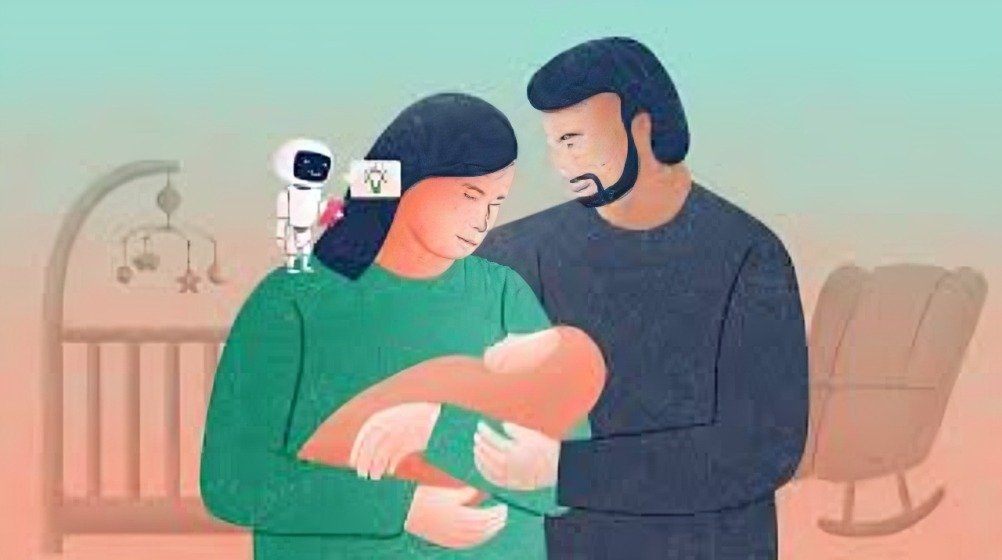

When Sam Altman told a late-night television audience that he could not imagine raising a newborn without ChatGPT, the remark landed less as a personal confession than as a cultural provocation. It exposed a widening gap between the speed of artificial intelligence adoption and the slower, more cautious rhythms of parenting, medicine and human judgment.
A Late-Night Comment With Daytime Consequences
Sam Altman’s appearance on The Tonight Show Starring Jimmy Fallon was meant to be light. Amid jokes and anecdotes, the OpenAI chief executive described slipping away during social gatherings to consult ChatGPT about his infant son’s behavior why the child dropped food on the floor and laughed, or whether it was normal not to walk at six months. Then came the line that reverberated far beyond late-night television: he could not imagine raising a newborn without the chatbot.

In isolation, the remark sounded like a familiar Silicon Valley flourish part humility, part evangelism. But delivered by the head of the world’s most prominent artificial intelligence company, it carried heavier implications. Within hours, social media lit up with disbelief and anger. Critics accused Altman of overstating the technology’s role in family life and of projecting a privileged experience one that included access to nannies, doctors and resources onto millions of parents navigating far different realities.
The backlash reflected something larger than a single television moment. It revealed how quickly AI tools have slipped into intimate spaces of decision-making, even as consensus lags on how much trust they deserve.
Parents Turn to Chatbots, and Experts Grow Uneasy
For many new parents, the attraction is obvious. Sleepless nights and relentless uncertainty create a powerful demand for reassurance, and AI chatbots promise instant answers without judgment or waiting rooms. Psychologists and pediatric specialists note that parents increasingly use AI to interpret pediatrician notes, track developmental milestones or make sense of feeding and sleep routines.
Sophie Pierce, an adolescent psychologist, has observed that chatbots can help parents articulate concerns and feel less alone. But she and others warn that convenience can mask risk. General-purpose AI systems are not trained on validated parenting science alone; they draw from vast swaths of the open internet, where advice ranges from evidence-based to dangerously wrong.
Nicholas Jacobson, a biomedical data scientist at Dartmouth College, has argued that while widespread adoption is now a fact, the tools’ limitations remain poorly understood by users. Their outputs can sound confident while being generic, contradictory or subtly biased qualities that matter little when planning a vacation, but far more when assessing a child’s health or development.
Evidence, Errors and the Limits of Automation
Academic research has begun to test those concerns. In a 2024 study focused on child healthcare information, researchers warned of a “critical need for expert oversight” when parents rely on large language models. The study found that participants often struggled to distinguish between verified medical guidance and AI-generated responses that only appeared authoritative.
In one experiment led by University of Kansas doctoral researcher Calissa Leslie-Miller, early versions of AI outputs contained factual inaccuracies. The problem, she said, was not malicious intent but a structural feature of the technology: when systems lack sufficient context, they can “hallucinate,” producing plausible-sounding but incorrect information.
Such findings have sharpened a long-running debate about whether AI should be framed as a supportive tool or something closer to an informal authority. Pediatricians emphasize that no model, however advanced, knows a child’s medical history, family environment or subtle behavioral cues the very details that guide clinical judgment and parental intuition.
Silicon Valley Confidence Meets Human Judgment
Altman’s defenders argue that his comments were descriptive, not prescriptive a candid admission of personal reliance rather than a directive to parents everywhere. Yet critics say that distinction collapses when statements come from technology leaders whose words shape public expectations and investor narratives.
Some observers also interpreted the late-night appearance as part of a broader public-relations push, at a moment when OpenAI faces intense competition, soaring costs and scrutiny over the societal effects of its products. To them, the image of a new father leaning on ChatGPT felt less like vulnerability and more like normalization.
What remains unresolved is where the boundary should lie. AI tools are already woven into daily life, offering efficiency and comfort in moments of stress. But parenting, perhaps more than any other domain, exposes the limits of automation. It depends on judgment formed through experience, uncertainty and care qualities that cannot be fully encoded.
Altman’s remark may fade from the news cycle, but the question it raised will persist: not whether parents will use AI, but how much authority they should grant it, and at what cost to human expertise and trust.
