
Follow us on Google News

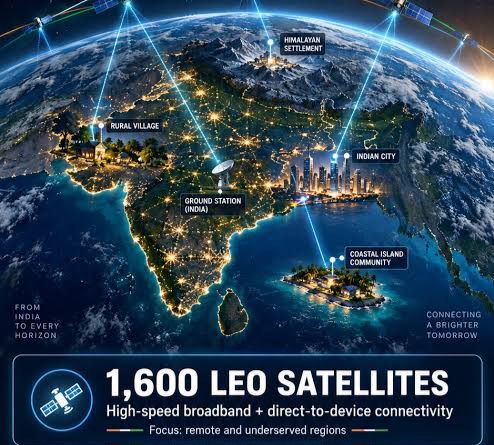
Mukesh Ambani’s Reliance Group is preparing to develop a 1,600-satellite broadband network to challenge Elon Musk’s Starlink in India. Targeted for completion by 2035, the low Earth orbit (LEO) constellation aims to deliver high-speed internet connectivity to remote and underserved regions across the country. The initiative is also expected to support the long-term growth plans of Reliance’s newly listed entity, Jio Platforms, while strengthening domestic space and telecommunications capabilities.
Domestic Manufacturing Partnerships and Foreign Procurement
To execute the project, Reliance is exploring manufacturing partnerships with Indian satellite makers, technology startups, and large industrial conglomerates. The company is offering capital investments to help build the necessary production infrastructure, aiming to expand local satellite manufacturing capacity and reduce reliance on foreign networks. Industry estimates indicate that India currently produces fewer than 15 satellites annually, whereas Reliance’s proposed rollout will require manufacturing roughly 200 satellites per year.
Alongside domestic production, Reliance plans to procure satellites from international suppliers. The company is considering importing at least 400 satellites from the United States and is currently in talks with two American firms regarding potential purchases. Suppliers in Europe are also being evaluated for the project, though Reliance has ruled out sourcing satellites from China.
Revised Timeline and Strategic Focus
According to the project roadmap, Reliance plans to launch test missions in September 2027, followed by large-scale satellite deployment starting in early 2028. The network was originally slated for completion by 2030, but manufacturing and launch constraints prompted the company to extend the target deadline to 2035.
While the constellation is primarily designed to meet India’s commercial broadband demand, it is also expected to serve strategic communication requirements. During periods of geopolitical tension or conflict, a domestically controlled satellite network could play a vital role in maintaining resilient internal communications. In entering this sector, Reliance is stepping into a market where Starlink already operates more than 10,000 satellites globally, though Reliance’s smaller network will focus specifically on Indian commercial and strategic needs.
Rocket Launch Capacity Remains a Key Hurdle
Industry observers note that building the satellites is only part of the challenge, as placing 1,600 units into orbit will require substantial rocket launch capacity. If Reliance intends to rely on Indian launch vehicles, the country’s launch frequency will need to increase significantly, alongside securing suitable orbital slots. Amal Chandran, chief executive officer of satellite manufacturer HEX20, noted that while large-scale satellite production can be achieved through investment, ensuring adequate rocket launches to place them in orbit could prove to be a greater obstacle.
The push for a domestic satellite network comes as Starlink’s expansion in India remains subject to regulatory and security scrutiny. Concerns over foreign control and oversight of satellite infrastructure have heightened the demand for indigenous alternatives, positioning Reliance’s project as a major component of India’s broader space and telecom strategy.