
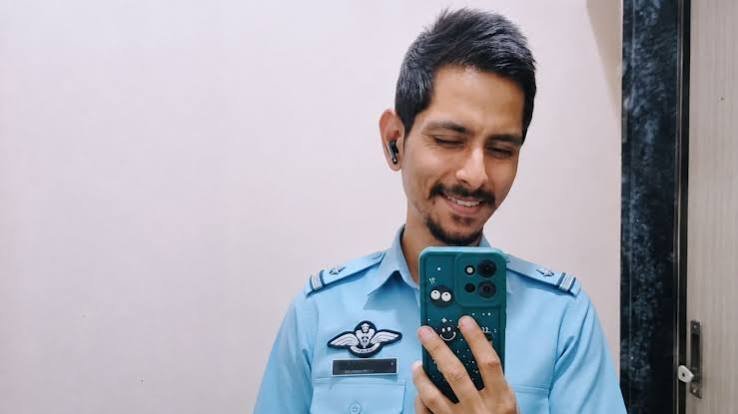

Rajkot Police have arrested a man accused of posing as an Indian Air Force officer associated with the elite Suryakiran aerobatic team and allegedly using that identity to gain trust and deceive people.
The accused has been identified as Prateek Bharadwaj. Police are examining how long he allegedly used the false identity, what documents or photographs supported the impersonation and whether more people were approached in the same manner.
The complaint was first recorded through Gujarat Police’s e-Zero FIR mechanism before being transferred for further investigation.
The case is significant because military impersonation can create an unusually high level of credibility. A uniform, rank or claimed association with a prestigious Air Force unit can make ordinary victims less likely to question the person presenting that identity.
Proposal for Conducting Cyber Crisis Drill, Tabletop Exercise (TTEx) & CCMP Readiness Exercise
Suryakiran name allegedly used to create credibility
The Suryakiran Aerobatic Team is one of the Indian Air Force’s best-known public-facing units.
Its pilots perform coordinated aerial displays at military events, national celebrations and air shows, giving the team’s name considerable public recognition.
Police allege that Bharadwaj exploited that reputation by presenting himself as connected with the team.
The exact manner in which the identity was used, and the benefits he allegedly obtained from it, form part of the ongoing investigation.
Officers are expected to examine photographs, social-media profiles, identity documents, uniforms or insignia, if any were used, and conversations with people who dealt with him.
The central question is whether the alleged impersonation was limited to creating social status or was used as part of a larger cheating scheme.
What is an e-Zero FIR?
An e-Zero FIR allows a person to report a cognisable offence electronically even when the complainant is not sure which police station has territorial jurisdiction.
The complaint can first be registered as a Zero FIR and then transferred to the police station legally responsible for investigating the offence.
The mechanism is meant to reduce delays caused by jurisdiction disputes.
Traditionally, victims have sometimes been sent from one police station to another because officers argued that the offence occurred somewhere else.
A Zero FIR avoids that problem by allowing police to record the complaint immediately and sort out jurisdiction afterwards.
The electronic version takes the same principle online.
For fraud, cybercrime and impersonation cases, this can be particularly useful because the victim, accused, communications and financial transactions may all be located in different cities.
Military impersonation can become a powerful social-engineering tool
Cases involving fake military identities are not new.
Fraudsters have repeatedly posed as Army or Air Force personnel on social-media platforms and marketplaces because the uniform itself creates trust.
The psychology is simple.
People tend to associate military service with discipline, official verification and public duty. A scammer who successfully borrows that identity may therefore face fewer questions than an ordinary stranger.
The same technique has been seen in online marketplace frauds, matrimonial scams and job-related cheating.
In several cases, fraudsters have used photographs of genuine defence personnel stolen from social-media accounts to construct convincing fake profiles.
That is why identity verification matters even when the person appears to belong to a respected institution.
A photograph in uniform, a WhatsApp display picture or a claimed posting is not proof of service.
Police will need to establish how the false identity was built
The investigation is now likely to focus on the infrastructure behind the alleged impersonation.
Police may examine whether Bharadwaj possessed forged identity cards, used altered photographs or relied only on verbal claims and social-media profiles.
His phone records and digital accounts could show how many people he contacted and whether the alleged IAF identity appeared repeatedly.
Investigators may also check whether money, gifts, accommodation, introductions or other benefits were obtained because people believed he was an Air Force officer.
If forged government or military documents were used, the case could become more serious than simple personation.
The existence of other victims would also change the scale of the investigation.
Police will therefore need to identify whether the Rajkot complaint represents one isolated incident or one part of a wider pattern.
Why the Suryakiran connection matters
The alleged use of the Suryakiran name adds another layer to the case.
The team is highly visible and prestigious, meaning many civilians recognise the name without necessarily knowing individual pilots.
That creates an opening for impersonation.
A person can make a claim that sounds specific enough to be believable but is difficult for an ordinary citizen to immediately verify.
The safest response is independent confirmation.
Someone claiming to be a serving defence officer should be able to establish that identity through legitimate official channels rather than relying on social-media photographs, uniforms or personal assurances.
The same principle applies to anyone claiming association with a senior government official, police unit or other public institution.
What this means for you: Do not treat a uniform, official-looking photograph or claimed military posting as proof of identity. If someone uses a defence connection to seek money, favours or personal trust, verify the claim independently before acting.
The420 Insight: Impersonation fraud works best when the borrowed identity carries automatic credibility. A military uniform can function like a social password — and that is exactly why fraudsters repeatedly exploit institutions people are conditioned to trust.
Follow for daily updates on cybercrime, corporate fraud, DFIR, hacking, investigations, and digital forensics
