
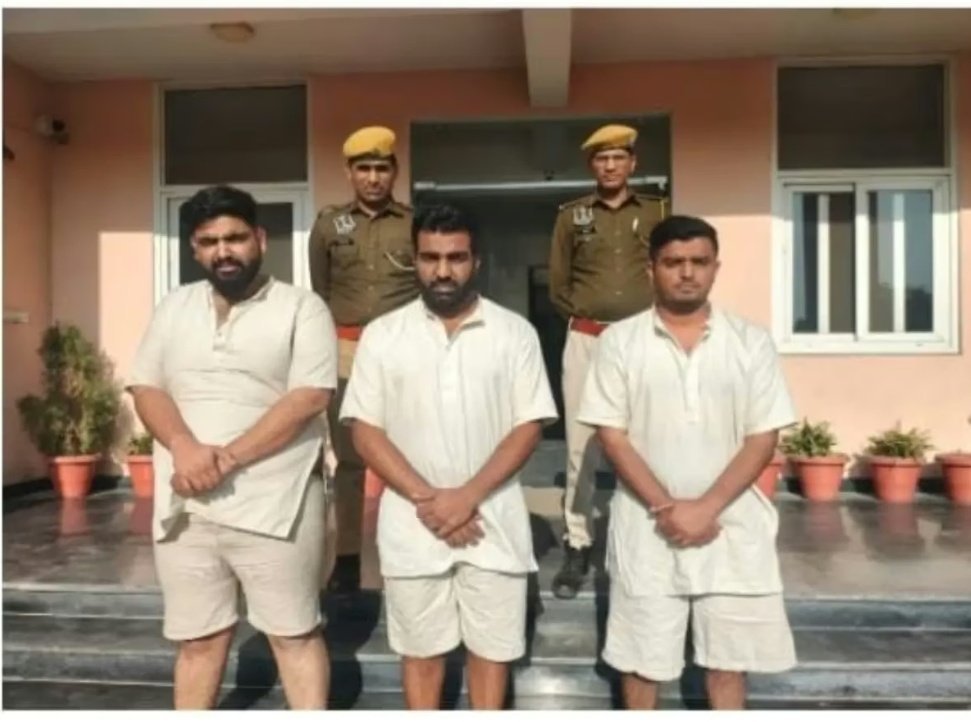

JAIPUR: After the arrest of three doctors accused of using forged certificates to practice medicine, Rajasthan’s Special Operations Group has widened an investigation that now spans thousands of foreign-trained physicians, exposing potential failures across India’s medical verification system.
A Crackdown Begins With Three Arrests
On December 4, 2025, Rajasthan’s Special Operations Group (SOG) arrested three doctors Dr Piyush Kumar Trivedi, Dr Devendra Gurjar and Dr Shubham Gurjar who were serving internships in government medical colleges. Investigators allege that all three had studied medicine abroad, failed India’s mandatory Foreign Medical Graduate Examination (FMGE), and later obtained forged FMGE certificates by paying about ₹16 lakh each.
Using those certificates, the doctors secured permission to complete internships at government institutions, including Karauli Government Medical College, Rajiv Gandhi Hospital in Alwar, and Dausa Government Medical College. From there, they were able to move closer to full medical registration, despite lacking the legal qualifications required to practice in India.
How Foreign-Trained Doctors Are Meant to Qualify
Under National Medical Commission (NMC) rules, Indian citizens who earn MBBS degrees abroad are allowed to practice in India only after meeting strict conditions. Their foreign universities must be recognised, and candidates must pass the FMGE or its upcoming replacement, the National Exit Test (NExT).
The FMGE has long recorded low pass rates, reflecting the exam’s role as a high barrier to entry. In 2024, only 25.8 percent of candidates cleared it. By June 2025, the pass rate had dropped further to 18.61 percent.
Only after clearing the exam can a foreign graduate apply for provisional registration, complete a mandatory internship, and later seek permanent registration. Each stage is designed to involve document verification and, in many states, in-person checks before a doctor’s name is entered into the National Medical Register. Despite this layered process, investigators say forged certificates slipped through.
Questions Over Verification and Oversight
The widening probe has placed the Rajasthan Medical Council (RMC) under scrutiny. Dr Girdhar Goyal, the council’s registrar, has said the three arrested doctors were never registered with the RMC and that their files had not been formally submitted to the council. Internship applications, he noted, can be made before registration, with full registration usually sought within a month of starting the internship.
SOG officials, however, are examining how fake FMGE certificates were accepted at earlier stages. The agency is investigating who created the forged documents, how they passed verification, and whether rules were ignored due to negligence or collusion.
Additional Director General of Police Vishal Bansal of the SOG said forging certificates itself was not particularly difficult. “The real issue,” he said, “is how authorities approved them.” Investigators are focusing on who accepted the documents, why no alerts were raised, and how the system failed over an extended period.
The SOG has written to the National Board of Examinations in Delhi seeking verification of FMGE certificates and has also contacted a medical university in Georgia to confirm whether certain MBBS degrees are genuine.
An Inquiry That Now Spans Thousands
Following the initial arrests, complaints began surfacing from across Rajasthan, pointing to a broader network. The SOG is now verifying records of more than 8,000 doctors in the state who obtained medical degrees from abroad and are either practicing privately or working in government and private hospitals.
Many of those under scrutiny studied in countries including Kyrgyzstan, Georgia, China and Bangladesh. Investigators are cross-checking FMGE results, internship records, registrations and academic certificates to determine whether forged documents were used elsewhere.
According to officials familiar with the inquiry, the scale of the review reflects concerns that weaknesses in verification may have allowed unqualified practitioners to work within the healthcare system for years. For now, authorities say the focus remains on documentation and process failures, as the investigation continues to expand.
