

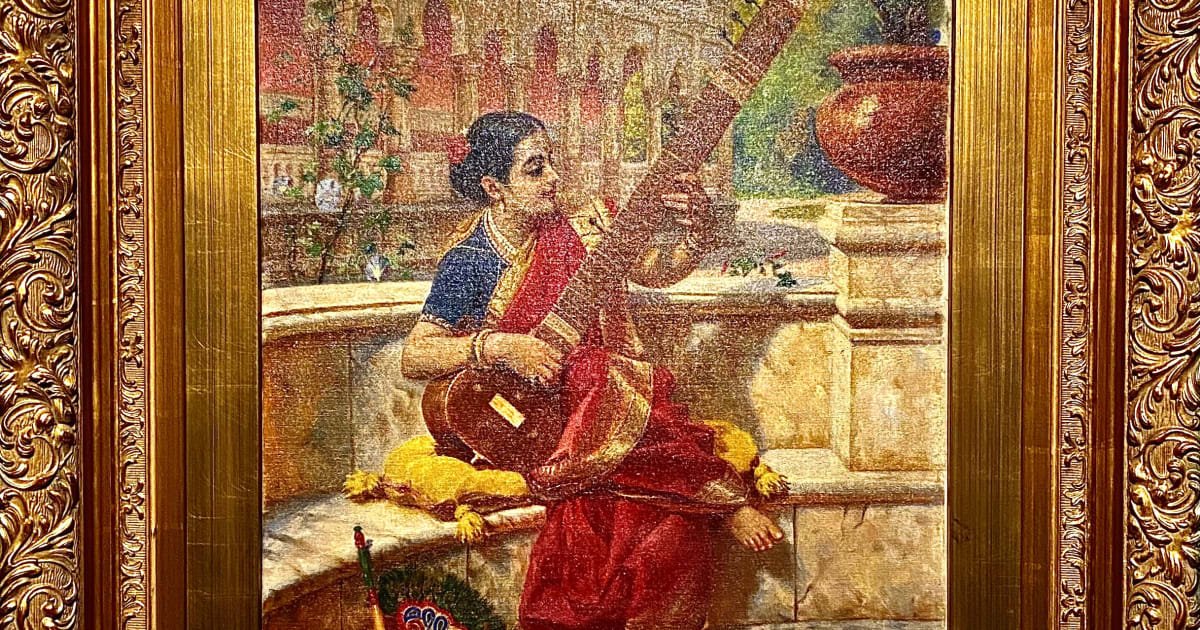

New Delhi: One of India’s most talked-about artworks — ‘Kadambari’, believed to be among the final creations of master painter Raja Ravi Varma — has become the centre of a high-stakes legal battle, with a Delhi-based art collector alleging that the painting was unlawfully auctioned for ₹20.40 crore without his consent.
A Claimed Masterpiece, A Contested Sale
The ownership dispute is currently before the Delhi High Court, where 64-year-old businessman Mohinder Verma has claimed that he is the lawful owner of ‘Kadambari’, which he says he purchased in 1998.
According to Verma’s petition, the artwork was handed over to his business associate Raj Agrawal strictly for restoration, reframing and exhibition purposes. However, Verma alleges that the painting was later sold without his knowledge, triggering what he describes as a carefully orchestrated fraud involving multiple intermediaries.
Court filings state that in 2021, Raj Agrawal and Akriti Agrawal allegedly persuaded Verma to consider selling the artwork. The painting was subsequently shown to art dealers Keshav Mahendru and Poonji Nath of FAQ Art, during which a security amount of ₹1.06 crore was paid. Months later, Verma claims, the painting was quietly transferred to an art restorer without his authorisation.
Certified Cyber Crime Investigator Course Launched by Centre for Police Technology
Registration, Auction and Transfer
The businessman further alleges that in October 2021, the accused parties approached the Archaeological Survey of India (ASI), declaring themselves owners and seeking registration of the artwork. This was followed by a December 2021 auction in which ‘Kadambari’ was acquired by the Kiran Nadar Museum of Art (KNMA) for ₹20.40 crore. Verma claims the proceeds were distributed among several individuals connected to the transaction.
In his plea, Verma has asked the court to declare him the sole legal and beneficial owner of the painting, direct that physical possession be restored to him, and nullify the ASI registration process that enabled the transfer. He has described the episode as a case of criminal conspiracy and breach of trust.
The Legal Battle Before the Court
Raising further alarm, Verma has told the court that he fears the painting may soon be shipped to a gallery in Queensland, Australia, for permanent display. He claimed to have received this information from senior figures in the art trade, warning that the artwork could soon leave India’s jurisdiction altogether.
During proceedings, KNMA informed the court that it is only displaying the artwork and is not involved in any sale process. The museum also clarified that it operates as a private institution.
On February 5, the Delhi High Court directed all parties to undergo mandatory pre-litigation mediation — a standard requirement in commercial disputes where no urgent interim relief is sought. The next hearing has been scheduled for May 18.
Art historians regard ‘Kadambari’ as one of Raja Ravi Varma’s final works, lending the case significance far beyond a commercial disagreement. Experts say the dispute underscores long-standing vulnerabilities in India’s high-value art market, particularly around provenance verification, ownership documentation and regulatory oversight.
If the allegations are proven, the case could have far-reaching implications for how rare artworks are authenticated, transferred and preserved in the country — raising uncomfortable questions about accountability in elite art transactions and the safeguarding of India’s cultural heritage.
