
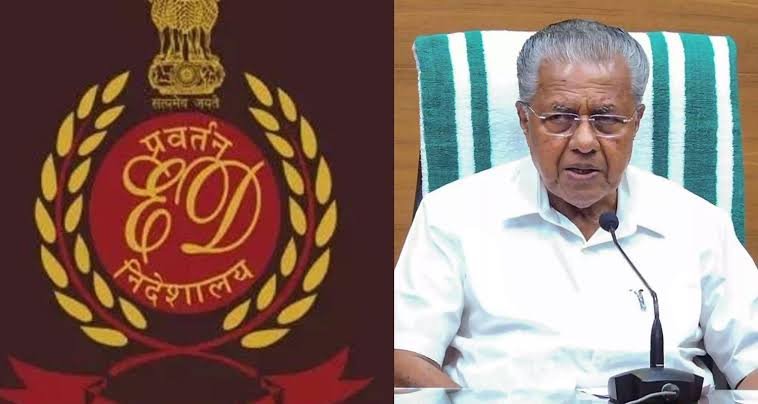

THIRUVANANTHAPURAM: In an escalation that has widened Kerala’s most closely watched financial investigation, Enforcement Directorate has issued a show-cause notice to Chief Minister Pinarayi Vijayan over alleged violations linked to the state’s ambitious masala bond program. The move draws a powerful political figure directly into a complex inquiry surrounding offshore borrowing and the limits of India’s foreign-exchange rules.
A Notice That Reverberated Through Kerala’s Political Establishment
The Enforcement Directorate (ED) on November 12 issued a show-cause notice to Kerala Chief Minister Pinarayi Vijayan, bringing the state’s top elected official into the center of a long-running inquiry into the Kerala Infrastructure Investment Fund Board (KIIFB). For years, the agency has scrutinized the Board’s decision to raise funds overseas through rupee-denominated “masala bonds,” a borrowing tool championed by the state as an innovative model for financing public infrastructure.
The notice served under provisions of the Foreign Exchange Management Act (FEMA) alleges that KIIFB’s bond issuance and spending decisions contravened Reserve Bank of India directives, amounting to violations worth ₹466.91 crore. The ED contends that portions of the money raised abroad were used for activities it claims were “specifically prohibited.”
Alongside the chief minister, former Finance Minister T.M. Thomas Isaac and KIIFB’s former Chief Executive Officer K.M. Abraham have also received notices, signaling a widening circle of scrutiny.
The Rise of KIIFB and the Promise of the Masala Bond
When KIIFB launched its masala bond on the London Stock Exchange and later on Singapore’s exchange, it was heralded as a milestone for sub-national borrowing. The state secured ₹2,672.8 crore under the external commercial borrowing route an approach that allowed Kerala to tap global markets without exposing itself to foreign-currency risk, since the bonds were denominated in rupees.
For the government, the borrowing mechanism promised a path around fiscal constraints that had long hampered infrastructure development. Schools, hospitals, roads, and power projects all staples of Kerala’s public model were to be financed through a steady, externally sourced inflow of capital. The initiative was billed as both financially prudent and internationally forward-looking.
Yet questions soon emerged about whether such borrowing complied with India’s tightly framed rules governing overseas debt. The ED’s investigation is the most serious challenge yet to the state’s claim that the program was entirely above board
What the Enforcement Directorate Says Went Wrong
According to the notices reviewed by investigators, the core allegation is that KIIFB used part of the ₹466.91 crore raised abroad to purchase land an activity the ED says breached RBI’s directives governing the use of external commercial borrowing. Those guidelines, the agency argues, restrict such funds to specific categories of capital expenditure and prevent their deployment for land acquisition.
The ED maintains that these decisions constitute a “contravention of FEMA provisions,” and that responsibility extends to the Board and its top officials, including the chief minister, who serves as KIIFB’s chairman. By framing the case this way, the agency has effectively placed administrative decisions made by a state-run investment authority within the purview of national financial-regulatory enforcement.
Kerala officials have consistently argued that KIIFB followed every regulatory protocol and obtained all necessary approvals. They describe the ED’s actions as an overreach into the state’s fiscal autonomy a recurring point of tension between the Left-led state government and the federal authorities.
A Political Battle With National Implications
The notice lands at a moment when relations between New Delhi and Kerala’s government are already strained. Previous summonses issued to Thomas Isaac were met with public pushback, as the former minister accused federal agencies of targeting state-level economic innovation for political reasons.
By drawing the sitting chief minister into the inquiry, the ED’s latest move raises the stakes sharply. The development is expected to intensify national debate over the boundaries of federal oversight and the latitude states should enjoy when accessing international capital markets.
