

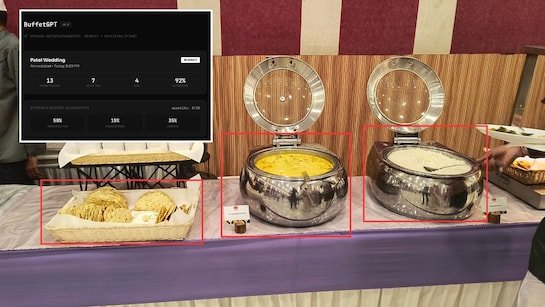

BENGALURU: At an Indian wedding buffet, abundance is rarely the problem. Choice is. A Bengaluru software professional’s experimental AI tool, designed to guide guests through overflowing spreads, has ignited an online debate about whether algorithms can tame one of the country’s most familiar social rituals.
A Familiar Frustration at the Wedding Buffet
Indian weddings are often defined by excess: long guest lists, layered rituals and, most visibly, food laid out in near-endless variety. Yet the experience of navigating a buffet—deciding what to eat, what to skip and how much to take—can leave guests oddly dissatisfied. Plates overflow early, enthusiasm fades quickly, and diners walk away wishing they had chosen differently.
It was this specific, everyday frustration that Pankaj, a Bengaluru-based software professional, sought to address. In a post on X, he described Indian wedding buffets as “a scam,” arguing that abundance itself leads to poor decisions. His solution, which he called BuffetGPT, was pitched as an artificial intelligence agent that could scan an entire buffet and generate a personalised eating “game plan” for each guest.

The idea was framed less as a commercial product than as a technical experiment, rooted in observation and personal experience. Still, it quickly drew attention far beyond its modest origins.
Certified Cyber Crime Investigator Course Launched by Centre for Police Technology
Building BuffetGPT: An Algorithmic Game Plan
According to Pankaj, BuffetGPT relies on computer vision to identify every dish on display. Once the spread is mapped, the system is designed to optimise three variables: what to eat, what to avoid and how much to consume. The recommendations, he said, are informed by what he described as “actual stomach volume physics,” an attempt to account for capacity rather than appetite alone.
The project remains in an early stage. Pankaj said it has been tested only once, as an alpha version at a friend’s wedding, where it delivered what he characterised as “decent results.” There has been no large-scale trial, no peer review and no public demonstration beyond his description and screenshots shared online.
For those familiar with his work, the project fits a pattern. Just a month earlier, Pankaj had posted about another AI-powered creation: a device that automatically switched his computer screen from Netflix to work-related content whenever his boss approached. That anecdote, shared with some humour, helped establish him as a tinkerer applying machine learning to small, situational problems rather than grand technological challenges.
Applause, Skepticism and the Internet’s Verdict
Reaction to BuffetGPT was swift and largely approving. In the comments under Pankaj’s post, users praised the ingenuity of applying artificial intelligence to a culturally specific annoyance. “This is what AI should be used for,” one commenter wrote. Another suggested expanding the tool to pull caterer reviews and prioritise dishes with the highest ratings.
Some responses were more playful, bordering on sarcastic admiration. “Thanks for finding a solution to a problem no one had,” one user remarked, capturing both the novelty and the perceived triviality of the idea.
Not everyone was convinced. A subset of commenters questioned whether such a tool could function in the chaotic reality of Indian weddings, where crowds, delays and social obligations often override planning. “By the time you get the game plan, my cousins would have ensured you regret it even more,” one comment read, highlighting the gap between algorithmic optimisation and lived experience.
The mix of enthusiasm and doubt underscored a broader tension in public attitudes toward AI: excitement about its potential paired with skepticism about its usefulness in unstructured, human environments.
Between Experiment and Cultural Commentary
Pankaj himself has been careful to frame BuffetGPT as an experiment rather than a finished solution. “Honestly, this is what my computer science degree was for,” he said, suggesting a personal satisfaction in applying technical skills to mundane problems.
In that sense, the project operates on two levels. Technically, it is an early-stage application of computer vision and recommendation logic. Culturally, it reflects a growing impulse among technologists to reinterpret everyday social experiences through data and optimisation.
Whether BuffetGPT evolves into a practical tool or remains an online curiosity, its brief moment of attention reveals something about the current moment: a willingness to imagine that even the most chaotic, tradition-bound spaces—like an Indian wedding buffet—might be made legible, if not manageable, by code.
