

The pitch for cybersecurity leadership training in India is no longer built around aspiration alone. It is built around pressure.
Boards want clearer answers on cyber risk. Regulators expect more structured reporting. Enterprises are being forced to translate technical vulnerabilities into business language. And as artificial intelligence expands both productivity and attack surface, the old idea of the chief information security officer as a purely technical custodian has become harder to sustain.
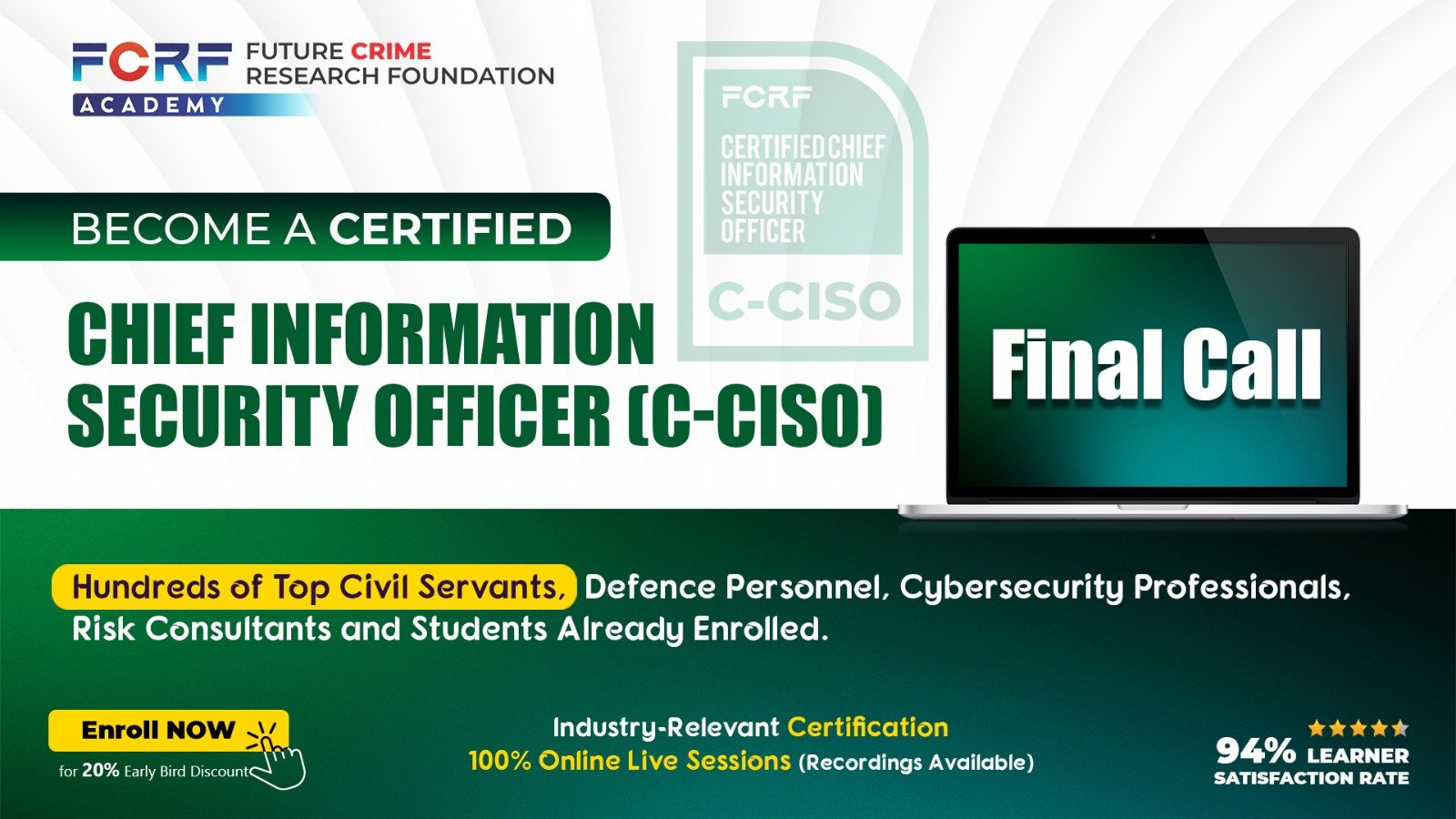
It is in that environment that FCRF Academy is making a final push around its Certified Chief Information Security Officer (C-CISO) program, which is scheduled to begin on April 11, 2026, in the academy’s standard four-week format. The message now is one of urgency: only ten days remain before the cohort begins.
That urgency is reinforced by demand. According to the source material for the current campaign, hundreds have already registered for the certification, drawing a mix of participants from across cybersecurity practice, defense services, government institutions and private industry. In practical terms, that makes the program not only a training course, but an emerging cross-sector community of people facing similar leadership challenges from different vantage points.

Why the Market Is Looking for Cyber Leadership, Not Just Cyber Skills
The growth of such interest reflects a broader shift in what organizations now expect from senior security professionals.
A modern CISO is increasingly required to do more than oversee controls or incident response. The role now sits at the intersection of technology, law, governance, crisis management, privacy, enterprise risk and executive communication. Security heads are expected to understand regulatory mandates, explain exposure to boards, manage resilience, coordinate breach response and, increasingly, help shape business decisions.
That shift has created a new market for cyber leadership certifications that go beyond narrow technical specialization.
FCRF Academy’s C-CISO program appears designed around that new reality. Its positioning, as described in earlier program materials, emphasizes governance, risk, compliance, sector-specific regulation, AI-era cyber threats, board reporting and the broader management responsibilities that now define senior security roles. In other words, the focus is not only on defending systems, but on preparing people to lead through cyber risk.
For many participants, that distinction is likely the main draw. The security market has no shortage of technical courses. What remains rarer is structured training aimed at the leadership layer.
FCRF Academy’s Track Record and the Weight of Its Ecosystem
The current push around C-CISO also leans on institutional memory.
FCRF Academy has, over recent years, built a recognizable portfolio of certifications in adjacent areas of digital risk and governance. Those include CCMP, the cyber crisis management program associated with CERT-In-aligned learning; CDPO on data protection; CCLP on cyber law; and GRCP in governance, risk and compliance.
Together, those programs have helped the academy present itself as more than a training startup. It has increasingly positioned itself as a capacity-building platform for professionals operating in India’s evolving cyber and regulatory economy. Organizers say that earlier programs have trained large numbers of professionals across law, enforcement, compliance, governance and technology.
The C-CISO certification appears to be the next extension of that ecosystem, aimed at a different tier of the professional ladder. It speaks to people who may already hold decision-making responsibilities, or are moving toward them, and who now need a more formal framework for navigating the strategic dimensions of cyber leadership.
That wider ecosystem may also help explain the speed of enrollment. Certifications often gain traction when prospective participants believe they are joining a known training community rather than experimenting with a first-time offering in isolation.
More Than a Course, a Cohort in Formation
The fact that hundreds have already joined changes the story around the program in another important way: it gives the cohort social value.
In cybersecurity, peer communities matter almost as much as curriculum. Security leaders often confront the same structural problems regardless of sector: limited budgets, fragmented reporting structures, boardroom skepticism, regulatory complexity, vendor exposure, burnout inside teams, and uncertainty around emerging technologies such as generative AI. A strong cohort can turn a program into a professional network where those challenges are discussed in real time.
That appears to be part of the current positioning of the C-CISO course. By emphasizing the growing participant base, the academy is suggesting that the value of the certification lies not only in what is taught, but in who else will be in the room.
With ten days to go, the underlying argument has become clear. This is not being marketed as a leisurely upskilling option. It is being presented as a timely intervention for professionals trying to catch up with a role that has already outgrown its older definitions.
As cyber risk becomes inseparable from business continuity, governance and national digital resilience, the rise of programs like this signals something larger. The market is beginning to treat cyber leadership as a discipline that must be learned deliberately, not simply inherited through years of technical work. Interested participants can click here to register for the Certified Chief Information Security Officer (C-CISO) program.
