

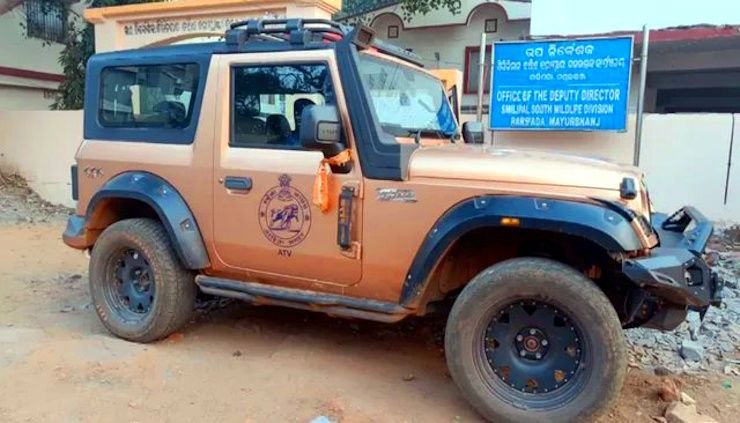

Bhubaneswar: The Odisha government has ordered a special audit into alleged financial irregularities in the procurement and customisation of 51 Mahindra Thar vehicles purchased for the state’s Forest and Environment Department. According to official records, while around ₹7.1 crore was spent on purchasing the vehicles, an additional ₹5 crore was incurred on add-ons and modifications, triggering controversy and prompting closer scrutiny at the highest levels of the administration.
The move is being seen as a significant step amid growing questions over the procurement process, cost approvals and the justification for the substantial additional expenditure.
Why the controversy erupted
The issue came to light after it emerged that an average of 21 additional items were installed in each vehicle, pushing the total customisation bill to nearly ₹5 crore. In administrative circles, this expenditure is being described as disproportionately high when compared to the base cost of the vehicles. This led to a series of questions, including:
- Whether the customisation was genuinely necessary
- Whether prior approval of the finance department was obtained
- And whether the entire process complied with government procurement rules
Scope and framework of the audit
As per a note sheet signed by Forest and Environment Minister Ganesh Ram Singhkhuntia, the special audit team of the Accountant General, Odisha will conduct a detailed audit of the office of the Principal Chief Conservator of Forests (Wildlife). The audit will focus on the following key aspects:
- The procedure followed to approve the customisation costs
- Whether consent from the finance department was taken
- Whether the add-ons were essential for field operations
- Whether any external agencies were involved in the process
A senior official indicated that if irregularities are found at any stage, responsibility will be fixed and strict action initiated.
Government and departmental stand
Officials from the forest department have maintained that the Mahindra Thar vehicles were procured specifically for use in rugged and inaccessible forest terrains. According to them, the customisation was intended to:
- Enable faster patrolling and surveillance
- Strengthen action against poaching and illegal timber smuggling
- Ensure quick response during forest fires
An official said, “Large parts of Odisha’s forests are located in extremely difficult terrain. The vehicles were modified keeping these operational requirements in mind. However, if the audit finds any procedural or financial lapses, the government will not hesitate to act.”
Deployment across forest divisions
The 51 Mahindra Thar vehicles have been deployed across 22 wildlife divisions in the state. The highest allocation—nine vehicles—has gone to the Similipal Tiger Reserve, where poaching and other illegal activities continue to pose serious challenges.
Odisha’s protected forest network spans around 8,869 square kilometres, accounting for nearly 5.7% of the state’s total geographical area. This includes national parks, one tiger reserve, 19 wildlife sanctuaries and several conservation reserves.
Political and administrative reactions
The matter has also triggered political reactions. Opposition parties have questioned the rationale behind such expensive customisation, arguing that the Mahindra Thar is already designed as an off-road, all-terrain vehicle.
The government, however, has maintained that by ordering a special audit, it has clearly demonstrated that there will be no compromise on transparency and accountability in the use of public funds.
What lies ahead
Experts believe that only the audit report will clarify whether the expenditure was need-based, whether due process was followed, and whether the case involves merely an administrative lapse or points to serious financial irregularities.
