
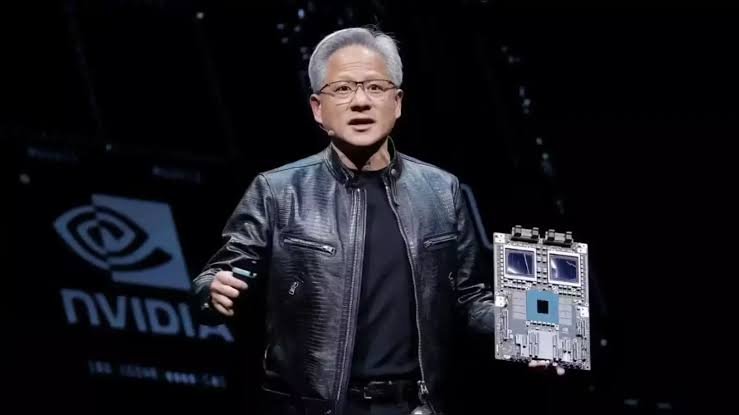

New Delhi | Business Desk: In what can only be described as a landmark moment in global corporate history, Nvidia — the American technology giant powering the world’s Artificial Intelligence (AI) revolution — has reached a market capitalization of $5 trillion, or roughly ₹440 lakh crore.
This makes Nvidia more valuable than the entire economies of over 190 countries, including India. It’s the first time in human history that a company’s market value has reached such an extraordinary scale, outpacing the GDPs of most nations on Earth.
If Nvidia Were a Country…
If Nvidia were classified as a nation, it would stand as the third-largest economy in the world, just behind the United States and China. United States GDP: ₹2,602 lakh crore, China’s GDP: ₹1,648 lakh crore, India’s GDP: ₹351 lakh crore. This means Nvidia’s current market value exceeds India’s entire economy by nearly 25% — an astonishing reflection of how far technology-driven capital has evolved.
One Company vs. an Entire Stock Market
The Bombay Stock Exchange (BSE) currently lists 5,838 companies with a combined valuation of around ₹475 lakh crore. Yet Nvidia alone is worth ₹440 lakh crore. In other words, one American company now nearly matches the value of India’s entire publicly traded corporate universe.
This comparison underscores a broader economic truth: in the 21st century, technological innovation has overtaken traditional industry as the world’s most valuable resource.
How Big Is ₹440 Lakh Crore?
To put this into perspective — if you were to spend ₹10 crore every single day, it would take you 12,000 years to spend ₹440 lakh crore. Such numbers are not just financial abstractions; they highlight the unprecedented concentration of wealth and influence in the modern tech sector.
The Heart of the AI Boom: Why Nvidia Matters
Nvidia’s meteoric rise is deeply tied to the AI revolution. Artificial Intelligence systems require an immense amount of computational power, and this power comes from Graphics Processing Units (GPUs) — the specialized chips that Nvidia designs and dominates.
Today, over 90% of all AI chips globally are produced by Nvidia.
These chips are the brains behind:
- Smartphones and Drones
- Autonomous Vehicles
- High-End Gaming Systems
- Supercomputers and Cloud Data Centers
- AI Models and Machine Learning Platforms
Nvidia’s flagship processors — such as the H100 and B200 AI chips — are now the backbone of advanced computing for tech giants like Google, Amazon, Microsoft, and Meta.
From $13 to $210: A Three-Year Miracle
In 2022, Nvidia’s stock traded at just $13 per share. Today, it hovers around $210, marking a 16-fold surge in three years.
- 2023: Nvidia becomes a $1 trillion company
- 2024: Surpasses $3 trillion
- 2025: Crosses the $5 trillion mark, becoming the most valuable company ever
This extraordinary growth has turned Nvidia into the face of the AI economy — the new oil of the digital age.
From Engineer to Tech Emperor: The Story of Jensen Huang
Nvidia was founded in 1993 by Jensen Huang, a Taiwan-born engineer who migrated to the U.S. with a vision to redefine computing. His goal was simple yet revolutionary — to make computers think and learn like humans.
Under Huang’s leadership, Nvidia evolved from a graphics chip manufacturer into the nerve center of global AI development.His foresight and relentless innovation have earned him comparisons to Steve Jobs, with many now calling him “the architect of the AI era.”
Technology Is the New Currency
Nvidia’s story is more than a business success — it is a paradigm shift. Where once oil, steel, and gold defined global wealth, today data and computational power do. The nations and corporations that master AI and semiconductor technology will dominate the next century.
