

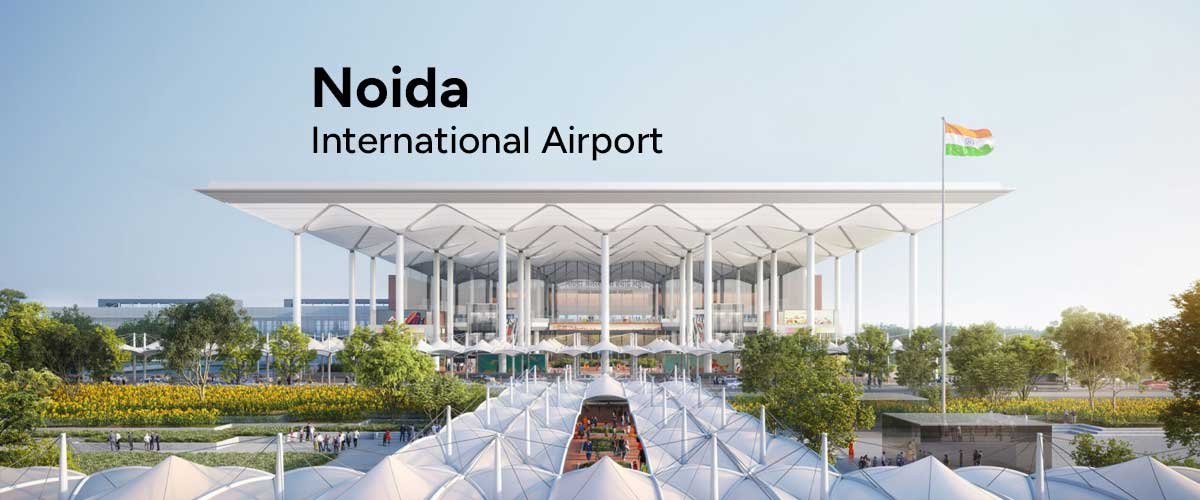

Greater Noida — The long-anticipated opening of the Noida International Airport, also known as Jewar Airport, has taken a significant step forward after India’s aviation security regulator issued a key clearance required before operations can begin.
The Bureau of Civil Aviation Security (BCAS) has granted a No Objection Certificate (NOC) confirming that the airport’s security infrastructure meets national standards. The clearance now allows the Directorate General of Civil Aviation (DGCA) to proceed with its final inspection before issuing the aerodrome license, the last regulatory approval needed for the airport to start commercial operations.
Once the license is granted, airlines will be permitted to launch scheduled flights from the airport, potentially marking the beginning of operations as early as April 2026.
For the Delhi–National Capital Region, where aviation demand has steadily outpaced infrastructure capacity, the development signals a major milestone in expanding air connectivity.
FCRF Launches Flagship Certified Fraud Investigator (CFI) Program
Security Clearance Removes Final Regulatory Barrier
The BCAS approval represents one of the most critical steps in certifying any new airport in India. As the agency responsible for aviation security oversight, BCAS evaluates whether an airport’s infrastructure and operational systems meet stringent national and international safety requirements.
According to officials involved in the review process, the assessment examined a range of security components including access control systems, surveillance infrastructure, passenger screening protocols, and anti-sabotage procedures.
Only after these elements are verified can the DGCA consider granting an aerodrome license.
Christoph Schnellmann, the chief executive of Noida International Airport, described the security clearance as a major breakthrough in the airport’s regulatory journey.
“Following the BCAS clearance, the next step is the DGCA’s aerodrome licensing process,” he said, noting that the approval would allow the airport and its airline partners to finalize operational timelines and route planning.
The clearance also comes after earlier delays in the security review process, which had slowed the airport’s anticipated launch.
DGCA Inspection Expected to Finalize Operational Approval
With the security approval in place, the DGCA is expected to conduct its final inspection of the airport this week.
The review will evaluate the runway, terminal facilities, navigation systems, and overall airfield infrastructure, ensuring compliance with the regulator’s Civil Aviation Requirements (CAR), Section 4, which governs aerodrome licensing in India.
Among the critical technical parameters being examined are:
- Runway certification: The airport’s 3,700-meter runway, classified as Code 4F, must meet international safety standards, including a 240-meter Runway End Safety Area (RESA).
- Navigation and landing systems: The airport has installed Category-I Instrument Landing Systems (ILS), along with airfield lighting systems such as Precision Approach Path Indicators (PAPI) and approach lighting infrastructure.
- Aircraft movement infrastructure: Taxiways, aprons and parking bays are being evaluated to ensure efficient aircraft movement and ground operations.
- Emergency preparedness: The airport must maintain Category-8 firefighting capability under ICAO standards, requiring specialized vehicles and trained personnel.
- Environmental and safety compliance: Regulators are also reviewing measures for noise control, bird-strike prevention, and ground handling safety.
If the inspection confirms compliance, the DGCA will issue the aerodrome license that formally authorizes commercial flight operations.
An Airport Designed for Long-Term Expansion
Spread across 1,284 acres, the Noida International Airport has been planned as one of India’s largest aviation projects, with development structured across four phases.
In its first phase, the airport is expected to handle 12 million passengers annually. Over time, expansion plans aim to increase capacity to 70 million passengers, supported by three runways and four passenger terminals.
The project has also been designed with extensive ground connectivity in mind.
Plans include intercity bus networks, integrated taxi services and intelligent traffic management systems. Future infrastructure projects are expected to strengthen access further, including potential connections to the Regional Rapid Transit System (RRTS) and the proposed Delhi–Varanasi high-speed rail corridor, which could include a stop at the airport.
Despite these ambitions, the project has experienced multiple timeline revisions. Earlier targets for opening in late 2024 and April 2025 were postponed as construction and regulatory processes progressed more slowly than anticipated.
Airlines Prepare for Launch and Regional Impact
Once licensed, airlines are expected to begin operations in phases.
Industry officials say IndiGo is likely to serve as the launch carrier, initially operating domestic flights from the airport. Other airlines, including Akasa Air and Air India Express, have already been in discussions with airport authorities regarding both domestic and international routes.
Additional carriers from India, the Middle East and Southeast Asia are also exploring potential partnerships.
A fully operational airport could significantly reshape air travel in northern India. Delhi’s Indira Gandhi International Airport, currently one of the busiest airports in the world, has been operating near capacity for years.
By providing an additional aviation hub in the region, the new airport could relieve congestion while expanding connectivity for passengers and cargo.
Officials also expect broader economic benefits for Uttar Pradesh and surrounding states, including increased tourism, logistics growth and new business development tied to improved international access.
For now, the final regulatory inspection remains the last step before the airport transitions from a massive construction project into a functioning gateway for one of India’s fastest-growing aviation markets.
