

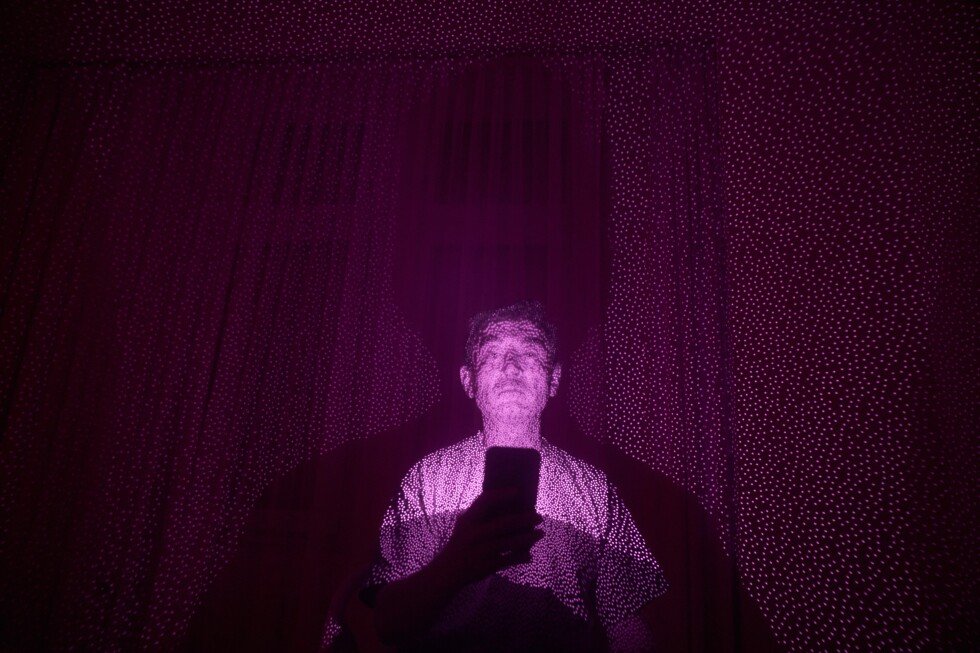

CHANGZHOU: In a darkened room in eastern China, a camera captured a scene invisible to the naked eye — not by accident, but by design. The resulting photograph, taken using infrared light emitted by surveillance equipment, reveals both a private moment and the quiet reach of technologies embedded in everyday life.
Seeing What the Eye Cannot
The photograph at the center of the project does not rely on visible light. Instead, it renders a scene using infrared illumination — the same spectrum routinely employed by surveillance and face-recognition cameras. What appears is a solitary figure, seated indoors, smoking quietly against the backdrop of a traditional Chinese interior common in rural homes.

To the photographer, the image represents an inversion of ordinary seeing. It exposes a layer of reality that normally remains hidden, despite being continuously present. Infrared light, though invisible to humans, surrounds modern life through smartphones, security systems and biometric devices. The photograph makes that hidden layer legible, turning surveillance itself into a subject.
The subdued composition is deliberate. With visible light reduced to near zero, details of the environment emerge only through infrared reflection, lending the image a muted, contemplative tone.
Certified Cyber Crime Investigator Course Launched by Centre for Police Technology
A Project on Surveillance and Power
The photograph was produced as part of a broader project examining invisible infrared surveillance technology. The aim, according to the photographer, was not to document a specific individual, but to demonstrate how powerful monitoring tools — including facial recognition systems — operate on people who may never see or fully understand the mechanisms observing them.
Such technologies, increasingly deployed by state agencies and private entities alike, function continuously and often silently. By using the same type of light emitted by face-recognition cameras, the project sought to mirror the perspective of the systems themselves rather than that of a human observer.
The setting — an ordinary domestic interior — underscores the tension between private space and public monitoring. The image situates advanced surveillance capabilities within the most routine aspects of daily life.
Working in Total Darkness
Creating the photograph required precise technical control. The camera used was modified with a filter designed to block visible light while allowing infrared wavelengths to pass through. To ensure accuracy, the subject was photographed in complete darkness.
Only under these conditions could the camera isolate the infrared beams emitted by a face-recognition device. Any ambient visible light would have overwhelmed the image, obscuring the very signals the photographer was attempting to reveal.
The process, according to the photographer, was one of subtraction rather than addition — stripping away what humans normally see in order to capture what machines perceive.
A Veteran Photographer’s Perspective
The photograph was taken in Changzhou, China, by Ng Han Guan, a longtime photojournalist with The Associated Press. Based in Beijing, he has worked for the news organization since 2001, covering China’s social, political and technological transformations over more than two decades.
In reflecting on the image, Ng described it as an attempt to visualize an unseen relationship between individuals and the systems that monitor them. Rather than dramatizing surveillance, the photograph presents it quietly, embedded within an everyday moment.
The result is an image that does not announce its subject loudly. Instead, it reveals — through absence of light — how deeply such technologies are woven into contemporary life, even when they remain unseen.
