
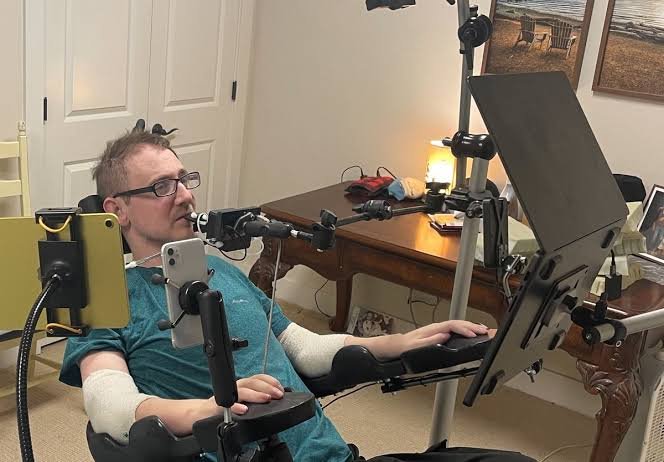

A growing number of Neuralink patients say the company’s brain-computer implant is allowing them to do something that once seemed impossible: play fast-paced, competitive video games using only their thoughts. Their experiences equal parts experimental breakthrough and lived-in daily adjustment are beginning to hint at the profound, and still uncertain, future of commercial neurotechnology.
A New Kind of Player Enters the Game
When Rob Greiner loads into a match of Battlefield 6, the mechanics of aiming, strafing and firing look familiar to anyone watching his gameplay video. What viewers can’t easily see is that Greiner, paralyzed from the shoulders down after a 2022 car accident, is moving his crosshair with a Neuralink brain implant. His mouth controls a QuadStick, a sip-and-puff device designed for quadriplegic players, but his field of vision and his aim come directly from his thoughts.
“It’s gonna take a ton of practice,” he admitted in a recent post, adding that he’s currently only as accurate as he is with a laptop cursor. “But you gotta hand it to Neuralink.” For him and a handful of other early patients, video games have become an early proving ground for a technology still in its medical infancy.
Inside a Hybrid Setup Built on Ingenuity
Greiner’s configuration is not purely mind-controlled at least, not yet. The QuadStick remains essential for movement and firing, while the implant functions as what he calls an “imaginary mouse.” By imagining the act of moving a cursor, he can rotate his field of view, track enemies, and aim down virtual sights. Other patients describe a similar hybrid approach. One, identified only as Alex in company materials, demonstrated last year that he could play Counter-Strike 2 by pairing the implant with a QuadStick.
“I can [think about where to] look and it goes where I want it to,” he said. “It’s insane.”
The arrangement is a workaround for hardware that is still highly experimental. Neuralink’s implant rests inside the skull, powered by a wirelessly charged battery, and requires software calibration akin to training a neural profile. The device’s limits latency, resolution, signal stability shape what users can currently do. But as the patients describe it, the blend of tools is less a compromise than an evolving craft. T
A Demand Led by Patients, Not Product Design
Neuralink’s public demonstrations have emphasized cursor control and simple computer tasks. But for many patients, gaming emerged not from corporate planning but from personal motivation. Video games offer a competitive arena, a social outlet, and crucially an intuitive testing environment for rapid, continuous movement.
Gaming also provides something the company itself cannot easily engineer: a way for patients to narrate their own experiences. In recent months, short gameplay clips shared by Greiner and others have circulated widely, allowing observers to see the technology in practice rather than in polished corporate presentations.
The demand highlights a recurring pattern in assistive technology. Users often “hack” the tools they’re given, turning them toward daily activities, entertainment, and expression and revealing possibilities that developers might not have considered. Neuralink’s patients are no different, for many, a first-person shooter offers a way to feel not just connected, but agile.
Breakthroughs Shadowed by Unresolved Questions
As Neuralink expands its first human trials the company says it has implanted the device in 12 subjects so far regulators, ethicists and competing research groups are watching closely. Brain-computer interfaces have long been pursued in academic and medical settings, often at cautious clinical speed. Neuralink, founded by Elon Musk, has pushed toward faster iteration and public demonstration, drawing both praise and anxiety.
Experts warn that alongside the extraordinary potential for restoring mobility and independence comes a new category of risk: “brain privacy.” The data extracted from neural signals, even when limited to motor intent, raise questions about ownership, security, and long-term use.
For the patients now experimenting with virtual worlds, those questions are abstract, overshadowed by the immediacy of regained agency. For Greiner, each match offers something rarer than a victory: a sense of control he lost three years ago.
Whether these early gaming feats become footnotes in the evolution of consumer neurotechnology or the first chapter of a larger cultural shift remains uncertain. But for now, the players pioneering mind-controlled gaming are already rewriting the rules — one thought at a time.
