
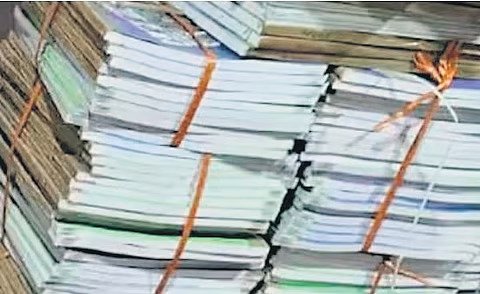
The National Council of Educational Research and Training (NCERT), in coordination with the Crime Branch of Delhi Police, has successfully cracked down on a large-scale illegal printing operation of pirated textbooks. Authorities seized more than 32,000 pirated NCERT books spanning various classes and subjects from a printing facility in Village Jawli, Loni, Ghaziabad, Uttar Pradesh.
The operation also led to the recovery of two high-capacity printing machines, aluminium printing plates, large rolls of paper, and printing ink, underscoring the industrial scale of the unauthorised printing activity.
Officials said the raid was carried out following actionable intelligence developed during an earlier investigation registered under FIR No. 336/2025 dated 11 November 2025, under relevant provisions of the Bharatiya Nyaya Sanhita and the Copyright Act, 1957.
“Pirated educational material undermines the efforts of the government to provide quality, standardised textbooks to students. Such illegal operations not only violate copyright law but also create unfair access to educational resources,” a senior NCERT official said.
Certified Cyber Crime Investigator Course Launched by Centre for Police Technology
Impact on students and education sector
NCERT textbooks are widely used across India for school education, forming the backbone of the curriculum followed by millions of students. The circulation of pirated books can lead to inaccuracies in content, potentially affecting students’ learning outcomes. The recovered stock included textbooks for classes 6 to 12, covering subjects such as mathematics, science, social studies, and languages.
Authorities highlighted that pirated printing is not just a copyright issue but also a public interest concern, as these books often enter the market at lower costs, making it difficult for parents and students to distinguish between authorised and pirated copies.
Crackdown and legal action
The Crime Branch has initiated proceedings against the operators of the printing facility and is examining whether the network extends beyond Ghaziabad. Officials indicated that the investigation is ongoing to identify suppliers, distributors, and retailers involved in the sale of pirated textbooks.
“Through this raid, we aim to deter others from engaging in copyright violations and to ensure that all students receive textbooks that are authentic, accurate, and aligned with the NCERT syllabus,” the official added.
NCERT has been working closely with state authorities across India to monitor and prevent the distribution of unauthorised educational material. The council periodically conducts inspections and encourages citizens to report any suspected instances of piracy.
Previous incidents and rising concern
This is not the first large-scale piracy case involving NCERT textbooks. In the past few years, authorities have detected multiple clandestine printing operations in Uttar Pradesh and other states. Experts note that the lucrative nature of low-cost, high-demand textbooks has led to an increase in organised piracy networks.
The council has also emphasised that students and parents must purchase textbooks only through authorised channels, such as the NCERT online portal, government bookstores, or verified school suppliers.
The Ghaziabad raid sends a strong message against illegal textbook production, highlighting the government’s commitment to safeguarding educational resources and protecting intellectual property rights. With over 32,000 pirated copies seized and key printing equipment recovered, authorities are determined to crack down on piracy networks operating under the radar, ensuring that authentic, high-quality educational material reaches students across the country.
About the author – Ayesha Aayat is a law student and contributor covering cybercrime, online frauds, and digital safety concerns. Her writing aims to raise awareness about evolving cyber threats and legal responses.
