

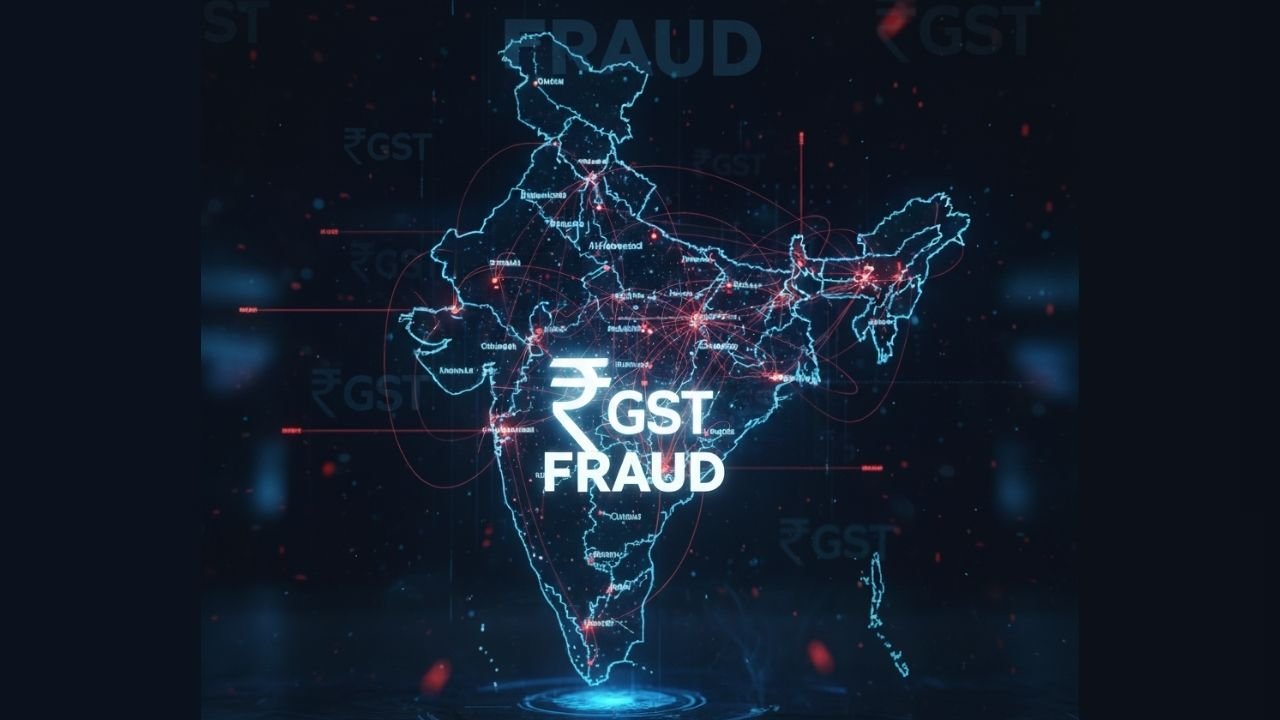

Moradabad | Special Correspondent: A massive case of tax evasion under India’s Goods and Services Tax (GST) framework has come to light, exposing systemic loopholes and a sprawling nexus of fraud.
According to officials, more than 10,000 organized syndicates across the country are operating fake firms to fraudulently claim tax benefits worth hundreds of crores of rupees.
Preliminary findings from the Moradabad division indicate that this regional network alone was responsible for generating ₹341 crore in fake Input Tax Credit (ITC), with ₹1,811 crore in fictitious transactions traced across multiple states.
Fake Firms Facilitating Multi-State Tax Evasion
Investigators have identified 122 shell firms allegedly created to issue false invoices and show non-existent trade activities.
These entities reportedly conducted fabricated transactions worth ₹1,811 crore, resulting in substantial revenue losses to the government.
In a recent enforcement drive, tax authorities raided two scrap-trading units in Moradabad, which were allegedly engaged in fraudulent documentation to claim ineligible tax credits. Officials believe these cases represent just the surface of a much larger, nationwide tax evasion network.
Technology and Digital Identity Misuse Behind the Scam
The investigation revealed that fraudsters utilized fake documents, mobile numbers, and bank accounts to establish the bogus companies. In several instances, unsuspecting citizens’ personal details were misused to register these fake GST accounts.
A senior state tax official commented:
“The Moradabad operation has revealed a deeply entrenched inter-state nexus. This is not a localized scam but a structured network exploiting the GST system through technology and digital manipulation.”
Expert View: Digital Frauds Merging with Economic Crimes
Renowned cybercrime expert and former IPS officer Prof. Triveni Singh described the GST scam as a convergence of economic crime and cyber fraud.
“These cases are not merely instances of tax evasion — they represent the next phase of cyber-enabled financial fraud. Criminals are using digital tools, forged e-documents, and fake identities to exploit automated tax systems. Without strengthening data analytics and AI-driven tracking mechanisms, it will be extremely difficult to contain such crimes,” Prof. Singh said.
He emphasized that India’s digital tax governance must evolve rapidly, with greater focus on real-time data integration, inter-departmental coordination, and verification infrastructure. According to him, a robust data-driven intelligence framework is key to early detection and prevention of such organized frauds.
Investigation Expands to National Level
Authorities have handed over the case to joint teams of State GST (SGST) and Central GST (CGST) departments for a coordinated investigation. The teams are now identifying all individuals and entities that benefited from the fake network and assessing the depth of collusion involved.
Preliminary evidence suggests that this may turn out to be one of the largest GST scams in India’s history, with potential losses to the exchequer running into thousands of crores of rupees.
Conclusion: A Wake-Up Call for India’s Tax Governance
The case underscores the vulnerabilities in India’s tax monitoring and verification systems. Fake firms exploiting digital registration and invoice mechanisms have not only caused massive fiscal damage but also raised serious concerns about tax transparency and public trust.
Experts believe that this case should prompt a comprehensive reform in digital tax compliance architecture, including AI-based monitoring, real-time verification, and stronger identity validation processes to detect fraud before it escalates.
