
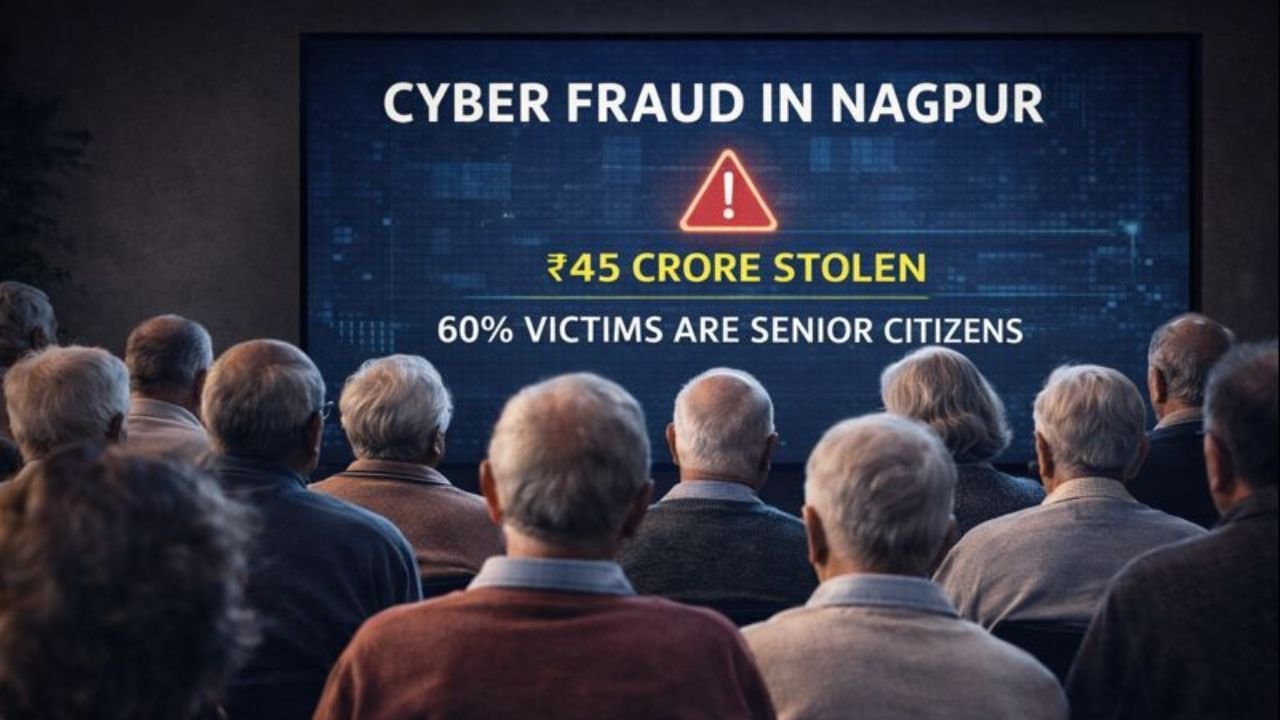

Nagpur | January 5, 2026 | As 2026 begins with renewed hopes and fresh resolutions, Nagpur is carrying forward a stark warning from the year gone by. The rapidly evolving nature of cybercrime has turned senior citizens into the most vulnerable targets in the city. Official cyber police data shows that in 2025, cyber fraud caused a total financial loss of ₹45.77 crore in Nagpur, with nearly 60 per cent of the victims being senior citizens.
Records from the cyber crime wing reveal that fake investment schemes, promises of high returns in the stock market, task-based frauds, cryptocurrency scams, and the particularly alarming phenomenon of so-called “digital arrest” have together wiped out the lifetime savings of elderly victims within minutes. According to officials, fraudsters deliberately combine fear and greed, placing senior citizens under intense psychological pressure and pushing them into hasty financial decisions.
Cybercrime research and policy think tank Future Crime Research Foundation (FCRF) has repeatedly warned that scams like digital arrest are fast emerging as the biggest cyber threat to senior citizens. The foundation notes that in such cases, technology plays a secondary role; it is the fear of government action and sustained psychological intimidation that forces victims to transfer money without verification.
15,000 complaints in a single year
During 2025, Nagpur cyber police received around 15,000 online complaints through the National Cyber Crime Reporting Portal (NCRP) and at the local cyber police station level. After preliminary verification, 125 cases were registered as FIRs. By December 29, 2025, cyber fraudsters had cheated city residents of ₹45.77 crore in total. So far, 42 accused persons have been arrested in connection with these cases.
Police data indicates a clear shift in fraud patterns. In 2025 alone, 20 cases related to digital arrest, 38 cases of stock market fraud, nine task-based fraud cases, and five cryptocurrency-related cases were recorded, reflecting the changing tactics of cybercriminals.
Area-wise complaint pattern
Area-wise analysis shows Hudkeshwar police station limits at the top, with 1,173 complaints, followed by Ajni (747) and Pratap Nagar (651). Shantinagar recorded the lowest number of complaints, at 148.
Charge sheets delayed, investigations pending
Another major concern is the slow pace of prosecution. Of the 125 FIRs registered, charge sheets have been filed in only 20 cases, while investigations in 105 cases remain pending. Police sources attribute the delay to inter-state crime networks, technical complexities, and digital evidence spread across multiple jurisdictions.
Experts from FCRF also point out that the lack of coordinated inter-state investigation mechanisms and rapid digital forensic support significantly delays case resolution—an advantage that ultimately benefits fraudsters.
Who are the most affected
According to cyber police data, victims include retired government officials, businessmen, doctors, engineers, and other senior citizens. This trend is not new. In 2024, nearly 45 per cent of registered cyber fraud cases in the city also involved elderly victims.
Awareness drives, yet scams continue
Despite regular awareness campaigns, fraudsters continue to adapt. Cyber teams frequently visit parks, morning walk groups, and senior citizen associations to spread awareness. However, criminals posing as “government officials” still manage to intimidate victims or lure them with promises of unusually high returns—a pattern described by FCRF as the “Fear–Greed Trap.”
Relief through fund freezing
In 2025, cyber police managed to freeze around ₹16 crore through timely intervention, which is expected to be returned to victims soon. Earlier, ₹14 crore had already been refunded following court orders, including ₹1.5 crore cheated from a postal employee and ₹4 crore taken from a company owner.
‘Caution is the best defence’
At the start of the New Year, both cyber police authorities and FCRF have urged citizens—especially senior citizens—not to trust suspicious calls, links, or investment offers. In case of even the slightest doubt, people are advised to immediately call the 1930 cybercrime helpline or register a complaint on the NCRP portal. The message for 2026 is unambiguous: alertness is safety.
About the author — Suvedita Nath is a science student with a growing interest in cybercrime and digital safety. She writes on online activity, cyber threats, and technology-driven risks. Her work focuses on clarity, accuracy, and public awareness.
