
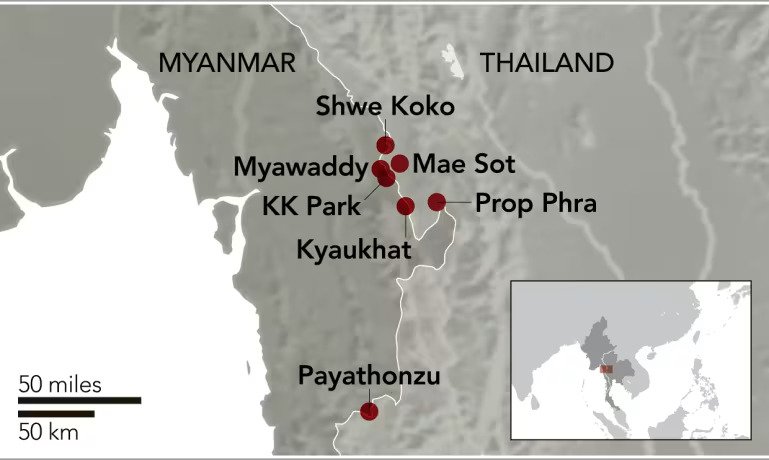

Along Myanmar’s porous border with Thailand, the collapse of order has created an unlikely convergence of civil war, cybercrime and human trafficking. As the junta stages a show of force against notorious scam compounds, the industry it claims to be dismantling appears to be adapting, dispersing and enduring.
At the River Crossing, a New Kind of Border Economy
An hour and a half south of Thailand’s Mae Sot, the road narrows and quiet replaces commerce. At Wa Le known as Wawlay in Burmese the Moei River is scarcely wider than a stream. An iron gate and a small blue wooden bridge mark the crossing into Myanmar, where the flags of the Karen National Union (KNU) flutter over a landscape long shaped by insurgency.
Yet control here is fragmented. While the KNU has seized several military bases in Karen State this year, the crossing itself is overseen by the Democratic Karen Buddhist Army (DKBA), a militia allied with Myanmar’s military junta. On the Thai side, large warning signs caution against being lured into scam centers across the border. Just meters away, however, a newly built compound rises beside the river high walls crowned with razor wire, generators humming inside.
Locals know it as Hengsheng 3. Barred windows, armed guards and white Starlink satellite dishes on the roof suggest its purpose. Monitoring groups say it is one of several new scam compounds constructed around Wawlay in recent months, even as authorities elsewhere claim to be dismantling the industry. Others, they say, have moved farther south to Payathonzu, near the Three Pagodas Pass, following patterns familiar to those who track organized crime: pressure in one place, migration to another.
A Military Offensive With Political Timing
The sudden visibility of the junta’s campaign against scam centers coincides with a moment of political urgency. Myanmar’s generals, who seized power in a 2021 coup, are pressing ahead with plans for a tightly controlled election later this month an effort widely criticized at home and abroad as an attempt to manufacture legitimacy amid an ongoing civil war.
With much of the opposition barred or unwilling to participate, and large swaths of the country too unstable for voting, the military has made retaking territory a priority. It has also sought to launder its international image through high-profile operations against scam compounds, a move analysts say is aimed as much at Beijing as at domestic audiences.
China, the junta’s most important ally, has grown increasingly alarmed by the proliferation of fraud operations along the border. Thousands of Chinese citizens have been victims of online scams or trafficked into compounds where they were forced to work under threat of violence. Beijing’s pressure has been sustained and public, including demands for arrests and repatriations.
In late October, Myanmar’s army stormed KK Park, one of the most notorious scam complexes in Karen State. Soldiers filmed themselves confiscating thousands of mobile phones, computers and Starlink dishes. Buildings were blown apart with explosives, their facades buckling under the blasts.
Demolition at KK Park, Dispersal Everywhere Else
From the Thai side of the border, the destruction was unmistakable. Dust clouds rose above KK Park as excavators tore into concrete shells. Windows shattered; walls collapsed. Hundreds of foreign workers fled across the Moei River into Thailand, ferried in overloaded wooden boats. But the scene also hinted at the limits of the crackdown. In the distance, many buildings remained intact. Some roofs bore the telltale white squares of satellite dishes, suggesting that scam operations had not fully ceased. Around 1,000 workers most of them Chinese reportedly refused to leave, fearing prosecution if they returned home.
International attention was fleeting. Aside from a handful of journalists, foreign law enforcement agencies did not arrive. Soon after, residents on the Thai side reported hearing shelling as junta forces attempted to retake contested ground. Many scam workers scattered deeper into Myanmar; others camped under tarpaulins along the riverbank, alongside local villagers caught between artillery exchanges.
The military also raided Shwe Kokko, another infamous scam city, but entered only a few buildings and demolished just one. Observers say the operations appeared selective, targeting the most visible sites rather than the infrastructure that underpins the industry.
Militias, Money and an Industry That Adapts
Further south, in the town of Minletpan, the fragility of the junta’s narrative became clearer. In November, fighters from the KNU clashed with the army and were fired upon from behind by the DKBA. After driving the DKBA out, the KNU found itself unexpectedly in control of two scam compounds Shunda and Baoli built along the river within the past two years.
Inside were thousands of foreign workers. Instead of destroying the sites, the KNU invited journalists and international law enforcement officials to inspect them. The group released photographs and documents detailing how the scams operated, arguing that exposure, not demolition, was the way to dismantle the business.
For years, local warlords allied to the military have been accused of protecting and profiting from Chinese crime syndicates operating these centers. The profits, by multiple accounts, enriched militia leaders and flowed upward to the junta’s generals. The military has sought to deflect blame onto the KNU, but unlike other armed groups in Karen State, the KNU has consistently distanced itself from the scam economy.
Globally, the cost has been staggering. Billions of dollars have been lost to romance scams, bogus crypto schemes and fraudulent investment funds. In Southeast Asia, the human toll is especially severe: trafficked workers, forced labor, beatings and ransom demands have become routine features of the trade.
The junta insists it is “working to completely eradicate online scam activities from their roots,” as its spokesman, Gen. Zaw Min Tun, has said. Yet along the Moei River, where new compounds rise even as old ones fall, skepticism runs deep. The civil war that enables the scams shows no sign of ending and neither, it seems, does the business that thrives in its shadows.
