

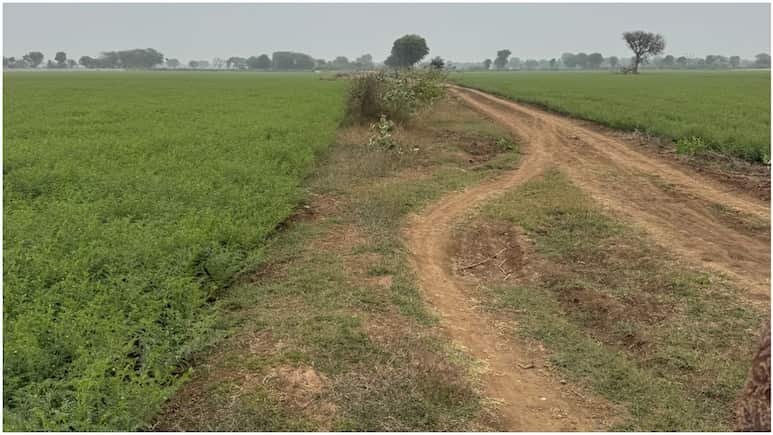

MOJAMABAD: In a farming belt on the outskirts of Jaipur, a dispute over an old government pathway has widened into allegations of record tampering, administrative delay and quiet official evasions—raising pointed questions about how public land is safeguarded in Rajasthan.
A Disappearing Path in Mojamabad
In Mojamabad, a rural subdivision near Jaipur, farmers from Bagot village say a government road that once cut through their fields has effectively vanished from official records. The pathway—listed for decades as a “non-motorable public route” under Khasra No. 525—was, according to residents, erased from revenue documents, clearing the way for surrounding land to be consolidated and sold at higher values.
The farmers allege that the change benefited land mafias seeking to exploit rising real estate prices on Jaipur’s expanding periphery. What had long been treated as common access land, they say, was quietly altered on paper, despite its continued use by villagers.
Certified Cyber Crime Investigator Course Launched by Centre for Police Technology
Revenue officials have acknowledged the dispute but insist the matter is now sub judice. Balveer Singh, the Sub-Divisional Magistrate (SDM) of Mojamabad, said the case is pending before a court and that any alteration to recorded public paths cannot be carried out unilaterally. He added that he would visit the site with a team to assess the situation.
Allegations of Record Manipulation
According to the farmers’ complaint, the original government road was removed from revenue records through alleged collusion between local revenue staff and influential private parties. They contend that instead of restoring the existing route, a new road was carved out elsewhere—without following due process—effectively legitimizing the loss of the older pathway.
The accusations extend to specific officials. Farmers have named a local patwari, along with senior figures in the revenue department, alleging that measurement records were altered under pressure from powerful interests. The claim, repeated in petitions and public statements, is that the official land demarcation was changed to facilitate private gain at the cost of public access.
Such disputes are not uncommon in Rajasthan’s rapidly urbanizing districts, where agricultural land, once peripheral, now lies in the path of expanding development.
A Report That Never Reached the Court
Central to the controversy is an internal fact-finding report. The SDM’s office issued repeated orders to the tehsildar of Mojamabad, Surendra Vishnoi, directing him to submit a factual report on the alleged record changes. According to officials familiar with the correspondence, the local patwari had completed his inquiry and submitted findings to the tehsildar some time ago.
Yet the report, farmers say, has not been placed before the court or formally disclosed. The delay has become a focal point of suspicion. Why, they ask, was a report prepared but not produced? The tehsildar’s office has not publicly explained the reasons for the hold-up.
Evasion and Escalating Frustration
When approached by journalists, the tehsildar declined to engage on camera. His response—that the issue was “not logical” and not within his knowledge—has only intensified local anger. Farmers point out that repeated written orders from the SDM make it implausible, in their view, that the matter could be unknown to the officer responsible for submitting the report.
The exchange has sharpened the sense of grievance in Bagot village, where residents say they are being pushed from one office to another while the disputed land status remains unchanged. For now, the case continues in court, its outcome uncertain
