
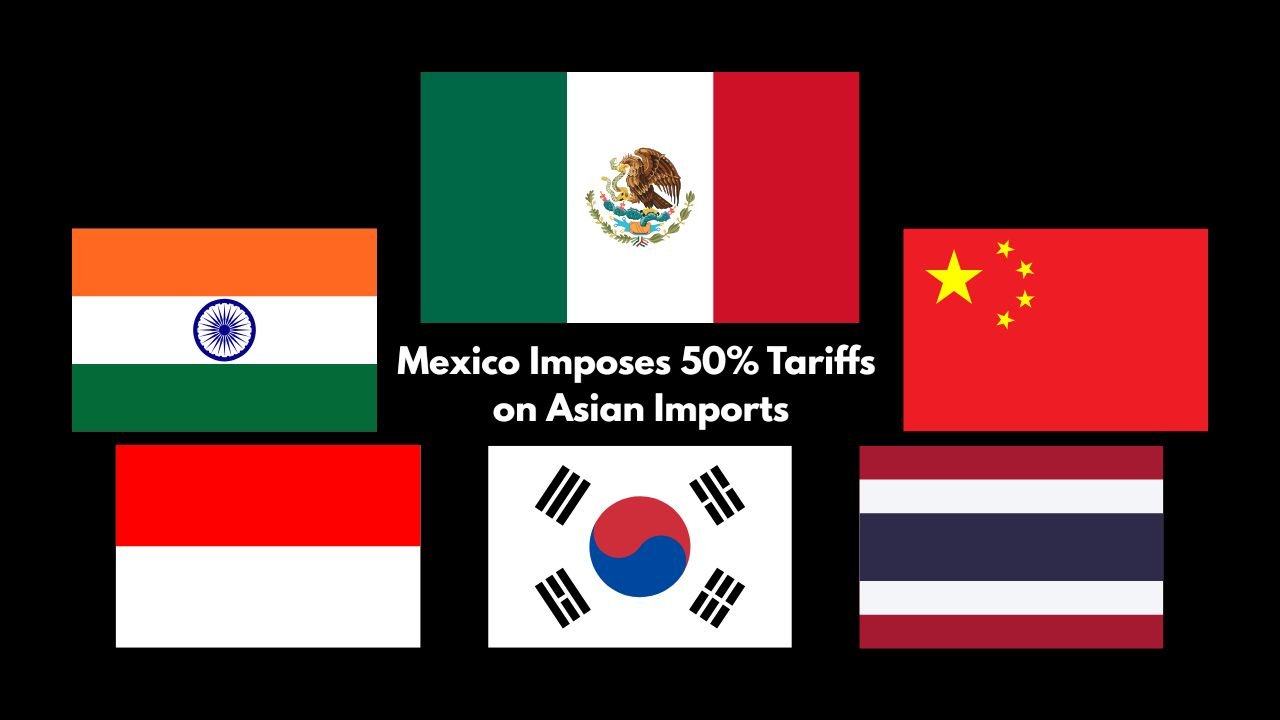

MEXICO CITY: In a dramatic policy reversal, Mexico’s Senate has approved a new tariff regime imposing duties of up to 50 per cent on more than 1,400 products imported from countries without a formal trade agreement, including India, China, South Korea, Thailand, and Indonesia.
The measure marks a decisive break from Mexico’s long-standing pro-free-trade stance. The upper house passed the bill with 76 votes in favour, five against, and 35 abstentions, brushing aside objections from domestic industry groups and criticism from China. The lower house had approved the bill earlier.
Under the plan, the new rates will take effect beginning in 2026, covering a wide range of industrial inputs and consumer goods — from automobiles and parts to textiles, plastics, metals, and footwear. While the highest duty is capped at 50%, most items will fall under a 35% tariff bracket.
Major Setback for Indian Exporters
The move poses a significant challenge for Indian exporters, particularly in sectors like textiles, auto components, engineering, and steel, which have relied on Mexico as a strategic entry point into the North American market.
Mexico is the second-largest economy in Latin America and a crucial link in the United States-Mexico-Canada Agreement (USMCA) supply chain. Indian firms have long leveraged Mexico’s trade proximity to the U.S. to access American buyers indirectly.
Analysts say the tariff hikes will undermine that advantage, making Indian goods less competitive and increasing the landed costs of products shipped through Mexico. Local manufacturers in Mexico, dependent on imports from Asia, have also warned that higher tariffs will push up production costs and fuel inflation.
India’s Commerce Ministry has yet to issue an official statement on the matter.
Mexico’s Protectionist Shift Seen as U.S.-Driven
Trade observers believe Mexico’s abrupt move toward protectionism is linked to mounting pressure from Washington ahead of the 2026 USMCA review.
President Claudia Sheinbaum’s government is seen as attempting to align with the U.S. administration’s tougher stance on Chinese trade practices, hoping to ease the impact of U.S. tariffs on Mexican exports such as steel and aluminum.
While Sheinbaum publicly denied that the decision was made under U.S. influence, the structure of Mexico’s tariff plan closely mirrors American trade actions, according to Bloomberg. The current version is less severe than earlier drafts, which had proposed sweeping tariffs across nearly 1,400 product categories.
Nonetheless, Mexico’s Finance Ministry expects the levies to generate nearly 52 billion pesos (₹19,000 crore) in additional annual revenue, which the government says will help narrow its fiscal deficit.
Political and Economic Debate Inside Mexico
The new policy has drawn mixed reactions across Mexico’s political spectrum. Opposition Senator Mario Vázquez from the PAN party cautioned that the tariffs may “help shield some sectors from cheap Chinese imports, but they will also act as a hidden tax on consumers.”
In contrast, Emmanuel Reyes, a lawmaker from the ruling Morena party, defended the measure as a necessary step to “strengthen Mexican industry, protect jobs, and reduce dependence on foreign manufacturing.”
The domestic auto industry has been one of the most vocal supporters of the move. Chinese-made cars now account for 20% of Mexico’s auto market, up from nearly zero six years ago. Under the new rules, imported Chinese vehicles will face the maximum 50% duty, aimed at reviving local assembly operations.
Implications for India and Regional Trade
For India, the implications of Mexico’s tariff regime are considerable. Indian exporters may face:
- Reduced competitiveness in price-sensitive sectors such as apparel and steel.
- Re-evaluation of supply chain routes that rely on Mexico for access to North America.
- Higher costs for firms operating within Mexican manufacturing ecosystems.
Industry experts believe Indian companies will now have to seek alternative hubs in Latin America — such as Brazil, Chile, or Colombia — for regional market access.
The move also underscores a broader North American shift toward protectionism, with both the U.S. and Canada tightening oversight of imports tied to Asian supply chains.
Broader Context: Mexico’s Strategic Repositioning
Mexico’s decision comes amid growing global trade realignments, where nations are reassessing dependence on Chinese and Asian supply chains. For Sheinbaum’s administration, the tariffs signal both a political message to Washington and an economic attempt to insulate domestic industries from foreign competition.
With the U.S.-China trade rivalry intensifying and the 2026 USMCA review approaching, Mexico’s latest policy appears designed to show compliance with North American trade priorities — even at the cost of straining ties with key Asian economies like India.
Economists warn that while the short-term revenue gains may ease fiscal pressures, long-term competitiveness and inflation control could become major challenges for Mexico if foreign suppliers withdraw or retaliate.
