

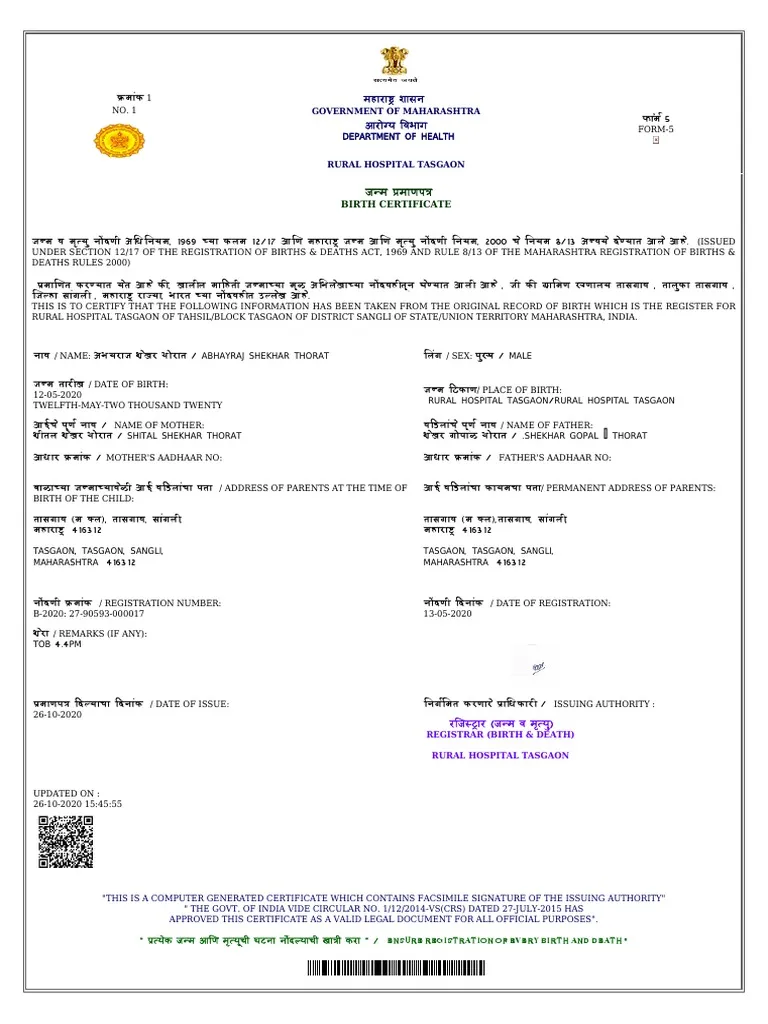

Mumbai: An extraordinary anomaly in official records has sent shockwaves through Maharashtra’s administration after a village with a population of just 1,500 people was found to have registered 27,397 births in a span of three months. The revelations have exposed what officials believe could be one of the largest birth certificate frauds in the state, raising serious questions about the integrity of digital governance systems.
The irregularities were detected in Shendurusani gram panchayat in Arni tehsil of Yavatmal district during a special verification drive conducted between September and November 2025 to review delayed birth and death registrations. During the exercise, officials noticed that the number of births recorded was wildly disproportionate to the village’s actual population, making it statistically and practically impossible.
Digital Registration System Found Compromised
Preliminary findings indicate serious manipulation of the digital birth and death registration system. A large number of entries showed no correlation with local records, household data, or census figures. Many names did not belong to residents of the village or even the surrounding region.
A senior official associated with the probe said the scale of the irregularities rules out clerical error or negligence. “This is not a technical glitch. The volume and pattern of entries suggest deliberate, organised tampering with official records,” the officer said, adding that the fraud appears to have been executed systematically over a short period.
Political Allegations and Interstate Links
The issue has also sparked political controversy. The Bharatiya Janata Party (BJP) has claimed that nearly 99 per cent of the names recorded in the suspicious birth entries belong to individuals from West Bengal and Uttar Pradesh, with no verifiable link to Shendurusani village.
Party leaders have alleged that such fraudulent birth certificates could be misused to obtain identity documents such as Aadhaar cards, voter IDs, domicile certificates, and access to government welfare schemes. The BJP has described the episode as a matter of administrative failure with potential national security implications, demanding a thorough and transparent investigation.
Special Audit Drive Exposes the Anomaly
The scam came to light during a state-initiated campaign aimed at reviewing delayed registrations, a common issue in rural areas where births and deaths are often reported late. However, the figures emerging from Shendurusani immediately stood out.
Official records show that during the three-month period in question, there were no large-scale medical camps, no sudden influx of migrant families, and no extraordinary demographic events that could justify such a surge in births. Despite this, thousands of birth certificates were generated, raising red flags within the district administration.
Cyber Fraud Angle Under Scrutiny
Authorities now suspect that the fraud may extend beyond the village and district level, possibly involving an interstate cyber network. Investigators believe that unauthorised access to official logins, misuse of digital credentials, or collusion by insiders may have enabled the mass generation of fake records.
The state government has indicated that the matter could be handed over to a joint probe involving the cyber crime wing, revenue department, and police authorities. Legal action is likely under provisions of the Information Technology Act, as well as sections related to forgery and tampering with government records.
Trust in Governance Systems Questioned
The case has raised broader concerns about the security of decentralised governance systems, particularly at the gram panchayat level. Experts warn that if birth and death registries—among the most fundamental civic records—can be manipulated on such a scale, other databases may also be vulnerable.
In response, the district administration has put all suspicious birth certificates on hold and ordered a comprehensive audit of records generated during the period. Officials have clarified that no certificate issued under scrutiny will be considered valid until the investigation is completed.
What began as a routine verification exercise has now evolved into a test case for administrative accountability and digital safeguards in Maharashtra. As the probe deepens, its findings are expected to have far-reaching implications for registration systems not just in the state, but across the country.
