

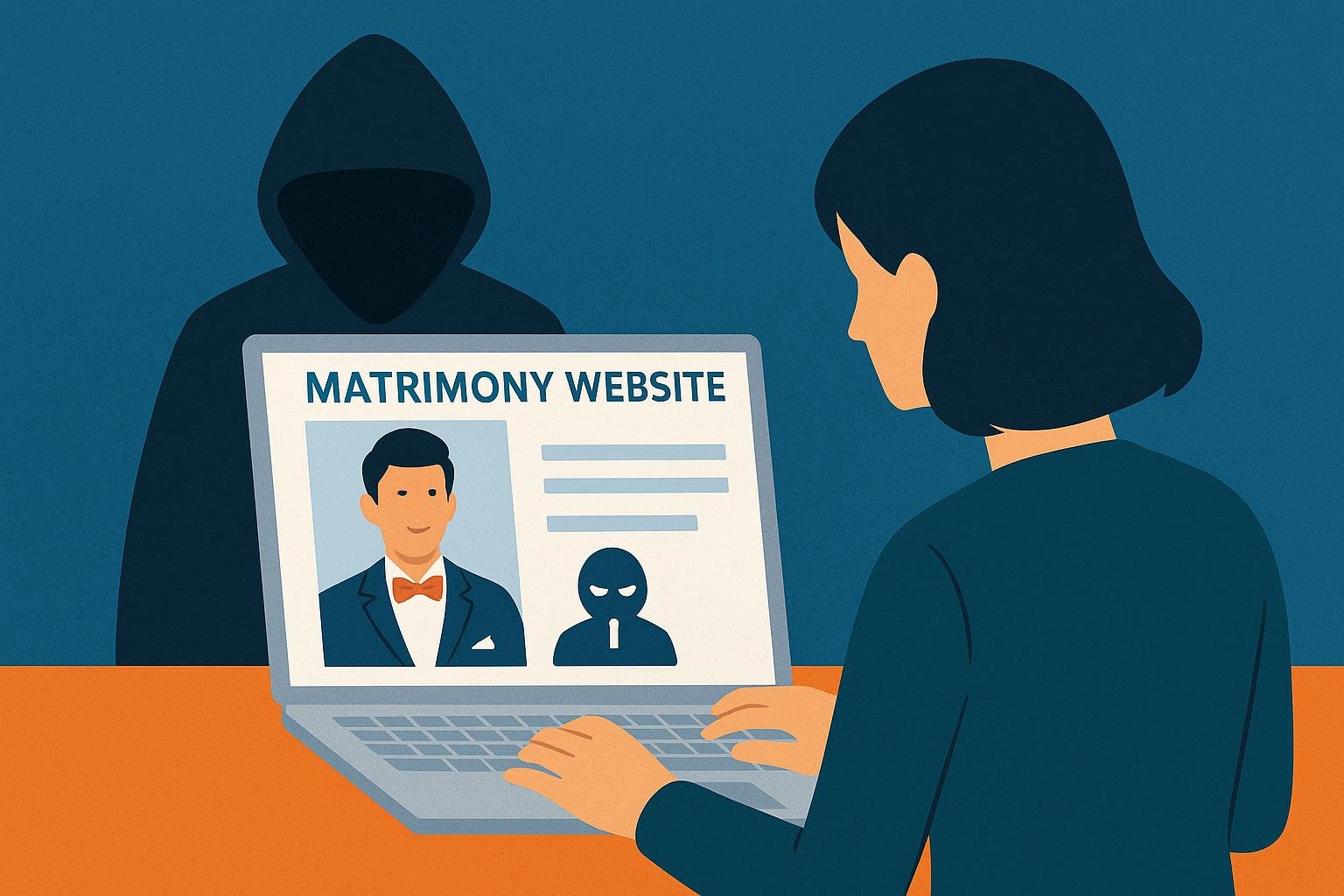
In a striking case of emotional cyber fraud, a 29-year-old Income Tax Officer fell victim to a sophisticated online scam after befriending a woman on a matrimonial website who claimed to be an Indian professional working in London.
What began as an innocent friendship soon spiraled into a digital nightmare — costing him ₹44 lakh in a series of deceptive transactions.
A Friendship That Turned Into a Trap
According to a complaint filed at the Nerul Police Station, the officer had created a profile on a matrimonial platform where he connected with a woman identified as “Divya Sarkar.”
She introduced herself as a native of Jabalpur, Madhya Pradesh, working in London, and sent her personal details and biodata to gain trust.
In her messages, she claimed to have lost her parents and said she was returning to India to fulfill her parents’ last wish — “to get married and settle in India.”
The officer’s trust deepened after exchanging phone numbers; her number carried a UK country code (+44), making her story appear more credible.
‘I’m Stuck at the Airport’ — The Beginning of the Scam
On September 18, the woman sent a screenshot of a British Airways ticket, claiming she was flying to India.
The next day, the officer received a call from a woman who identified herself as Sujata Dhar, allegedly an official at Delhi Airport.
She informed him that Divya had been detained with an unregistered demand draft worth £50,000 and required ₹1 lakh for clearance.
She added that Divya had already paid ₹40,100, and ₹59,900 was still pending.
Believing the story, the officer transferred ₹55,000 to the bank account provided.
Soon after, Dhar called again, demanding another ₹99,700 to issue an anti–money laundering certificate, warning that Divya would otherwise be detained at the airport.
Moved by concern, the officer once again transferred the money.
A String of Deceptions and Emotional Manipulation
Over the following days, the officer received multiple calls and messages — each with a new excuse and new payment demand.
At one point, the fraudsters asked for his bank details to “convert the demand draft into Indian currency.” When he refused, they urged him to deposit ₹3.86 lakh to “open a new account.”
He ultimately transferred ₹1.86 lakh and ₹2 lakh to two separate accounts.
By September 29 and October 5, the scammers contacted him again — this time claiming that Divya was trapped in a hotel, unable to pay her bills, and that the hotel manager had stopped her meals.
A desperate message followed from an alleged hotel employee’s phone requesting ₹3.69 lakh for help.
That’s when the officer finally realized he had been ensnared in a cyber fraud network.
Police Investigation and Expert Insights
The Nerul Police have registered a case of ₹44 lakh cyber fraud and are now working with cyber forensic experts to trace the digital footprints of the perpetrators.
Preliminary investigations reveal that the gang used international phone numbers, fake matrimonial profiles, and social engineering scripts to target professionals seeking serious relationships.
Cybercrime expert and former IPS officer Professor Triveni Singh described the case as a classic example of “emotional social engineering.”
“This is a new-age cybercrime trend,” Singh explained. “Fraudsters no longer just steal OTPs or passwords — they manipulate emotions. They gain psychological control before financial control. Matrimonial platforms are easy targets because people come there with trust and emotional vulnerability.”
He added,
“Such criminals often project foreign locations and professional credentials to establish credibility. Every word they use is psychologically crafted to prevent the victim from saying ‘no.’ By the time the emotional bond breaks, the bank balance is already gone.”
How to Stay Safe from Matrimonial Cyber Frauds
- 1. Verify every matrimonial profile carefully — especially those claiming to live abroad.
- 2. Never share financial information or send money to someone you haven’t met in person.
- 3. Avoid emotional decisions — insist on live video calls or identity verification.
- 4. Do not click on links or open attachments shared through unknown sources.
- 5. Report suspicious activity immediately at cybercrime.gov.in or to your nearest police station.
The Broader Picture — The Rise of Emotional Cybercrime
The incident highlights a growing and deeply concerning trend — digital emotional fraud.
Unlike traditional cyberattacks that exploit technical weaknesses, these scams exploit human emotions — loneliness, trust, and empathy.
In an age where artificial intelligence is being used to mimic human behavior, cybercriminals are mastering the art of emotional deception.
The case of this young officer is a grim reminder that in the digital era, the heart has become the newest attack surface.
