

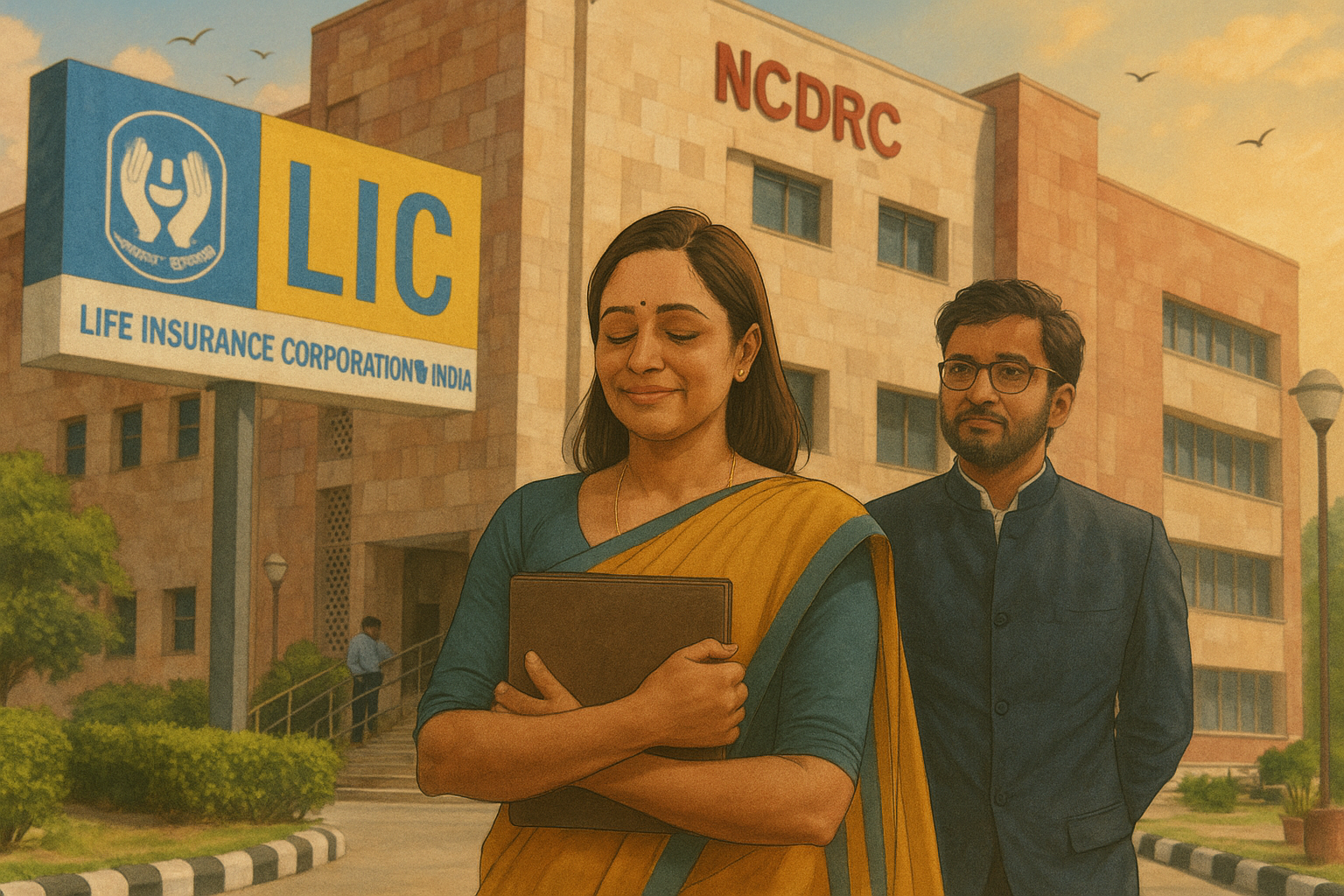
A mother’s 12-year legal battle against the Life Insurance Corporation of India (LIC) has finally ended in her favor after the National Consumer Disputes Redressal Commission (NCDRC) ordered the insurer to honor all life insurance claims linked to her late son. With the addition of interest, compensation, and litigation costs, the total payout has exceeded ₹1.26 crore.
The case involved Mumbai resident Jayshree Suresh Gambhir and her son, Nitin Suresh Gambhir. In 2010, Nitin had purchased five life insurance policies from LIC with a combined sum assured of ₹60 lakh. His mother was named as the nominee under all the policies. Nitin passed away in June 2013 at the age of 38 due to a cardiac arrest, following which his mother submitted claims under the policies.
Registration Begins for FutureCrime Summit 2026, India’s Largest Cybercrime Conference
The Burden of Proving Pre-Existing Disease
However, LIC rejected all five claims in July 2014, alleging that the policyholder had suppressed material information about his health at the time of purchasing the policies. The insurer argued that Nitin was suffering from diabetes and undergoing treatment but had failed to disclose the condition in the proposal forms.
The dispute subsequently turned into a prolonged legal battle. The matter was initially heard by the Maharashtra State Consumer Commission, which granted partial relief by directing payment under three policies while upholding LIC’s rejection of claims under two others. Dissatisfied with the outcome, both parties challenged the order before the NCDRC.
Contradictory Hospital Logs Dismissed
During the proceedings, the commission closely examined medical records, policy documents, and other evidence submitted by both sides. It concluded that LIC had failed to establish that Nitin was suffering from a serious illness or was aware of any such illness when he signed the proposal forms.
According to the commission, the insurer did not place any medical records on file proving that the policyholder had been diagnosed with diabetes or was receiving treatment before the insurance applications were submitted. The absence of such evidence weakened the insurer’s argument that material facts had been deliberately concealed.
No Nexus Established with Cause of Death
The commission also noted that a reference to diabetes in a hospital discharge summary could not, by itself, be treated as conclusive proof of a pre-existing medical condition. In fact, later medical records from the same hospital described the insured as non-diabetic. As a result, the commission held that assumptions or incomplete medical information could not justify rejection of an insurance claim.
Another significant factor considered by the commission was the cause of death. Nitin died nearly three years after the alleged diagnosis and succumbed to a heart attack. The commission observed that LIC had failed to demonstrate any direct connection between the illness it claimed had been concealed and the eventual cause of death. Therefore, repudiation of the claims on that basis was found to be unjustified.
Risk Commencement and Premium Receipts
A separate dispute concerned two policies for which LIC argued that risk coverage had not commenced when the health-related developments occurred. However, after examining premium payment records, the commission found that the first premiums had been received earlier than claimed by the insurer. Consequently, the insurance risk had already come into effect before the hospitalization in question, eliminating the insurer’s grounds for denying coverage.
In its final order, the NCDRC dismissed LIC’s appeal and allowed the mother’s plea, directing the insurer to pay the full insured amount of ₹60 lakh under all five policies. The commission further ordered LIC to pay simple interest at the rate of 9 percent per annum from 2014 onward. Over the course of the prolonged litigation, the accumulated interest alone reached approximately ₹64.8 lakh.
Additionally, the commission awarded ₹1 lakh as compensation for mental agony and ₹50,000 towards litigation expenses. Together with the principal amount and accrued interest, the total payout rose to ₹1,26,30,000.
Legal experts say the ruling reinforces the principle that insurance companies cannot reject claims solely on the basis of assumptions or incomplete medical records. The judgment also highlights that policyholders and their families can successfully challenge claim denials when insurers fail to provide convincing evidence to support allegations of non-disclosure.
