
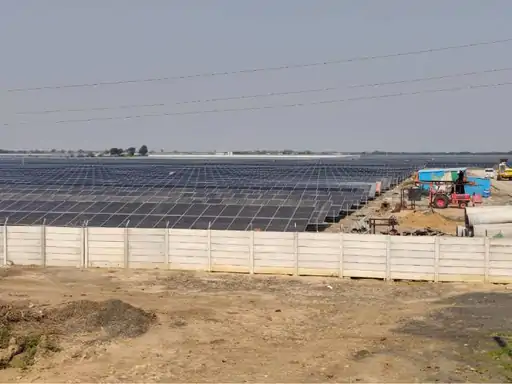

SURENDRANAGAR: On the edge of Gujarat’s scrubland, a solar power project promoted as a symbol of clean energy has instead become the subject of overlapping allegations—of premature power generation, disputed approvals, altered project costs, and mounting local harm—drawing farmers, district officials, and central investigators into a widening inquiry.
A Project That Moved Ahead of Final Clearance
In Krishnanagar village of Gujarat’s Surendranagar district, the solar power project at the centre of the controversy began generating electricity on April 24, 2025, even though the district Collector had stipulated that power generation could commence only after final approval. Local complainants allege that starting operations before such clearance amounted to unauthorised electricity generation.
The developer, ENECI Solar Private Limited, later approached the Collector seeking permission, warning that halting the project would lead to losses estimated at ₹850 crore. On April 3, 2025, the Collector granted a temporary approval limited to the construction of structures. According to farmer Ashwin Malvaniya, this interim permission was subsequently used to continue operations and sell electricity before final clearances were obtained. He claims employees at the plant spoke of daily revenues ranging between ₹30 lakh and ₹40 lakh during this period.
District officials and the Forest Department, however, have maintained that the project functioned within the scope of temporary approvals and that statutory requirements could be fulfilled in phases.
Safety, High-Tension Lines, and Unanswered Permissions
Concerns surrounding the project extend beyond its timing. Rules framed by the Central Electricity Authority require high-tension transmission lines to be at least 100 meters away from schools and religious structures. In Krishnanagar, villagers say a high-tension line runs just 27 meters from a primary school, with the sound of electricity audible up to 200 meters away.
Malvaniya has also alleged that two Narmada canal branches lie beneath the transmission line and that a snapped wire could cause casualties. According to him, permissions were not obtained from either the Narmada authorities or the Railways, and only partial consent was taken from private landowners. Farmers further claim that at least 73 electric poles were installed between Krishnanagar and Dhrangadhra without proper authorisation, with compensation to affected landowners remaining incomplete.
Costs, Conservation Funds, and an Eco-Sensitive Zone
The solar plant spans roughly 2,000 to 2,200 bighas near Krishnanagar village, close to the Wild Ass Sanctuary and within an eco-sensitive zone where prior forest approval is required. Under wildlife conservation norms, developers must deposit 1 percent of the total project cost with the Forest Department.
Malvaniya alleges that the project presented two different costs: ₹60 crore to the Forest Department and ₹850 crore before the Collector—a 14-fold increase. Based on the initial declaration, the company deposited ₹60 lakh. Later, after the higher project cost was acknowledged, the Forest Department agreed to recover ₹8 crore in eight annual instalments.
Forest officials have said the non-objection certificate was granted earlier and that instalment-based payment is permissible. They have also clarified that the solar park is not located on sanctuary land and that the high-tension line falls under the Revenue Department. Villagers, however, argue that conservation payments were revised only after construction had already altered grazing patterns and wildlife movement.
Protests, Local Impact, and a Growing Investigation
Local resistance surfaced publicly in November 2024, when farmers protested the installation of large electric poles on private land, alleging damage to roads and irrigation pipelines. Villagers say heavy vehicle movement destroyed canals, broke water pipes, and disrupted cattle grazing routes. Malvaniya has claimed that a village pond was filled and internal roads were built inside the project area without approval.
Farmers from neighbouring villages have echoed these grievances. Lakha, a resident of Jesda village, said grazing areas and water sources for cattle were disrupted. Govind Bharwad of Sajjanpur village pointed to the risks posed by overhead electric wires and the loss of a pond that had existed for generations.
Malvaniya has filed complaints with the Prime Minister’s Office and the Gujarat Vigilance Commission and sought information under the Right to Information Act on 16 aspects of project approvals. He says these complaints contributed to heightened scrutiny of district officials. Over the past week, the Enforcement Directorate conducted searches at the residences of senior officials in Surendranagar. Following the raids, the district Collector was transferred, and a Deputy Mamlatdar was taken to Delhi on remand.
Malvaniya has also spoken of attempts to intimidate him, including alleged efforts to run him over, though he says he has no evidence to identify those responsible. He maintains he will continue pursuing the case, including approaching the High Court if required.
