

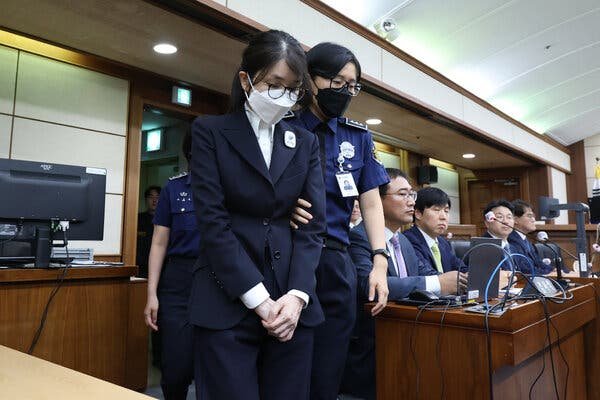

SEOUL: A South Korean court has sentenced former first lady Kim Keon Hee to 20 months in prison for corruption, a ruling that lands amid an unusually volatile moment in the country’s politics, just weeks before a separate court is expected to decide the fate of former President Yoon Suk Yeol over his brief imposition of martial law.
A Verdict Amid Political Turbulence
A court in Seoul on Wednesday sentenced Kim Keon Hee, the wife of former President Yoon Suk Yeol, to 20 months in prison for corruption, concluding one strand of a case that has shadowed South Korean politics for more than a year. The decision came as the country awaits a separate and closely watched verdict on Mr. Yoon, who faces a rebellion charge over his short-lived declaration of martial law in December 2024.
The timing underscored how legal proceedings against the former first couple have unfolded in parallel, each amplifying the political sensitivity of the other. The ruling against Ms. Kim was delivered roughly three weeks before the court is expected to rule on Mr. Yoon’s case, a sequence that has kept public attention fixed on the judiciary and its handling of politically charged prosecutions.
Certified Cyber Crime Investigator Course Launched by Centre for Police Technology
Days before her arrest, Ms. Kim issued a public apology for causing concern but indicated that she would contest the allegations, portraying herself as “someone insignificant.” Despite that statement, prosecutors argued that the case involved serious abuses of influence tied to her position as first lady.
The Charges and the Court’s Reasoning
The Seoul Central District Court found Ms. Kim guilty of receiving gifts from the Unification Church in exchange for business favors, sentencing her to 20 months in prison on bribery charges. The ruling marked a partial outcome in a case that had included a wider range of allegations.
Judges acquitted Ms. Kim of charges related to stock price manipulation and violations of political funding laws, citing a lack of evidence. That split decision narrowed the scope of criminal liability while still imposing a custodial sentence that the court deemed proportionate to the bribery offense.
The verdict differed sharply from the position taken by an independent counsel, who had sought a 15-year prison term for Ms. Kim on the combined charges of bribery, stock manipulation and political funding violations. The court’s rejection of most of those allegations appeared to reflect a more restrained assessment of the evidence presented at trial.
Detention, Defense and the Prospect of Appeal
Ms. Kim has been in custody since August, when a Seoul court approved a warrant for her arrest, citing concerns that she might destroy evidence if released. Her continued detention through the trial added to the political and public scrutiny surrounding the proceedings.
Following the verdict, her defense team thanked the court but described the 20-month prison term as “relatively high” for the bribery conviction alone. Lawyers said they would discuss whether to file an appeal, leaving open the possibility of further legal proceedings.
The prosecution has not publicly indicated whether it will challenge the acquittals on the other charges, though the case remains closely watched as part of a broader reckoning with allegations of corruption involving senior political figures.
Parallel Cases and a Wider Legal Reckoning
The ruling against Ms. Kim comes as South Korea’s judiciary grapples with another extraordinary case: the rebellion charge against former President Yoon for his brief imposition of martial law in December 2024. An independent counsel in that case has demanded the death sentence, raising the stakes of the impending verdict.
Together, the cases have placed unusual pressure on the courts to demonstrate independence and rigor amid intense political polarization. While the legal questions differ, the proximity of the rulings has bound them in the public mind, reinforcing the sense that South Korea is navigating a period of profound legal and political accountability.
For now, the sentence handed down to Ms. Kim stands as a concrete outcome in a longer sequence of investigations, with further decisions still to come that may shape the country’s political landscape in the months ahead.
