
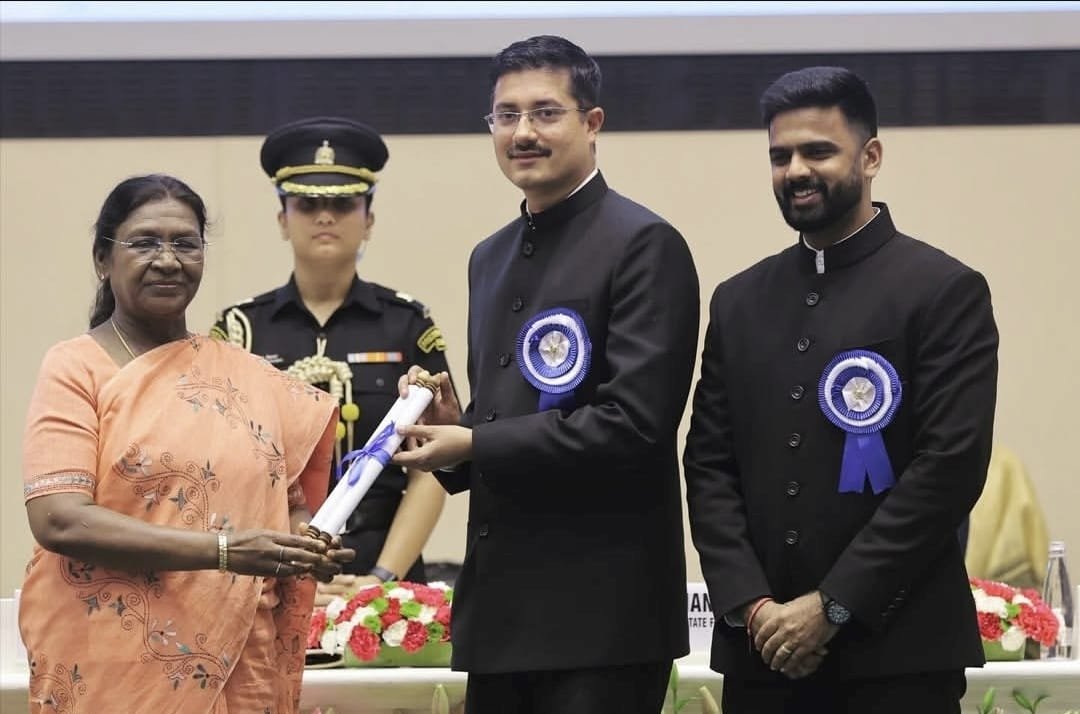

In the arid plains of Khandwa, Madhya Pradesh, the official records tell a story of transformation. Government dossiers describe a district rejuvenated by thousands of new water structures—check dams, ponds, and wells—constructed under the zealous supervision of the local administration. This purported success was so compelling that it recently won Khandwa the prestigious National Water Award from the President of India.
But on the ground, the reality is starkly different. Where official geotagged photos show brimming ponds, local farmers are harvesting wheat in dry fields. “Wells” listed in government data appear as mere two-foot depressions in the earth, bone-dry and useless.
A sweeping investigation by the Hindi daily Dainik Bhaskar has ‘exposed’ what appears to be a massive administrative deception, alleging that district officials, led by Zila Panchayat CEO Nagarjun B. Gowda and Collector Rishabh Gupta, fabricated evidence to secure national accolades. The scandal has not only embarrassed the state government but has also resurrected serious questions about the integrity of Mr. Gowda, a high-profile officer previously shadowed by allegations of multimillion-dollar bribery and land fraud.
The Digital ‘Deception’
The crux of the Bhaskar investigation lies in the gulf between the district’s digital submissions and physical reality. To clinch the award under the Jal Sanchay, Jan Bhagidari (Water Accumulation, Public Participation) initiative, the Khandwa administration submitted a dossier teeming with data and photographic evidence of their achievements.
However, forensic scrutiny of these submissions revealed a clumsy reliance on technology to mask the lack of progress. Several photographs of “newly constructed” water harvesting systems bore the unmistakable watermarks of artificial intelligence tools, including the logo of Google’s Gemini AI. The implication was clear: instead of building infrastructure, the administration had allegedly generated it on a computer screen.
Reporters visiting the coordinates provided in the award nomination found nonexistent structures. In one instance, a site designated as a flourishing community pond was found to be flat agricultural land. In another, structures claimed as deep recharge wells were identified as shallow pits that could barely hold a bucket of rainwater. The “verification” process, intended to ensure the integrity of such awards, appears to have been bypassed or manipulated, allowing a phantom success story to receive the country’s highest honor for resource management.
The ‘Architects’ of the Illusion
The controversy centers on two key figures: District Collector Rishabh Gupta and, more prominently, the Zila Panchayat CEO, Nagarjun B. Gowda. As the bureaucratic heads of the district, they were responsible for the proposal sent to the central government.
Mr. Gowda, a doctor-turned-IAS officer of the 2019 batch, represents a modern breed of civil servant—young, tech-savvy, and immensely popular on social media. Together with his wife, IAS officer Srishti Jayant Deshmukh, he commands a following of millions. The couple is often celebrated as the face of “New India’s” bureaucracy, authoring books on ethics and motivating aspirants to join the civil services.
The irony of the allegations—using AI to fake development work—has struck a chord with the public. Critics argue that the drive for recognition and social media validation may have superseded the fundamental duty of public service. While the district administration has dismissed the Bhaskar report as “baseless and misleading,” they have yet to provide a credible explanation for the AI watermarks or the missing infrastructure at verified sites.
A Pattern of Allegations
For Mr. Gowda, the Khandwa water scandal is not an isolated incident but the latest in a troubling pattern of accusations that have trailed his short career.
During his previous tenure as the Additional District Magistrate (ADM) in Harda district, Mr. Gowda faced intense scrutiny over a controversial decision regarding illegal mining. A private company, Path India, had been slapped with a provisional fine of roughly ₹51 crore ($6 million) for alleged illegal excavation. Under Mr. Gowda’s adjudication, this penalty was drastically reduced to a mere ₹4,000 ($48).
RTI activist Anand Jat alleged that this reduction was the result of a quid pro quo, accusing Mr. Gowda of accepting a bribe of ₹10 crore to make the penalty vanish. Mr. Gowda vehemently denied the charge, maintaining that the original fine was procedurally flawed and that he had followed the letter of the law.
Compounding these troubles were subsequent allegations regarding a land deal in Bhopal. Documents surfaced suggesting Mr. Gowda had purchased eight acres of prime real estate for ₹90 lakh—a figure significantly below the market value, which is estimated to be in the crores. Critics and activists have alleged that the funds for this acquisition were linked to illicit payoffs, though Mr. Gowda has maintained that all purchases were declared and legal.
The Crisis of Credibility
The convergence of these scandals—the phantom dams of Khandwa and the vanished fines of Harda—has triggered a crisis of credibility for the Madhya Pradesh administration. The opposition Congress party has seized on the reports, demanding an immediate high-level inquiry and the suspension of the officers involved.
The scandal also touches on a deeper rot within the awards ecosystem of Indian governance. If a district can win a Presidential award with AI-generated photos and nonexistent wells, it calls into question the vetting mechanisms of the central government’s flagship schemes.
For now, the farmers of Khandwa wait for water that exists only in digital files, while the “power couple” of the state bureaucracy faces a trial not in the court of law, but in the court of public opinion—where the images are real, and the anger is palpable.
Update: Administration Issues Strong Rebuttal
In a detailed counteroffensive, the Madhya Pradesh government has categorically dismissed the investigation as “baseless and misleading,” arguing that the allegations conflate two entirely separate administrative initiatives. In an official “Fact Check” released by MP Jansampark, the district administration contended that the specific irregularities cited in the report—such as those in Shahpura Mal and Harvanshpura—pertained to the Jal Ganga Samvardhan Abhiyan, a separate state-level scheme, rather than the central Jal Sanchay Jan Bhagidari campaign for which the National Water Award was conferred. The administration further clarified that over 129,000 verified photographs were uploaded to the central portal—contradicting claims of a smaller, manipulated dataset—and asserted that the central government had conducted rigorous desk and field verifications before granting the honor. Officials labeled the report an attempt to “tarnish the image” of the district administration, noting that punitive action had already been taken against local staff in cases where genuine discrepancies were found.
