

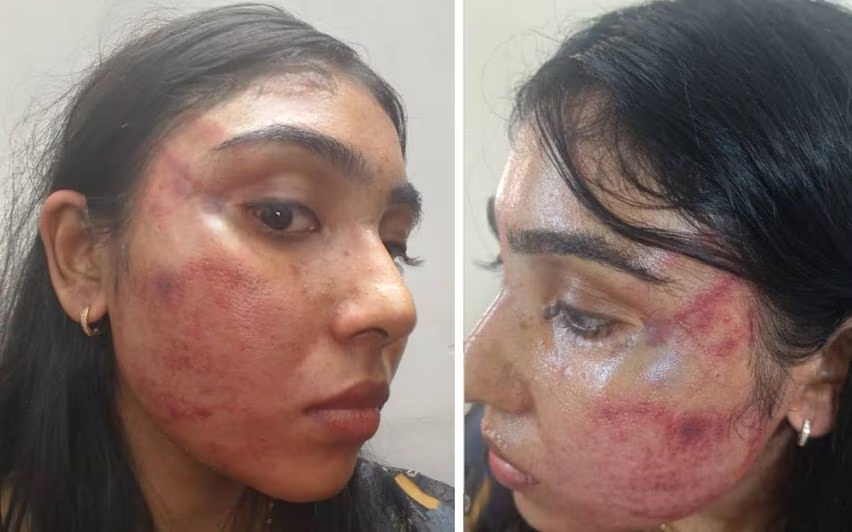

A brutal assault on a young woman advocate by her senior in Thiruvananthapuram has sparked outrage in legal circles and raised uncomfortable questions about gender-based violence and institutional accountability within India’s legal profession.
“Nobody Stopped Him”: A Shocking Attack in a Legal Office
On a quiet Tuesday afternoon, what began as a disagreement escalated into a scene of violence within the sanctified walls of the legal fraternity. At around 12:30 p.m., Advocate Shamili Justine, a junior lawyer practising at the Thiruvananthapuram District Court, was allegedly assaulted by her senior, Advocate Bailin Das, inside his office in the Maharani Building at Vanchiyoor.
The tool of violence: a mop stick. The aftermath: visible bruises, injuries to her face and neck, and a medical emergency that has since left her under observation at the Government General Hospital. Doctors have recommended scans to determine potential fractures or internal injuries. Shamili may soon be shifted to the Medical College Hospital due to the seriousness of her condition.
In her formal complaint to the police, Shamili recounted being struck violently, falling to the ground, and being assaulted again after being lifted. Perhaps more disturbingly, she noted that no one in the vicinity attempted to intervene during the attack—a silence that has only compounded the trauma.
Also Read: Attention Startups! Showcase Your Smart Policing Solutions on India’s Biggest Stage
Legal Bodies Under the Scanner: “Temporary Suspension” Raises Eyebrows
Following the incident, the Vanchiyoor Bar Association moved to temporarily suspend Bailin Das, but not before facing criticism for their initial hesitance to act. The Association has now formally directed Das to submit a report to the Bar Council explaining the incident.
Bar Association officials publicly stated their solidarity with Shamili, asserting they will support her legal pursuit of justice. However, Shamili and her family allege that some members of the Association attempted to shield Das. Her family specifically accused Bar Association Secretary G. Muraleedharan of stating that Das would not be arrested from within the office premises—a claim the Association has denied knowledge of.
The contradiction between public posture and internal handling of the issue has ignited debates among legal professionals and activists alike. While the Association claims it eventually reported the matter to police, their initial inaction, paired with the serious nature of the assault, has led to sharp criticism and questions about the legal profession’s commitment to protecting its youngest and most vulnerable members.
Police Case and Legal Proceedings Under BNS
Shamili’s complaint has resulted in the registration of a case under non-bailable sections of the newly-enacted Bharatiya Nyaya Sanhita (BNS). While authorities have not disclosed the exact sections invoked, the non-bailable nature of the charges suggests serious penal implications for Das.
A fellow woman advocate practicing at the Thiruvananthapuram District Court confirmed that the case had been filed and expressed concern over a growing culture of impunity when it comes to gender-based violence within the legal fraternity. “We often speak of justice in courtrooms, but our own corridors remain unsafe,” she said, requesting anonymity.
The police are currently investigating the matter, and the Bar Council of Kerala is expected to take up the case following the submission of Das’s report. Meanwhile, Shamili’s health remains a pressing concern, with her transfer to a tertiary hospital being considered due to the risk of deeper injuries.
ALSO READ: FCRF Launches Campus Ambassador Program to Empower India’s Next-Gen Cyber Defenders
Institutional Intimidation or Isolated Incident?
This incident is not just about an assault—it is a mirror to the deep structural issues embedded in India’s legal profession. The fact that a young woman lawyer could be brutally attacked in broad daylight, within an office space frequented by legal professionals, and yet no immediate intervention occurred, paints a chilling picture.
The fact that the Association only acted after pressure further adds to growing mistrust in internal grievance redressal mechanisms. Legal activists are calling for the Bar Council of India to take suo motu cognizance of the issue and initiate disciplinary proceedings, not just against the alleged perpetrator, but also against those who may have enabled or shielded him.
For now, Shamili Justine’s courage to file a formal police complaint, despite institutional pressures and threats of isolation, stands as a rare but important step towards justice in a system often slow to act against its own.
This is a developing story.
