
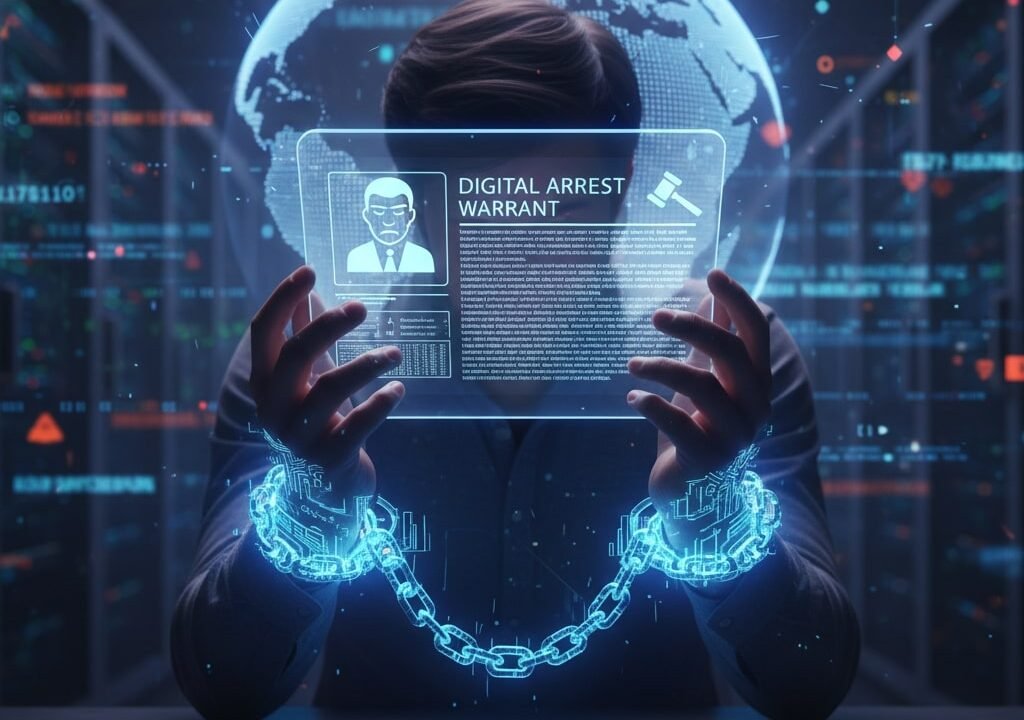
In one of the longest and most disturbing cases of so-called “digital arrest” reported in the city, cyber fraudsters allegedly held a retired superintendent engineer of the Kanpur Electricity Supply Company (KESCO) and his wife under virtual confinement for 69 days, extorting ₹53 lakh by impersonating senior law-enforcement officials.
The victim, Ramesh Chandra, who undergoes dialysis twice a week, was allegedly threatened with arrest, imprisonment and attachment of family assets after being falsely linked to a money-laundering case and a fabricated suicide incident in Mumbai. An FIR has been registered at Kohna police station, and cybercrime investigators have begun tracing the financial and digital trail.
A Single Phone Call Triggered the Ordeal
According to the complaint, the harassment began on October 3, when Chandra was in Lajpat Nagar for a dialysis session. He received a call accusing him of misusing a SIM card issued against his Aadhaar number to harass a 19-year-old woman in Mumbai, who was later claimed to have died by suicide.
Within hours, a series of calls followed from multiple numbers. After returning home, Chandra received a video call from a man claiming to be an official from Colaba police station. Shortly thereafter, another caller introduced himself as a CBI officer, escalating the intimidation.
The fraudsters alleged that Chandra’s name had surfaced in the ₹538-crore Jet Airways money-laundering case, warning him of immediate arrest.
Threats of Jail and Action Against Family
The callers allegedly threatened to send the retired engineer to a Mumbai jail and place his wife and sons—one based in the United States and another in Noida—under investigation and detention.
When Chandra informed them about his medical condition and dependence on dialysis, the fraudsters instead imposed what they termed a “home-based digital arrest.” He was ordered not to step out of his house except for medical emergencies.
The callers falsely claimed that his bank accounts, PPF, mutual funds, shares and lockers had been frozen and asserted that the investigation was being supervised by the Supreme Court of India and the Reserve Bank of India.
Money Extracted in Instalments
Under relentless psychological pressure, the elderly couple was forced to transfer money in stages:
- October 4: ₹15.31 lakh transferred from PPF and savings
- October 9: ₹20 lakh transferred
- November 21: ₹23 lakh sent via RTGS
- December 11: ₹10 lakh deposited as so-called “bail security”
In total, ₹53 lakh was siphoned off.
Video Surveillance Even During Dialysis
The victim told police that for 69 consecutive days, video calls remained active almost continuously. If the call dropped, it was immediately reconnected. Even during dialysis sessions, he was forced to stay on video.
If internet connectivity failed, he was instructed to send photographs as proof of compliance. The fraudsters allegedly used abusive language, constant threats and intimidation to ensure the couple did not contact relatives or approach authorities.
Fake CBI Offices and Courtrooms Used to Deceive
To reinforce the illusion of legitimacy, the fraudsters staged video calls displaying what appeared to be CBI offices and courtrooms, complete with files, official-looking furniture and multiple individuals playing different roles.
Police said this elaborate setup was designed to overwhelm victims psychologically and suppress rational judgment, especially among elderly individuals unfamiliar with digital fraud techniques.
Silence Exposed the Scam
After December 11, the calls abruptly stopped and no bail documents were provided. The sudden silence for three days raised suspicion, prompting Chandra to finally approach the police.
An FIR was registered on Monday.
DCP Central S.K. Singh confirmed that a case of large-scale cyber fraud involving prolonged digital confinement has been registered. “We are examining bank transactions, IP addresses and communication platforms used by the accused,” he said.
Growing Threat of ‘Digital Arrest’ Scams
Police officials warned that digital arrest frauds are emerging as one of the most dangerous forms of cybercrime, particularly targeting elderly citizens, retired officials and medically vulnerable individuals.
“These scams combine impersonation, psychological coercion and financial exploitation. Public awareness is crucial,” an officer said.
The investigation is ongoing, and authorities have not ruled out the involvement of an organised interstate or international cybercrime network.
