
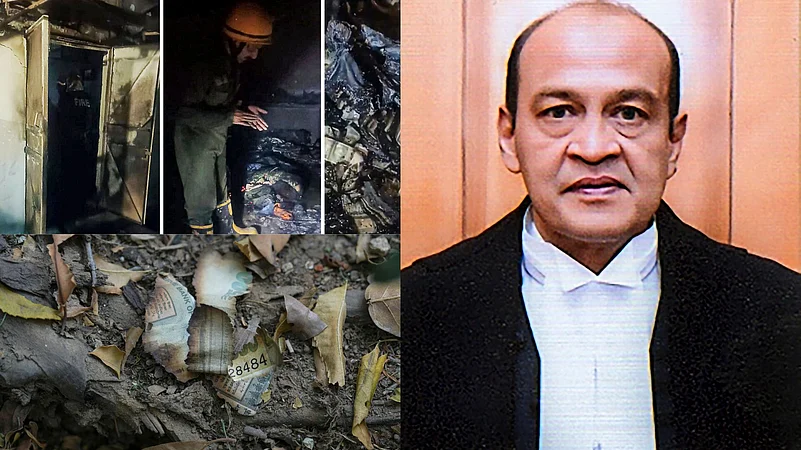

Justice Yashwant Varma, a judge of the Allahabad High Court who was facing an inquiry linked to the alleged cash-at-home controversy, has submitted his resignation to the President of India with immediate effect.
In his resignation letter, Justice Varma wrote that it was “with deep anguish” that he was tendering his resignation from the office of judge of the High Court of Judicature at Allahabad. A copy of the letter was also sent to the Chief Justice of India, Surya Kant. He did not spell out the reasons for the decision, stating instead that he did not wish to burden the President’s office with them and that it had been an honour to serve.
The resignation came while an inquiry ordered under the Judges (Inquiry) Act, 1968, was already under way. Lok Sabha Speaker Om Birla had constituted a three-member committee after an impeachment motion signed by 146 members of the Lok Sabha was submitted seeking Justice Varma’s removal. The committee comprised Justice Arvind Kumar of the Supreme Court, Justice Shree Chandrashekhar, Chief Justice of the Bombay High Court, and senior advocate Vasudeva Acharya of the Karnataka High Court.
The issue at the center of the proceedings was the alleged discovery of a huge pile of currency notes at an outhouse attached to Justice Varma’s official residence in Delhi during a firefighting operation on March 14, 2025, when he was serving as a judge of the Delhi High Court.
The Long Arc of the Cash-at-Home Case
The resignation does not emerge in isolation. It is the latest step in a case that has already moved through several layers of the judicial and parliamentary system.
After the alleged recovery of burnt cash from a storeroom near the servants’ quarters at Justice Varma’s official residence in Lutyens’ Delhi, the Supreme Court constituted a three-judge committee on March 22, 2025, to conduct an in-house inquiry. On May 4, a panel of three senior judges submitted its report to the then Chief Justice of India, Sanjiv Khanna.
Following that, the court took away Justice Varma’s judicial work at the Delhi High Court, transferred him to his parent Allahabad High Court and asked its Chief Justice not to assign him any judicial work. In a striking and highly unusual development, the court also uploaded photographs and videos of the cash allegedly recovered from his residence.
The parliamentary process advanced in parallel. In July last year, the impeachment process formally began. In August, the Lok Sabha Speaker set up the inquiry committee to examine the charges against him. Earlier this year, Parliamentary Affairs Minister Kiren Rijiju said the process was under way and that the government was awaiting the committee’s report.
Justice Varma had denied that the cash belonged to him or his family members and had said the room where it was found was accessible to all.
Does Resignation End Accountability?
That is now the central question.
With Justice Varma resigning, the parliamentary process to remove him as a High Court judge is expected to come to an end. Reports indicate that the resignation effectively brings the impeachment proceedings to a close, because impeachment is a mechanism to remove a sitting judge from office. Once the judge is no longer in office, the immediate constitutional objective of that process ceases to exist.
But that does not settle the larger issue of accountability.
The political and legal discomfort arises from what resignation appears to preserve. By stepping down rather than being removed by Parliament, Justice Varma would remain entitled to pension and other post-retirement benefits ordinarily available to a High Court judge. Had he been removed by Parliament, he would have been deprived of those benefits.
That distinction is not merely administrative. It goes to the heart of public confidence in judicial accountability. If the most serious proceedings available against a sitting constitutional judge can be neutralized by resignation before conclusion, then the system is left confronting an old and uneasy dilemma: is departure from office itself being treated as sufficient consequence, even where the underlying allegations have not been publicly resolved through the fullest available process?
A post circulating online put the matter in especially blunt terms, arguing that if a judge resigns before impeachment, the case is effectively closed in practical terms, and that no High Court or Supreme Court judge in India has ever been punished for corruption since independence. The wording is sharp, but the anxiety beneath it is unmistakable. The worry is not simply about one judge. It is about whether the institutions designed to discipline judges are structurally capable of finishing what they begin.
A System Under Judgment
The resignation letter itself is restrained. The case around it is not.
What now remains is a troubling institutional vacuum. The impeachment route may end with the resignation. Yet the public controversy that gave rise to it does not. The alleged recovery of a large amount of cash from a judge’s residence, the in-house judicial inquiry, the stripping away of judicial work, the transfer, the constitution of a parliamentary inquiry committee and, finally, the resignation before the process could run its full course have together produced a sequence that is legally significant and symbolically damaging.
In such cases, the law may distinguish clearly between removal, resignation and criminal process. Public confidence does not always make those distinctions so easily.
That is why the question now being asked is larger than whether Justice Varma has resigned. It is whether resignation, in a case of this magnitude, can be treated as closure. For the institutions involved, the answer will shape not only the legacy of one controversy, but the credibility of the machinery meant to uphold judicial accountability itself.
