
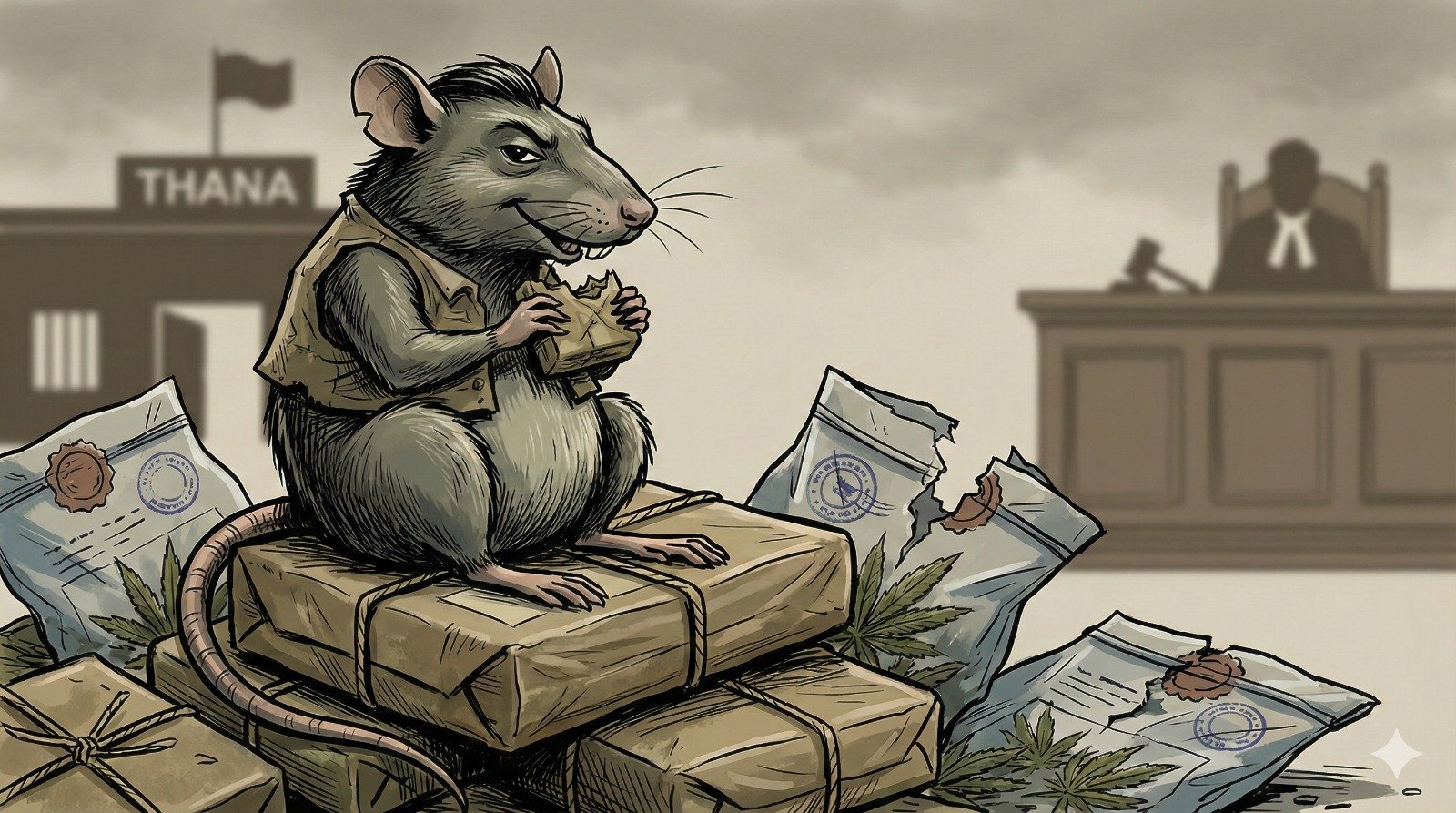

In January 2022, the Jharkhand Police appeared to have landed a significant catch. Acting on a tip-off, officers from Ormanjhi police station intercepted a white Bolero on National Highway–20, allegedly transporting a large consignment of narcotics from Ranchi toward Ramgarh. As the vehicle was stopped, three men attempted to flee. One—26-year-old Indrajeet Rai, also known as Anurjeet Rai—was apprehended. Two others escaped.
A search of the vehicle, police said, yielded nearly 200 kilograms of ganja, packed in about 170 packets concealed in specially designed compartments. An FIR was registered under stringent provisions of the Narcotic Drugs and Psychotropic Substances (NDPS) Act, invoking sections that carry severe penalties. Rai was arrested and remained in custody as the prosecution prepared what seemed, on paper, to be an open-and-shut case.
But three years later, in a Ranchi courtroom, the case collapsed—not because the ganja was proven nonexistent at the time of seizure, but because it was no longer available at all.
Only Two Weeks Left to Register for India’s Premier Data Protection Officer Programme
“Destroyed by Rats”: The Explanation That Changed Everything
As the trial progressed, the prosecution’s narrative began to fray. Witness testimonies contradicted one another on basic facts: who intercepted the vehicle, the exact location of the seizure, how long the search lasted, and even who detained the accused. No independent public witnesses were examined, despite the alleged seizure taking place on a busy national highway flanked by residential areas.
Then came the most damaging disclosure.
The prosecution informed the court that the seized ganja, stored in the malkhana of Ormanjhi police station, had been destroyed by rats. A station diary entry from 2024 was produced to support the claim. The contraband—valued at approximately ₹1 crore, based on prevailing estimates of ₹50,000 per kilogram—was gone.
The court was unimpressed. Calling the explanation a case of “gross negligence,” it noted that the police had failed in their basic duty to safeguard seized material. With the chain of custody broken and no material evidence left to examine, the prosecution’s case was fatally compromised.
In its order dated December 19, 2025, the special NDPS court acquitted Indrajeet Rai of all charges, holding that the benefit of doubt must go to the accused.
Procedural Lapses, Missing Links, and a Broken Chain
Beyond the missing contraband, the judgment catalogued a series of procedural failures that, taken together, painted a picture of systemic laxity.
The court observed that the prosecution failed to establish any credible link between the accused and the seized vehicle. No documentary evidence was produced to show that the Bolero was associated with Rai. During cross-examination, the investigating officer admitted that the vehicle allegedly seized did not have a recorded engine or chassis number—an omission neither documented in the case diary nor reported to transport authorities.
Sampling and sealing procedures were equally opaque. Witnesses could not clearly state when samples were drawn, how they were marked, or how they were preserved. These gaps, the court noted, rendered the seizure, storage, and sampling process unreliable.
Most damaging of all was the prosecution’s own admission that the seized narcotics had been destroyed while in police custody—an assertion that, in the court’s words, “casts a suspicion on the very seizure of the case and its handling by the police.”
A Pattern That Raises Larger Questions
The Ranchi acquittal has triggered wider unease about how high-value seized materials are stored and safeguarded by law enforcement agencies. The case is not an isolated embarrassment.
Earlier this year, a similar explanation surfaced in Dhanbad, where officials claimed that rats had consumed liquor stored in government warehouses, leaving behind empty or half-filled bottles with chewed caps. That incident, too, raised eyebrows, even if the stakes were lower than in a major NDPS prosecution.
Taken together, these episodes point to a troubling pattern: the casual erosion of evidentiary integrity in cases where procedure is not merely technical but foundational. Under the NDPS Act, strict compliance with seizure, storage, and documentation norms is not optional—it is the backbone of lawful prosecution.
For now, the official record shows that a narcotics case involving 200 kilograms of ganja ended not with a conviction, but with an acquittal prompted by rodents, record-keeping failures, and unanswered questions. The accused walked free. The contraband exists only in paperwork. And the court was left to deliver a verdict that read less like a legal technicality and more like a quiet indictment of institutional neglect.
In a justice system that relies on evidence, the disappearance of evidence—however explained—tends to speak louder than any witness ever could.
