
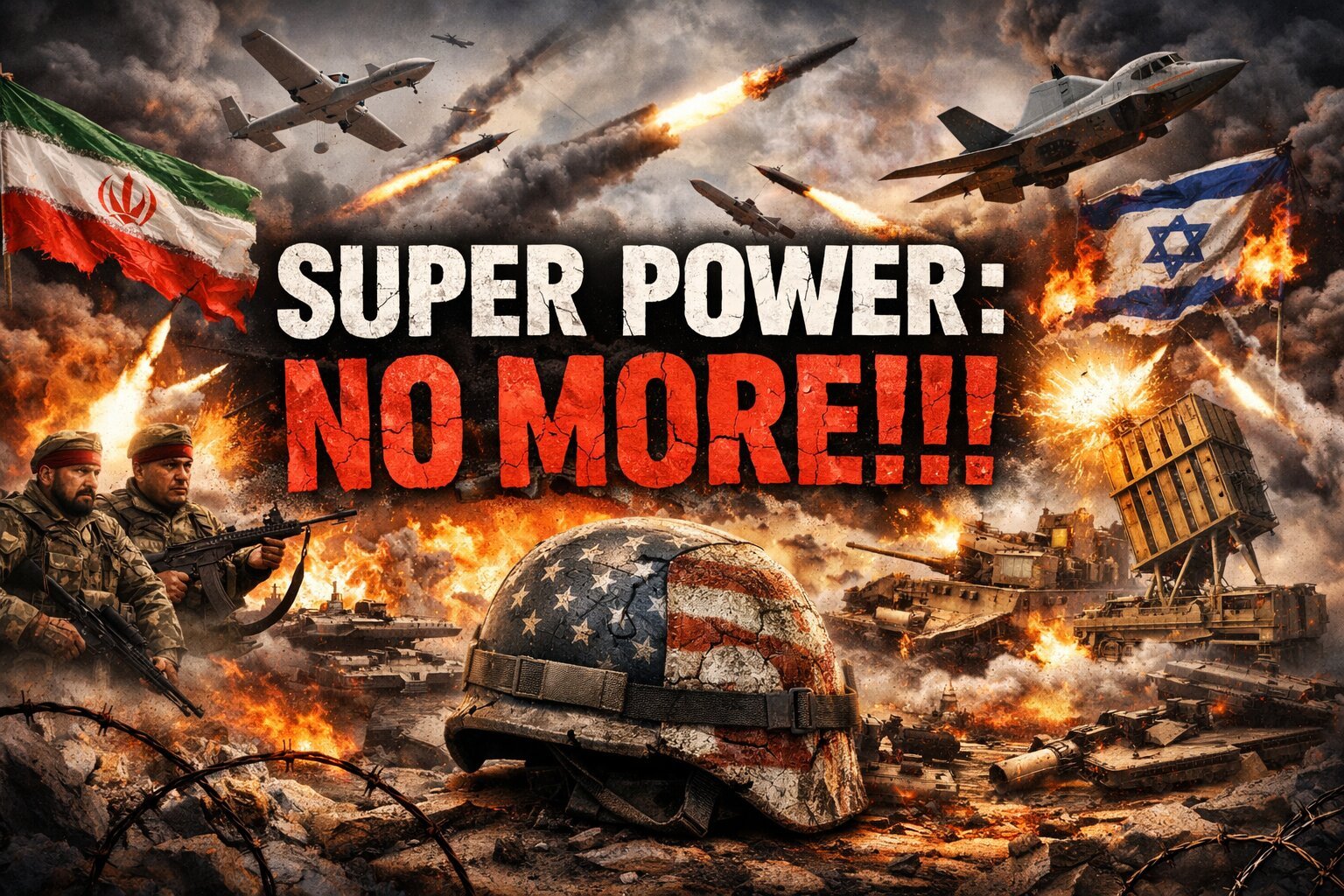

The evolving Iran–US–Israel confrontation has reignited a provocative global question: is the long-standing image of the United States as an unchallenged military superpower beginning to erode? While it would be premature to declare the end of American dominance, credible reporting from The Washington Post, Al Jazeera, and The New York Times suggests that recent battlefield dynamics have exposed notable weaknesses in even the most advanced defence technologies.
At the heart of this shift lies Iran’s strategic reliance on asymmetric warfare. Instead of matching the United States and Israel in high-end platforms like stealth jets or aircraft carriers, Iran has focused on scalable, low-cost systems—particularly drones and ballistic missiles. According to analyses highlighted in The Washington Post, Iranian-origin drones, including variants similar to the Shahed series, cost a fraction of Western interceptor missiles. This cost asymmetry has created a tactical dilemma: expensive air defence systems are being forced to counter waves of relatively cheap incoming threats, quickly straining resources.
Al Jazeera reporting further underscores how Iran has refined its tactics over time. Through repeated engagements, Tehran has adapted missile trajectories, launch patterns, and timing to probe and exploit gaps in air defence systems such as Iron Dome, Patriot, and THAAD. While these systems remain highly capable, they are not designed to guarantee a 100% interception rate—especially under saturation attacks involving dozens or hundreds of projectiles launched simultaneously. Over time, data has suggested that a higher percentage of incoming threats have been able to penetrate these defences, not because the systems have failed entirely, but because they are being pushed beyond optimal operational limits.
Another dimension highlighted in international coverage is Iran’s use of mixed attack strategies. By combining drones, cruise missiles, and sometimes cluster-type munitions, Iran increases the complexity of interception. Each category of threat requires different tracking and response mechanisms, complicating defensive coordination. As The New York Times notes, modern warfare is increasingly about overwhelming systems rather than outmatching them technologically.
However, interpreting these developments as a complete collapse of American military superiority would be misleading. The same reports emphasize that US and Israeli forces continue to maintain overwhelming advantages in intelligence, surveillance, precision strike capability, and global power projection. Iranian infrastructure and military assets have sustained significant damage in retaliatory strikes, underscoring that the broader balance of power still favors Washington and its allies.
What has changed, though, is the nature of vulnerability. The conflict reveals that even the most advanced and expensive military ecosystems can be stressed by persistent, lower-cost threats. This has broader implications: future conflicts may be less about direct technological competition and more about endurance, cost-efficiency, and adaptability.
In essence, the “myth” of invincibility—not the reality of power—has taken a hit. The United States remains a superpower by every conventional metric, but the Iran–US–Israel conflict demonstrates that dominance is no longer absolute. Instead, it exists within a more contested and dynamic battlefield environment where smaller or less technologically advanced actors can still impose significant strategic costs.
The lesson is clear: modern warfare is evolving, and with it, the very definition of power.
