

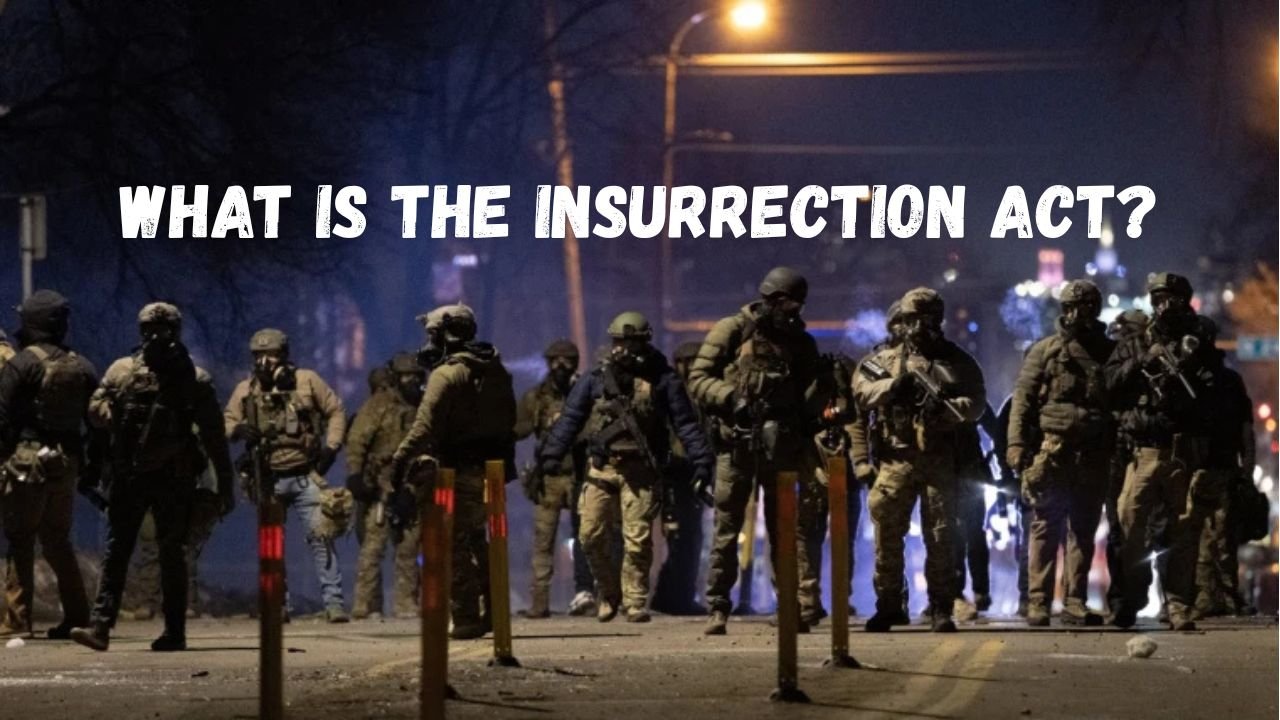

Washington | US President Donald Trump has once again threatened to invoke the Insurrection Act, a rarely used and highly controversial 19th-century law that allows the president to deploy the military within the United States to enforce federal authority. The warning comes amid escalating protests in Minneapolis, Minnesota, against large-scale operations by Immigration and Customs Enforcement (ICE).
Tensions intensified after a protester was killed in a shooting involving an ICE officer, followed by another person being injured during subsequent federal enforcement actions. The incidents triggered widespread unrest, with demonstrations turning violent in parts of the city. The Trump administration has accused the state government of failing to control the situation, arguing that federal intervention may be required to restore order.
Certified Cyber Crime Investigator Course Launched by Centre for Police Technology
What is the Insurrection Act
Enacted in 1807, the Insurrection Act authorises the US president to deploy active-duty armed forces and the National Guard inside the country under exceptional circumstances. The law allows such action when the president determines that “unlawful obstructions, combinations, or assemblages” make it impracticable to enforce federal law through normal judicial means.
Once invoked, the Act permits the military to perform roles typically reserved for civilian law enforcement — including crowd control, enforcement of federal orders, arrests and detention — powers that the armed forces are otherwise prohibited from exercising in domestic settings.
Why the law is controversial
The Insurrection Act has long drawn criticism because of its broad and loosely defined language. It does not clearly specify what constitutes an “insurrection” or the threshold of violence required for its activation. This ambiguity grants the president wide discretion, raising concerns over potential misuse.
Civil liberties groups and legal scholars argue that deploying troops against civilians risks undermining democratic norms and eroding the traditional separation between military and civil authority. Critics warn that the Act can be used to suppress dissent rather than address genuine threats to public safety.
Why Trump wants to use it
Donald Trump has consistently taken a hardline stance on immigration, framing border control and immigration enforcement as matters of national security. During his election campaign and after beginning his second term in January 2026, he repeatedly described the situation at the southern border as a “national emergency”.
The ongoing protests in Minneapolis against ICE operations have been labelled by the administration as “organised lawlessness”. Trump has stated that if state authorities are unable or unwilling to restore order, the federal government would step in — including through military deployment if necessary.
When has it been used before
The Insurrection Act has been invoked only a handful of times in US history:
- President Abraham Lincoln relied on it during the Civil War to counter secessionist uprisings.
- In the post-war period, President Ulysses S Grant used the Act to suppress violence by the Ku Klux Klan.
- In 1957, President Dwight D Eisenhower deployed federal troops to Little Rock, Arkansas, to enforce school desegregation orders.
- In 1992, President George H W Bush sent active-duty troops to Los Angeles following riots sparked by the Rodney King verdict.
Are there legal limits
Traditionally, the US military is barred from routine domestic policing under the Posse Comitatus Act of 1878, which restricts the use of armed forces for civilian law enforcement. The Insurrection Act, however, serves as a key exception to that rule.
Trump has previously relied on emergency powers in areas such as immigration, trade tariffs and federal enforcement actions, many of which faced legal challenges. Any formal invocation of the Insurrection Act is expected to be swiftly contested in court.
What happens if the Act is invoked
If Trump formally activates the Insurrection Act, it would almost certainly trigger a major legal and political confrontation. The move would test the balance between federal authority, states’ rights and civil liberties, potentially setting a precedent for how internal unrest is handled in the future.
Legal experts say the issue extends beyond immediate law-and-order concerns, raising fundamental questions about the limits of presidential power during domestic crises and the role of the military in a democratic society.
About the author — Suvedita Nath is a science student with a growing interest in cybercrime and digital safety. She writes on online activity, cyber threats, and technology-driven risks. Her work focuses on clarity, accuracy, and public awareness.
