

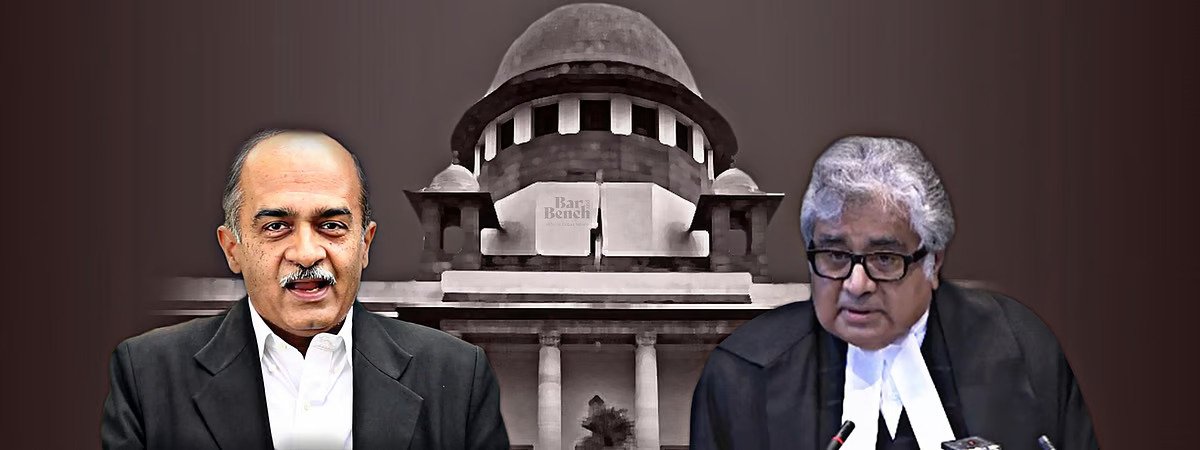

In the marbled courtroom of India’s Supreme Court, what began as a procedural hearing soon became a legal spectacle. During arguments over a Citizens Whistle Blower Forum plea seeking a Special Investigation Team probe into Indiabulls Housing Finance Ltd. (IHFL), senior advocates Harish Salve and Prashant Bhushan engaged in a rare public confrontation.
Salve, appearing for Indiabulls from London via video conferencing, accused the petitioner-forum of being driven by “blackmail motives.” Bhushan, representing the Forum, shot back, questioning the “audacity” of such a statement from “someone sitting in London.” The courtroom murmured as Bhushan retorted that Salve, “while abroad, may not even know what the affidavits say.”
FCRF Launches CCLP Program to Train India’s Next Generation of Cyber Law Practitioners
Unfazed, Salve countered: “Whichever city you are sitting in, you can read an affidavit written in simple English.” The exchange — sharp, personal, and laced with irony — encapsulated a deeper tension: the collision between India’s public-interest litigation culture and corporate law’s elite defenses.
Allegations of Massive Irregularities and Regulatory Lapses
At the heart of the petition lies a stunning claim: a company with a net worth of just ₹1 lakh allegedly received a ₹1,000 crore loan from Indiabulls. Bhushan cited regulatory affidavits suggesting a web of “round-tripping” transactions and fund diversions through subsidiaries and associates of Indiabulls and its promoters, including Sameer Gehlaut, the company’s founder.
“Indiabulls, now known as Sammaan Capital, has given ₹400 crores in loans to several such shell companies,” Bhushan told the bench. “One firm of negligible worth was handed ₹1,000 crore. The money was misappropriated and laundered through related entities, leaving hundreds — perhaps thousands — of homebuyers defrauded.”
He further cited findings from the Securities and Exchange Board of India (SEBI), claiming that SEBI’s counter-affidavit had “substantiated the allegations we made.” The Ministry of Corporate Affairs (MCA), Bhushan added, had compounded over 200 violations in a single day, many concerning undisclosed related-party transactions.
Salve, representing Indiabulls, dismissed the accusations as “witch-hunting by strangers.” He argued that the Reserve Bank of India (RBI) had already filed an affidavit stating no irregularities had been detected in the company’s loan books. “Every rupee has come back,” Salve maintained.
Judicial Restraint Amid Sharp Rhetoric
As the verbal sparring continued, Justice Surya Kant, heading the three-judge bench with Justices Ujjal Bhuyan and N. Kotiswar Singh, intervened to restore calm. “We will not comment on this,” Justice Kant said lightly, smiling at the escalating rhetoric.
Other senior lawyers observing the proceedings weighed in. Mukul Rohatgi, appearing in another case the same day, quipped that both Salve and Bhushan should “argue from London next time,” drawing laughter across the courtroom. Later, Kapil Sibal called the exchange “unfortunate,” urging senior counsels to “set a better example.”
Dr. Menaka Guruswamy, also present, noted that while advocates may argue freely, judges cannot — lest their words be misinterpreted on social media. “If your lordships said anything,” she remarked, “it would be on social media within minutes. So only we can say.”
Despite the tension, the bench maintained composure, steering the hearing back to the central issue: the scale of alleged financial wrongdoing and the appropriate institutional response.
Court Orders Fresh Clarifications from ED and MCA
As the arguments concluded, the bench directed the Enforcement Directorate (ED) to file a detailed affidavit clarifying its position in light of the Central Bureau of Investigation’s (CBI) findings, which had already suggested “serious prima facie irregularities.” The justices also summoned a senior MCA officer to appear with original records, remarking pointedly:
“We would like to see in how many cases you have been so magnanimous in closing hundreds of objections.”
Bhushan reiterated that Sameer Gehlaut had fled the country and was living in London, evading CBI summons in the Yes Bank case. Salve objected sharply: “What do you mean fled? There is nothing in the chargesheet.”
The Court stopped short of passing any coercive order but made clear that the corporate regulatory system itself was under the microscope. With both SEBI and CBI having found apparent irregularities — and ED now tasked to explain its position — the case has expanded beyond one company to expose systemic cracks in India’s financial oversight mechanisms.
For now, the courtroom confrontation between two of India’s most celebrated lawyers has illuminated a larger national debate — about corporate transparency, regulatory accountability, and the uneasy line where advocacy ends and influence begins.
