
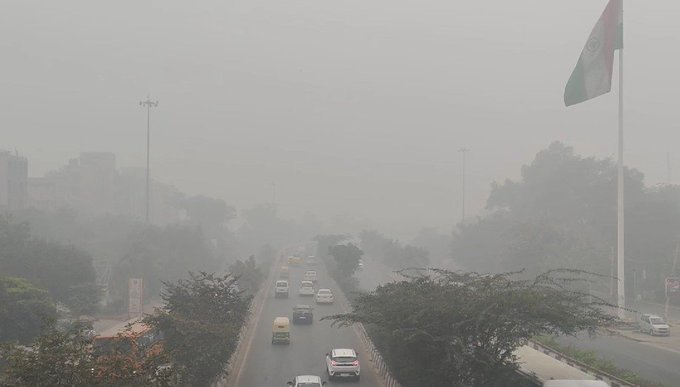

For years, Delhi has been synonymous with choking smog and hazardous air quality readings. Each winter, the headlines return, framing the capital as the epicenter of India’s pollution crisis. But environmental researchers say the narrative now demands a wider lens.
New data suggests that air quality in several states across north, east, and northeast India is deteriorating rapidly, revealing a pattern of industrial emissions, vehicular congestion, crop-residue burning, and construction dust far beyond Delhi’s borders.
Recent studies reviewed show that cities and districts in Assam, Bihar, Haryana, Uttar Pradesh, Tripura, Rajasthan, and West Bengal are emerging as severe air pollution hotspots — many for the first time.
New Airsheds Identified Across Seven States
Researchers analyzing multi-year AQI and particulate matter data have identified high-risk airsheds — geographical zones where pollution from different districts and states converges, creating persistent toxic pockets.
These hotspots include:
- Industrial clusters in Assam and Tripura
- Rapidly expanding peri-urban belts in Haryana and Uttar Pradesh
- High-density corridors in Bihar and West Bengal
- Arid-zone towns in Rajasthan experiencing amplified dust pollution
Environmental experts say these airsheds now display pollution levels comparable to or approaching those of Delhi, particularly during peak winter months when atmospheric inversion traps pollutants close to the ground.
“What we are seeing is the emergence of a multi-state pollution arc,” one researcher involved in the study said. “These regions are no longer seasonal outliers — they are becoming chronic hotspots.”
Policies on Paper, Weak Enforcement on the Ground
While many states have drafted pollution mitigation strategies — ranging from industrial emissions norms to restrictions on open burning — experts warn that implementation remains sporadic or symbolic.
“There are policies, but no monitoring,” a senior environmental scientist told.
On the ground, monitoring stations are sparse or outdated, enforcement teams are understaffed, and penalties often go uncollected. As a result:
- Industrial emissions frequently exceed permissible limits.
- Urban construction sites operate without dust-control measures.
- Peripheral agricultural districts continue to rely on stubble burning.
- Public reporting of local air quality remains patchy or non-functional.
In several districts identified in the studies, officials conceded off-record that they lack both the technical capacity and political backing to enforce air-quality norms consistently.
A National Challenge in Need of Regional Solutions
The spread of pollution hotspots across states complicates policy responses. Air does not respect administrative boundaries, and mitigation in one city often depends on action taken hundreds of kilometres away.
Environmental governance experts argue that India must strengthen airshed-level planning, enabling coordinated measures across multiple districts and states — similar to models used in California and parts of Europe.
They also warn that without such coordination, rising pollution in emerging hotspots will worsen respiratory diseases, strain public hospitals, and deepen climate vulnerabilities.
While Delhi continues to draw global attention, the new data makes clear that India’s air pollution crisis is far broader, more complex, and more urgent than previously understood.
The challenge, researchers say, is no longer just cleaning Delhi’s air — it is preventing the rest of India from becoming the next Delhi.
