


New Delhi — The Indian government on Monday formally released its first National Counter Terrorism Policy and Strategy, a document years in the making that officials describe as a comprehensive blueprint for confronting threats ranging from cross-border militancy to cyberattacks and drone-enabled operations.
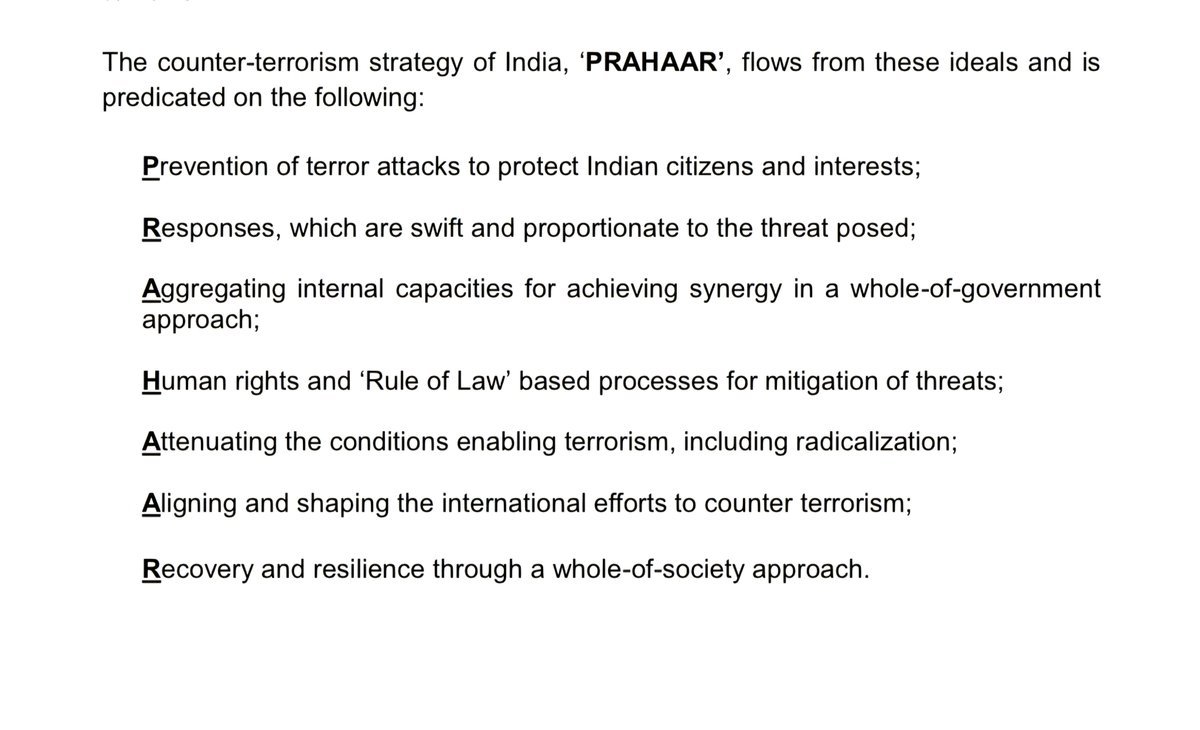
Issued by the Union Ministry of Home Affairs (MHA), the policy, titled “PRAHAAR,” was uploaded to the ministry’s website and presented as a unified framework for prevention, disruption and prosecution of terrorist activities. The document emphasizes that India “does not link terrorism to any specific religion, ethnicity, nationality or civilisation,” even as it references longstanding concerns about “sponsored terrorism” emanating from across the border.
The policy underscores that India faces threats on multiple fronts — land, air and water — and notes that capacities have been developed to safeguard critical sectors of the economy, including power, railways, aviation, ports, defense, space and atomic energy, from both state and non-state actors.
Certified Cyber Crime Investigator Course Launched by Centre for Police Technology
Community Engagement and De-Radicalization
A significant portion of the document focuses on prevention, particularly countering radicalization among vulnerable populations.
It highlights the role of community and religious leaders, stating that moderate preachers and nongovernmental organizations are engaged to spread awareness about the adverse consequences of radicalization and extremist violence. Youth engagement is described as a key pillar, with young people “constructively engaged” to ensure that issues threatening peace and communal harmony are addressed early.
The policy also acknowledges concerns about radicalization within prisons. Prison staff, it says, are periodically cautioned to prevent hardened inmates from influencing vulnerable prisoners. De-radicalization programs are being undertaken, according to the ministry, though the document does not provide operational details.
Once individuals are identified as susceptible to extremist influence, the policy calls for a graded police response. Legal action, it says, is initiated based on the assessed level of radicalization, within what it describes as a “multi-stakeholder setting” aimed at comprehensively addressing violent extremism.
To strengthen prosecutions, the document recommends associating legal experts at every stage of investigation — from the registration of a First Information Report (FIR) through the culmination of prosecution — in order to build stronger cases against perpetrators of terrorism.
Cross-Border Networks and Global Links
The policy situates India’s security concerns within a broader transnational landscape. It states that terrorist groups based outside the country increasingly rely on local infrastructure, logistics networks and knowledge of terrain to launch attacks.
National measures, it argues, must be coupled with international and regional cooperation to address what it calls the “transnational terrorism challenge.”
The document refers to global terrorist organizations such as Al-Qaeda and the Islamic State of Iraq and Syria (ISIS), stating that India has been a target of such groups, which have attempted to incite violence through sleeper cells. It adds that violent extremists operating from foreign countries have conspired to promote terrorism within India.
According to the ministry, terrorist organizations continue efforts to recruit Indian youth. In response, intelligence and law enforcement agencies are described as having “continuously disrupted” such designs.
The policy also notes the increasing intersection between organized criminal networks and extremist groups, particularly in logistics and recruitment, suggesting a convergence of criminal and ideological motivations in facilitating attacks.
Technology, Cyber Threats and Emerging Risks
A prominent theme in the document is the evolving technological landscape of terrorism. Handlers operating across borders are described as using the latest technologies, including drones, to facilitate attacks in regions such as Punjab and Jammu and Kashmir. Terror groups, the policy states, are leveraging social media platforms and instant messaging applications for propaganda, communication, funding and operational guidance.
Encryption, the dark web and crypto wallets are cited as tools that allow such groups to operate anonymously. The ministry identifies the misuse of emerging technologies as a growing challenge for counterterrorism agencies.
The document specifically references the threat posed by CBRNED materials — chemical, biological, radiological, nuclear, explosive and digital — and notes that disrupting or intercepting efforts to access and deploy such materials remains a concern. It also flags the potential misuse of drones and robotics by both state and non-state actors for lethal purposes.
Beyond conventional terrorism, the policy acknowledges “Cyberattacks” as an expanding domain of risk. It states that criminal hackers and nation states continue to target India through cyber operations, underscoring the need to protect critical infrastructure in an increasingly digitized economy.
