

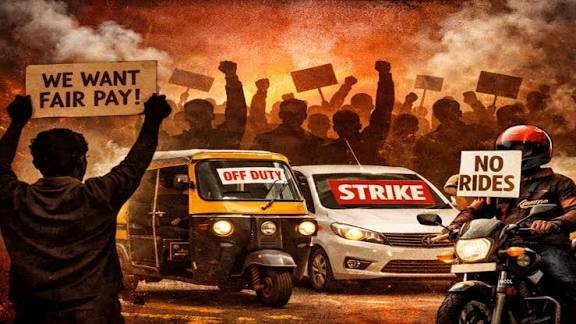

Across India’s cities, the apps that deliver food, groceries and transport have become everyday utilities. On February 7, that dependence will be tested, as thousands of drivers and delivery workers plan a nationwide shutdown to protest falling earnings, rising costs and what unions describe as prolonged policy inaction.
A Nationwide Shutdown Takes Shape
App-based drivers and delivery workers across India are preparing for a coordinated strike on February 7, 2026, in what unions are calling an “All-India Breakdown.” Workers linked to platforms such as Ola, Uber, Rapido, Porter, Swiggy, Zomato, Blinkit and Zepto are expected to log off en masse, raising the prospect of disruptions in urban transport, food delivery and quick-commerce services, particularly during peak hours in major cities.
Union leaders say participation is likely to be highest in metropolitan areas, where gig work has become a primary source of livelihood for millions. Delivery workers warn that if talks with companies and governments fail, disruptions could extend beyond a single day and recur more frequently in the months ahead, unsettling a gig economy that urban consumers now rely on daily.
Certified Cyber Crime Investigator Course Launched by Centre for Police Technology
What Workers Are Demanding
At the centre of the protest is a demand for government-notified minimum base fares under the Motor Vehicle Aggregator Guidelines, 2025. Workers and unions argue that despite the guidelines being in place, state governments have not notified or enforced base fares, allowing platforms to continue setting prices unilaterally.
Beyond base fares, workers are seeking transparent fare calculation, mandatory consultation with recognised unions before changes to pricing or incentive structures, social security benefits, and what they describe as fairer incentives and commissions. Many drivers say they are working longer hours for lower take-home pay, even as fuel prices, vehicle maintenance costs and insurance expenses continue to rise.
For many participants, the strike is framed not only as a dispute over wages, but as a demand for dignity and long-term stability in a sector that classifies them as independent contractors while exercising tight algorithmic control over their work.
A History of Protests and Falling Incomes
This is not the first time gig workers have taken to the streets. In earlier nationwide actions, delivery agents affiliated with the Indian Federation of App-Based Transport Workers (IFAT) alleged unfair wages, poor working conditions and the absence of social security. Workers said their earnings had declined steadily despite spending more hours on the road.
An Aam Aadmi Party Member of Parliament, speaking to ANI, described gig workers as the backbone of platform companies that have achieved unicorn valuations, while remaining among the most vulnerable in the ecosystem. He pointed to what he called a structural imbalance, with operational risks — fuel, repairs, insurance and unpaid waiting time — increasingly shifted onto workers, even as incentives are cut.
The Policy Gap at the Heart of the Dispute
Union leaders say the immediate trigger for the February 7 strike is the failure of governments to act on existing rules. Shaik Salauddin, Founder President of the Telangana Gig and Platform Workers Union (TGPWU) and Co-Founder and National General Secretary of IFAT, said platforms were exploiting delays in implementation of the Aggregator Guidelines, 2025.
“The guidelines clearly mandate consultation with recognised worker unions before fare fixation,” he said, arguing that the absence of notified base fares has made incomes unpredictable and unsustainable. According to unions, companies continue to fix fares on their own terms, leaving workers with little say in how much they earn.
If participation in the shutdown is widespread, commuters may face longer wait times for cabs, fewer Ola and Uber rides, delays in food deliveries, and disruptions in quick-commerce services. For workers, unions say, the strike is intended to force attention on a policy gap that has persisted despite formal rules — and to press for changes they argue are essential for the survival of India’s gig workforce.
