


New Delhi, February 2026: As cybercrime becomes more sophisticated—ranging from ransomware cartels and APT intrusions to AI-enabled fraud and critical infrastructure attacks—nations are quietly competing not only in cyberspace, but in how they train their cyber police. A detailed review of Chinese cyber police training material reveals a highly structured, simulation-driven, and technically rigorous model. At the same time, India’s Centre for Police Technology (CPT), along with MHA and I4C initiatives, is attempting to build an indigenous training architecture capable of matching—and potentially surpassing—global standards.
Inside China’s Cyber Police Training Architecture
Open-source tender documents and course outlines from Chinese police academies, particularly institutions functioning under the Ministry of Public Security, indicate a centralized and technology-intensive approach. The Xinjiang Police Academy is frequently referenced as a key cyber policing hub, offering an integrated cyberspace security training platform.
Certified Cyber Crime Investigator Course Launched by Centre for Police Technology
The Chinese cyber police syllabus is built around core cybersecurity fundamentals and layered operational simulations. Key modules include:
- Network Security: Understanding TCP/IP architecture, packet inspection, firewall deployment, IDS/IPS configuration, intrusion detection, lateral movement detection, and network segmentation. Officers are trained to monitor enterprise-scale networks and identify anomalies.
- Operating Systems: In-depth exposure to Windows and Linux internals, log analysis, privilege escalation detection, kernel behavior, and forensic artifact extraction.
- Web Application Security: SQL injection, cross-site scripting (XSS), CSRF exploitation, authentication bypass techniques, and web shell detection. Hands-on lab exercises simulate compromised websites.
- Cryptography: Encryption algorithms, public key infrastructure, hashing, digital signatures, cryptanalysis basics, and encryption misuse detection in criminal networks.
- Network Attack & Defence: Red–Blue team simulations form the backbone of this module. Trainees simulate real attack vectors using frameworks like Cobalt Strike (for defensive study), exploit kits, phishing infrastructure, and post-exploitation techniques.
- Vulnerability Exploitation: Zero-day awareness, vulnerability scanning, exploit development basics, patch management strategies, and defense against browser-based zero-day attacks (including Chrome vulnerabilities).
- Intelligence Gathering: Structured OSINT techniques, metadata analysis, social network mapping, and automated web crawling tools.
- Online Public Opinion Monitoring: A distinctive module where officers are trained in sentiment analysis, social media monitoring, and data-driven public opinion assessment to maintain law and order.
- Online Fraud Scenarios: Simulated attacks on banks, educational campuses, communication platforms such as RocketChat, and digital payment ecosystems. Officers are trained to trace mule accounts and digital money trails.
- Critical Infrastructure Protection: Scenario-based simulations involving attacks on power grids, financial institutions, and municipal cloud systems.
- Advanced Persistent Threat (APT) Scenarios: Study of groups such as Ocean Lotus (APT32) and White Elephant, including attack chains, command-and-control behavior, and lateral movement techniques.
- Malware & Android Trojan Analysis: Reverse engineering basics, spyware detection, mobile compromise investigation, and app-based surveillance analysis.
The distinguishing feature of the Chinese system is not merely subject coverage, but structured simulation labs, extended practical hours, and centralized curriculum enforcement.
India’s Current Landscape: Momentum with Gaps
India faces an unprecedented surge in cybercrime—investment fraud, digital arrest scams, VoIP spoofing, crypto laundering, APK-based malware attacks, and AI deepfake fraud. While the Ministry of Home Affairs (MHA) and the Indian Cyber Crime Coordination Centre (I4C) have strengthened reporting mechanisms and launched programs such as Cyber Commando training, capacity disparities persist across states.
Challenges include inconsistent syllabi, shortage of experienced trainers, limited lab infrastructure, low honorarium discouraging private experts, and insufficient red–blue simulation exposure.
CPT’s 35-Domain Expansion: A Decentralized, Accessible Alternative
Learning from structured international modules, the Centre for Police Technology (CPT) has launched free online tutorials across more than 35 operational domains. Unlike purely academic training, CPT emphasizes techno-legal integration and field applicability.
Domains include:
• Disk Forensics
• Mobile Forensics
• Video/CCTV/DVR Forensics
• Audio Forensics
• GPS Forensics
• Vehicle Forensics
• Drone Forensics
• Dark Web Forensics
• Face Forensics
• OSINT
• E-Discovery
• Document Tampering Detection
• Photo/Image Forensics
• AML/CTF Investigation
• Banking Data Investigation
• Cell Site Analysis
• Forensic Workstation Setup
• Information System Audit
• Forensics Audit
• Quantum Cryptography
• Steganography
• Web Browser Forensics
• Password Recovery
• CDR/IPDR/PCAP Analysis
• Big Data Analytics
• Email Forensics
• Network Forensics
• Malware Forensics
• Cyber Forensics Van Operations
• Predictive Policing
• Case Management
• Social Media Analytics
• Damaged Media Forensics
• Memory Forensics
• AI/Deepfake Forensics
• Crypto/Blockchain Forensics
• Cloud Forensics
• Child Sexual Abuse Material (CSAM) Forensics
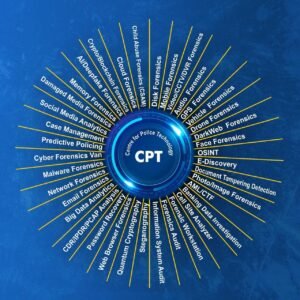
CPT complements these tutorials with a Skill Registry of vetted investigators, a Knowledge Exchange platform linking police with OEMs and researchers, and copsGPT, an AI-powered investigation assistant designed to support procedural documentation, notice drafting, and evidence pattern analysis.
How India Can Outpace the Chinese Model
While China’s model is centralized and simulation-heavy, India can create a more agile and globally benchmarked system by integrating:
1. National Cyber Police Certification Framework under MHA-I4C with tiered competency levels.
2. Mandatory Red–Blue Exercises aligned to Indian fraud typologies.
3. Incident Response & Ransomware War-Gaming Units in each state.
4. Enhanced Trainer Compensation & Visiting Fellowships for ethical hackers and forensic scientists.
5. AI-Driven Multilingual Investigation Tools expanding copsGPT capabilities.
6. Inter-State Digital Lab Grid for resource pooling.
7. Judicial-Police Joint Training Modules for admissibility of digital evidence.
8. Preventive Cyber Policing & Threat Intelligence Courses.
9. Advanced Crypto & Blockchain Tracking Labs.
10. Continuous Skill Audits and Competency Assessments.
The Strategic Edge
Chinese cyber police training emphasizes cybersecurity fundamentals, APT simulation, OSINT-based monitoring, and structured lab exercises. India’s opportunity lies in blending similar technical rigor with democratic accountability, privacy safeguards, judicial transparency, and AI-assisted efficiency.
With CPT’s 35-domain free tutorial mission, combined with MHA and I4C, NCRB, NPA, State Police Academy, NFSL, NFSU, RRU, State Forensic Labs, BPR&D institutional support, India has the ingredients for a distributed yet standardized cyber training ecosystem.
The next leap will depend not merely on infrastructure, but on structured curriculum, simulation realism, expert engagement, and sustained leadership commitment.
If executed with urgency, India will not just narrow the gap—it may define the next global template for modern, accountable cyber policing.
