
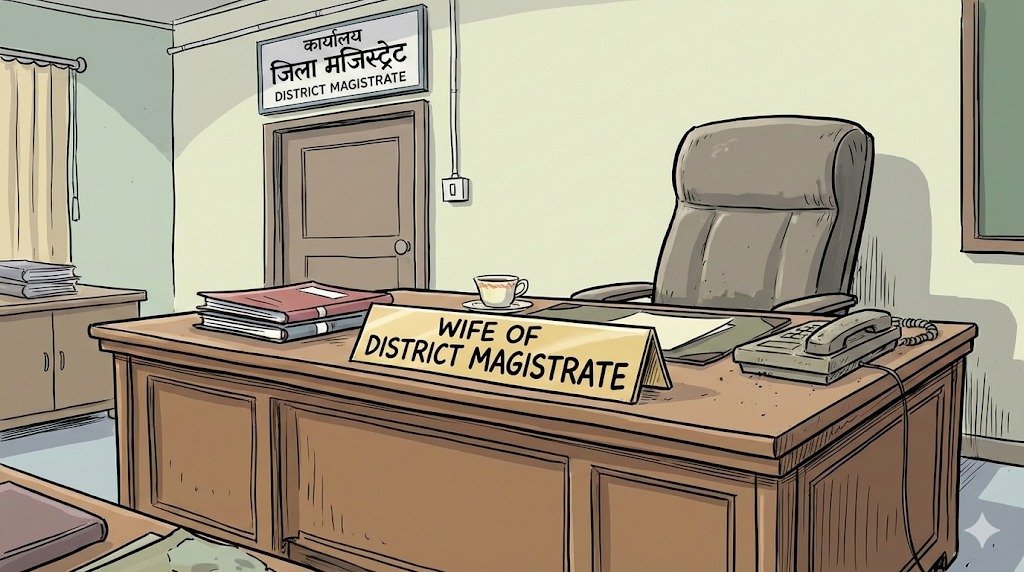

Bulandshahr, Uttar Pradesh — In India’s districts, authority often radiates beyond the formal powers of the District Magistrate. Over time, an informal convention took hold: the “DM’s wife” would preside over women’s welfare bodies, not by election or statute, but by proximity to office.
For Kalpana Gupta, a long-time member of the Zila Mahila Samiti in Bulandshahr, that assumption crossed a line. The Samiti, founded in 1957 on government-leased land, was meant to be run by and for widows, orphans and poor women. Yet its bye-laws placed the district magistrate’s wife as ex-officio president — a position of influence in a body designed to empower the marginalised.
In 2022, Gupta and other members pushed back. They sought to amend the bye-laws, arguing that the automatic elevation of an officer’s spouse blurred the boundary between administration and association. What followed was not merely an internal dispute, but a test of how deeply informal privilege is embedded in local governance.
Courts, Conventions and the Weight of Power
The challenge was first blocked by the deputy registrar, who annulled the Samiti’s attempt to revise its rules. From there, the case moved to the Allahabad High Court and ultimately to the Supreme Court of India.
Before the court, the issue crystallised into a broader question: could a welfare cooperative reserve its top post for the spouse of the district’s most powerful official?
The judges were unsparing. They described the “DM’s wife” clause as “atrocious,” “insulting,” and reflective of a “colonial-era mindset.” The court made clear that no individual acquires authority in a public-facing body by virtue of marriage alone — and that welfare institutions cannot become extensions of administrative households.
The ruling has since prompted the Uttar Pradesh government to revisit the Societies Registration Act, 1860, aiming to override bye-laws that hard-wire such privileges into local bodies.
Inside the Samiti: Control, Conflict and Consequences
The legal battle unfolded alongside an internal struggle that disrupted the Samiti’s work. Workers described months of paralysis, stalled projects and growing mistrust. Nisha, a masala grinder who had worked there for a decade, said she was abruptly told not to return after protesting against the shutdown of operations.
Others alleged that decisions were being taken unilaterally, with little consultation. Supporters of the old system countered that the presence of an official’s spouse provided protection against misuse and ensured administrative backing.
Even within the civil services, views diverged. Some officers described the practice as a benign convention, honorary and non-statutory. Others said they had never encountered such roles during postings across states — and questioned why any public function should bypass due process.
A Ruling With Wider Ripples
When the Supreme Court finally settled the matter, the Samiti reopened. Workers returned. Spice grinding resumed. The symbolism, however, travelled far beyond Bulandshahr.
The judgment has triggered a statewide audit of societies where wives of senior officials are automatically named presidents or patrons — not only in Zila Mahila Samitis, but also in district-level women’s committees and affiliated bodies.
For Gupta, the outcome was less about removing an individual than reclaiming an institution. “To run the Samiti smoothly, we had to go to two courts and make repeated visits,” she said. “Now we can finally run it without interference.”
What began as a local objection has become a rare public confrontation with a form of privilege that rarely names itself. In dismantling it, the court has not merely redrawn the rules of one women’s cooperative — it has questioned how power seeps into public life, quietly, through family ties rather than democratic choice.
