


Earlier this month, the group known as Handala Hack Team claimed responsibility for a cyberattack that disrupted operations at Stryker, a Michigan-based manufacturer of medical devices and healthcare technologies.
According to accounts of the incident, the attackers asserted that they had deleted large volumes of company data, forcing the firm to undertake urgent system recovery measures. The disruption, they said, affected operations for approximately a week.
U.S. authorities later moved to counter the group’s activities. The Federal Bureau of Investigation and the U.S. Department of Justice seized several domains linked to the group in mid-March, part of a broader effort to disrupt its online infrastructure. Despite the action, the group was reported to have quickly re-established its digital presence.
FCRF Launches Premier CISO Certification Amid Rising Demand for Cybersecurity Leadership
Federal Response and Escalating Countermeasures
Officials described a coordinated response to the group’s operations, combining law enforcement actions with public advisories.
Authorities confirmed that four websites associated with the group had been taken offline. Legal filings from federal investigators characterized Handala’s operators as part of a broader conspiracy involving the deployment of destructive malware.
The U.S. government has also announced a reward of up to $10 million for information that could help identify members of the group, reflecting the seriousness with which officials view the campaign.
These measures signal an intensifying effort to confront cyber actors whose operations extend beyond financial crime into areas of disruption and strategic messaging.
A Personal Breach at the Top of Law Enforcement
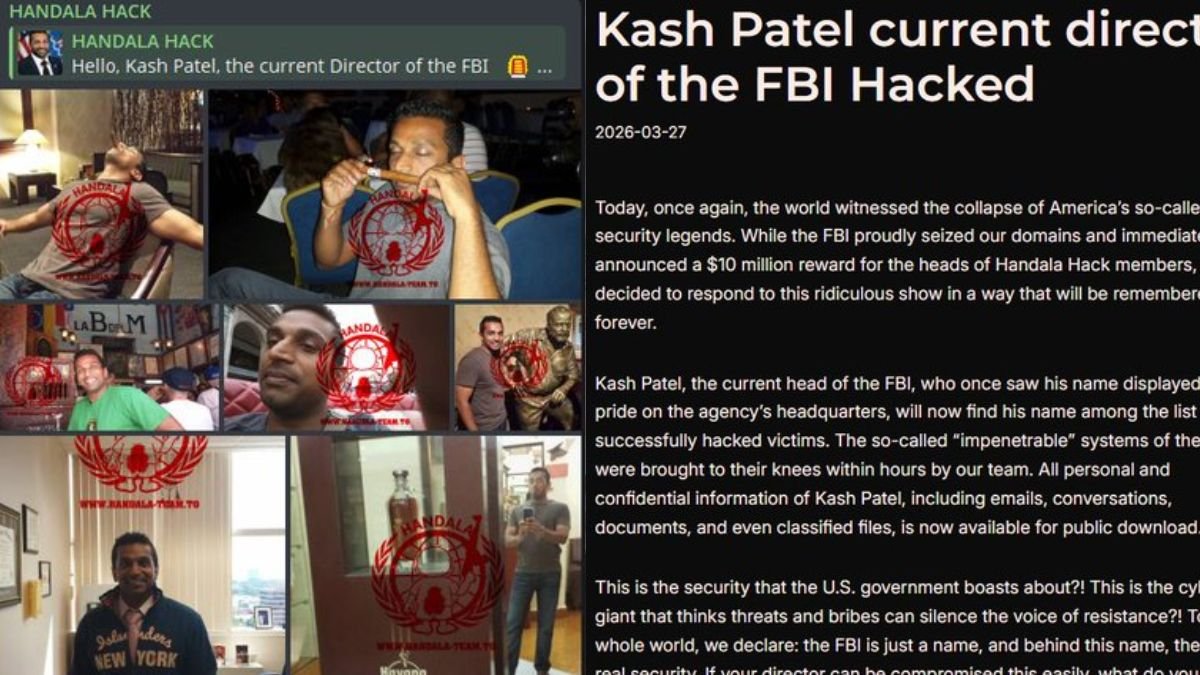
In a separate but related development, the group claimed to have breached the personal email account of Kash Patel, director of the FBI, and published a collection of personal photographs and documents online.
According to a report by Reuters, a Justice Department official confirmed that Patel’s email had been compromised and that the materials released appeared authentic. The dataset included a mix of personal and work-related correspondence dating from 2010 to 2019.
Among the released materials were personal photographs, including images of Patel in informal settings. Officials have maintained that the compromised data did not involve classified government information.
The breach marked a rare instance of a sitting U.S. law enforcement chief being directly targeted in a cyber intrusion of this nature.
A Pattern of Hybrid Cyber Operations
Security analysts say the Handala group has gained visibility for targeting U.S. government officials, private companies, and critical infrastructure, often combining cyberattacks with online messaging campaigns.
The group identifies itself as a pro-Palestinian hacktivist collective, though cybersecurity researchers have linked it to broader networks associated with Iranian state interests. Its operations have included data destruction, leaks of sensitive information, and attempts to amplify psychological impact.
The attack on Stryker and the breach involving Patel’s email reflect a broader pattern in which cyber operations are used not only to disrupt systems but also to shape narratives and signal geopolitical intent.
Investigators and analysts continue to examine the group’s activities, including its methods of access, use of infrastructure, and coordination across multiple targets, as part of ongoing efforts to understand and contain the evolving threat.
