
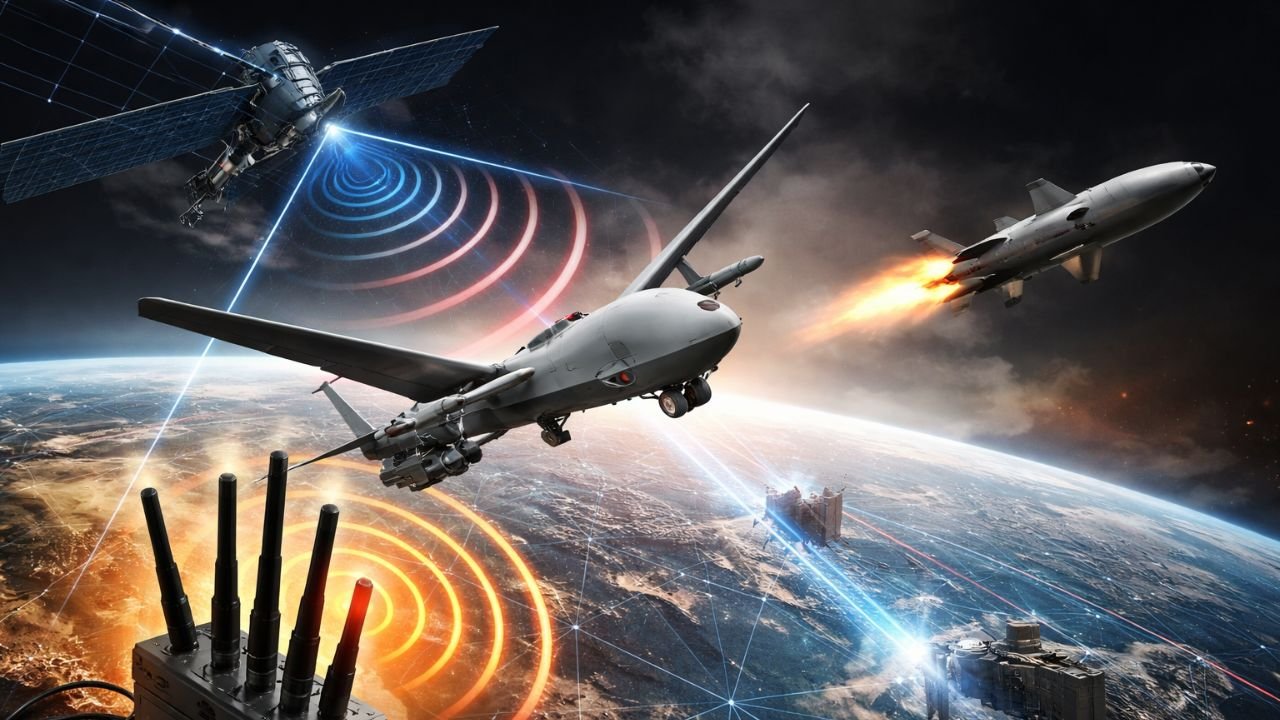

New Delhi | Amid rising global military tensions, the nature of warfare is rapidly evolving, with technology playing an increasingly decisive role. In recent developments, a technique known as “GPS jamming” has come into sharp focus, significantly altering combat strategies. Reports indicate that the use of this technology is causing drones and missiles to deviate from their intended targets, weakening enemy capabilities without direct confrontation.
What is GPS Jamming and Why It Matters
GPS jamming is an electronic interference technique designed to disrupt signals from the Global Positioning System (GPS). It can manipulate or completely block location data for GPS-dependent devices such as mobile phones, vehicle navigation systems, drones, and military equipment.
In simple terms, the technology confuses devices, preventing them from functioning accurately. This is why it is increasingly being viewed as a “silent weapon” in modern warfare—capable of inflicting significant damage without any physical explosion.
FutureCrime Summit 2026: Registrations to Open Soon for India’s Biggest Cybercrime Conference
How the Technology Works
GPS jamming operates by transmitting high-frequency radio signals that overpower genuine GPS signals. Normally, GPS devices receive weak signals from satellites to determine their position. However, when a jamming device emits stronger, fake signals, the real ones get suppressed.
As a result, the device processes incorrect data, leading to misdirection. This is particularly critical for drones and missiles, which rely heavily on precise navigation. In such cases, they may stray off course or lose control entirely, making this technology highly effective in neutralizing enemy strategies.
Rising Use in Warfare: A Cost-Effective Alternative
Experts suggest that GPS jamming is emerging as a cost-effective and efficient alternative to conventional military attacks. It allows forces to disable advanced enemy weaponry without engaging in direct combat.
Recent conflicts have shown instances where drones and missiles veered off their intended paths and landed kilometers away from their targets. Such incidents are widely attributed to disruptions in GPS signals, highlighting the growing importance of electronic warfare in modern conflicts.
Potential Impact on Civilian Life
The effects of GPS jamming are not limited to battlefields—they can also disrupt everyday civilian life. In areas where GPS signals are interfered with, smartphones may display incorrect locations. Services like ride-hailing, navigation apps, and delivery platforms can also be affected.
Moreover, aviation and maritime navigation systems may face disruptions, increasing safety risks. This is why many countries have implemented strict regulations and monitoring mechanisms regarding the use of such technologies.
A Growing Threat in the Future
According to technology experts, as the world becomes more dependent on satellite-based and digital systems, the risks associated with GPS jamming are expected to intensify. The threat may extend beyond warfare into broader cyber and electronic attack domains.
This presents a major challenge for security agencies and tech companies, which must develop resilient systems capable of operating accurately even under signal interference. For now, GPS jamming has made one thing clear: future wars will not only be fought with weapons, but also through control over signals and technology.
