

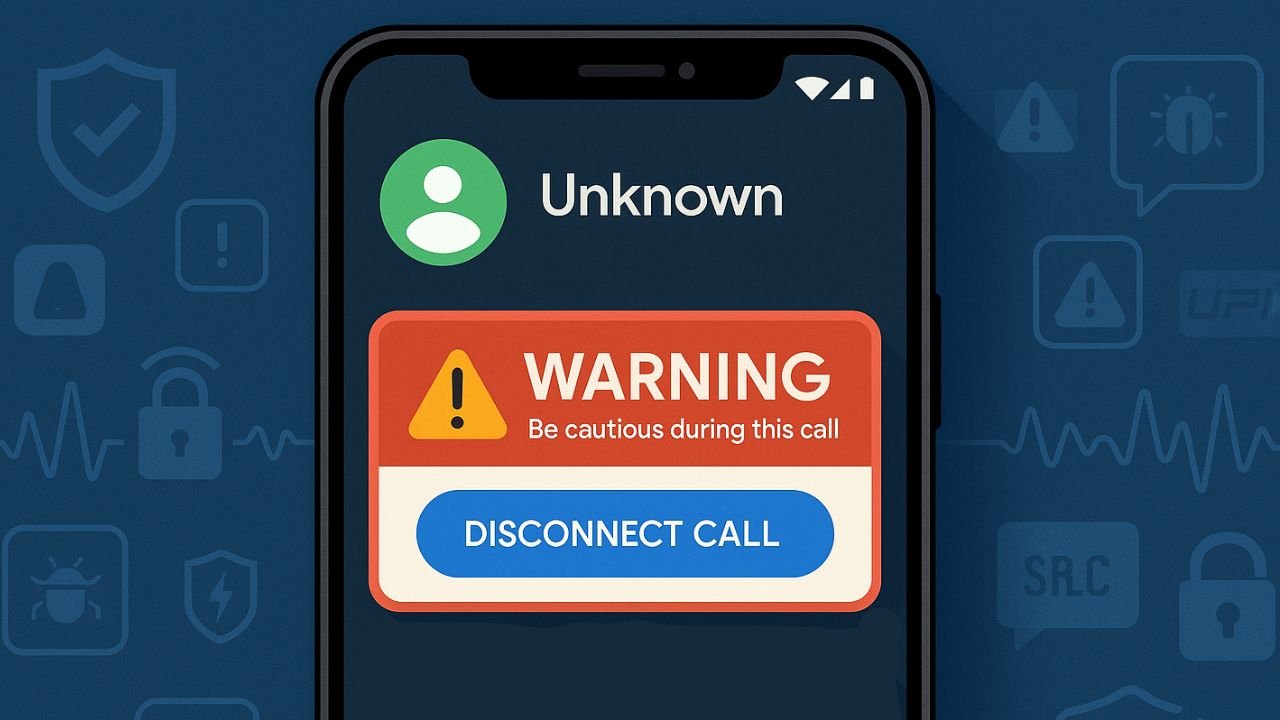

New Delhi: With call-based fraud and screen-sharing scams on the rise, Google has announced a significant upgrade to Android’s security framework. The company is strengthening its In-Call Protection feature—designed to alert users in real time whenever they open a financial application while on a call with an unknown number.
The move aims to disarm scammers who often manipulate victims during live conversations and compel them to perform risky actions on their phones.
Real-Time Warning When a Financial App Opens; Option to Disconnect the Call
Google says the enhanced protection layer will work automatically in the background on supported Android devices. If a user is speaking to an unverified number and simultaneously opens a banking or payment application—such as a UPI app, digital wallet, or mobile banking app—the system instantly displays a prominent warning.
The alert advises the user to carefully reconsider their action and recommends disconnecting the ongoing call. The company notes that scammers frequently maintain pressure during voice conversations, guiding targets step-by-step until they unknowingly compromise their accounts.
The ’30-Second Pause Period’: A Critical Window for Judgment and Safety
A unique component of the feature is a mandatory 30-second pause period. After the warning is triggered, the user cannot proceed further until the pause timer completes.
This cooldown window allows the user to:
- Reassess the situation calmly
- End the suspicious call
- Break free from the psychological influence of the scammer’s scripted instructions
- Avoid taking hasty actions such as sharing OTPs, granting screen access, or authorising payments
Google emphasises that this intentional slowdown has proven highly effective in interrupting social-engineering attacks, where fraudsters rely on urgency and continuous verbal pressure.
Proven Success in the UK: Thousands Shielded From Fraud Attempts
Google first introduced the feature as a limited pilot programme in the United Kingdom earlier this year. According to the company:
- Thousands of users were prompted to abandon risky calls
- Many were seconds away from sharing sensitive credentials or enabling screen-sharing
- A significant number of potential scams were prevented through timely on-screen alerts
These early results, Google says, validate the need for real-time intervention at moments when users are most vulnerable.
Pilots in India and Brazil; Broader Expansion Under Way
Following the UK rollout, Google conducted similar pilot implementations in major digital economies such as India and Brazil, where digital payments are deeply entrenched and fraud cases are rising steadily.
Encouraged by the positive outcomes, the company is now expanding the technology to a wider network of financial institutions and service providers across the UK. Wider availability—including for users in India—is expected in subsequent phases as Google collaborates with ecosystem partners.
Why This Feature Has Become Critical
The rapid adoption of digital payments has been accompanied by unprecedented sophistication in scam operations. Fraudsters often:
- Pose as bank officials or support agents
- Demand remote-screen access
- Persuade users to open payment apps during live calls
- Extract OTPs, passcodes, or authorisation details under the guise of “verification”
Google argues that the point at which a user opens a financial app during a call is one of the most critical and high-risk moments. By interrupting this scenario with a forced delay and a clear warning, Android can break a scammer’s momentum.
