

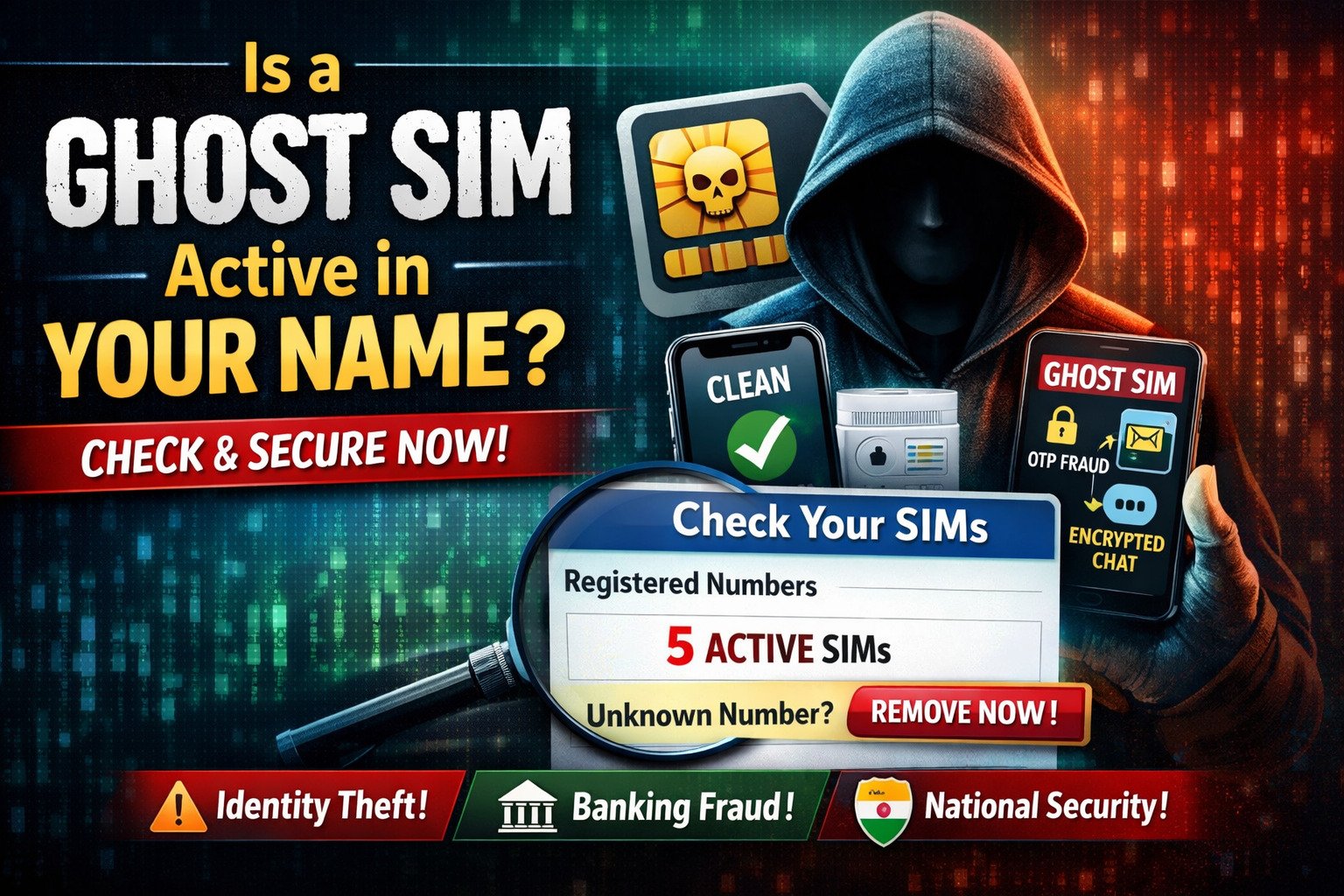
The terror plot uncovered around November 10, 2025 has once again brought the threat of “Ghost SIMs” into focus. According to investigating agencies, the suspects used SIM cards activated with fake KYC documents — making it difficult to trace their real identities.
These SIM cards were allegedly used for communication with cross-border handlers, encrypted chats, OTP frauds and trace-free calling. Investigators warn — the danger isn’t limited to terrorism; ordinary citizens can also be victims.
Final Call: FCRF Opens Last Registration Window for GRC and DPO Certifications
What is a Ghost SIM — and why is it dangerous?
A Ghost SIM is a mobile connection activated:
- using fake KYC
- with stolen Aadhaar/ID
- or through collusion between agents and fraud networks
Once activated, the real criminal hides — and the SIM runs in someone else’s name.
According to the Future Crime Research Foundation (FCRF):
“Ghost SIMs have become a major weapon in terrorism, investment fraud, OTP scams and social-engineering. The real criminal escapes — suspicion often falls on an innocent person.”
FCRF warns that once digital identity leaks, cyber-risk multiplies rapidly.
The dual-phone strategy: one ‘clean’, one ‘shadow’
Investigations revealed many suspects followed a dual-phone model:
- Phone 1 — genuine KYC, used for family and official work
- Phone 2 — Ghost SIM, used only for encrypted apps and suspicious contacts
This is why agencies often take longer to trace the real user behind such numbers.
Prof. Triveni Singh: “Identity theft is today’s biggest silent crime”
Former IPS officer and cyber-crime expert Prof. Triveni Singh explains:
“Ghost SIMs exist only when someone’s identity or documents leak from somewhere. Identity theft is today’s biggest silent crime — people don’t even know until loans, frauds or SIM cards appear in their name.”
He stresses that strong KYC, regular audits and public awareness are essential to reduce the threat.
New rules: No valid SIM, no encrypted apps
Under the Telecommunication Act 2023:
- A KYC-verified active SIM is mandatory
- Only then can apps like WhatsApp, Telegram and Signal work fully
The goal — to prevent misuse of communication channels through fake identities.
A Ghost SIM may be active in your name — check it now
Don’t panic — just stay aware.
Checking on the Sanchar Saathi portal is simple:
1️⃣ Open the Sanchar Saathi website
2️⃣ Click Know Your Mobile Connections
3️⃣ Enter your mobile number + captcha
4️⃣ Login with OTP
5️⃣ See how many numbers are registered on your ID
If you spot an unknown number:
- Click “Not My Number / Not Required”
- Track the case through your Case ID
- If needed, file a complaint with the local cyber cell
FCRF advises:
“Check numbers registered in your name every 3–6 months — the earlier you report, the less the damage.”
Safety checklist — experts’ recommendations
1. Never share photos of your ID/Aadhaar with unknown people
2. Avoid scanning documents at public printers/cyber cafés
3. Never share KYC or OTP links
4. Keep records of closed/unused SIMs
5. Report suspicious calls or messages immediately
Bottom line
A Ghost SIM isn’t just a technical term — it’s a real danger.
Your identity, banking data and national security can all be affected.
Experts agree — strong laws, secure technology and aware citizens are the three real shields.
Check how many SIMs are active in your name — right now.
Because sometimes, a small mistake can become very expensive.
About the author – Ayesha Aayat is a law student and contributor covering cybercrime, online frauds, and digital safety concerns. Her writing aims to raise awareness about evolving cyber threats and legal responses.
