

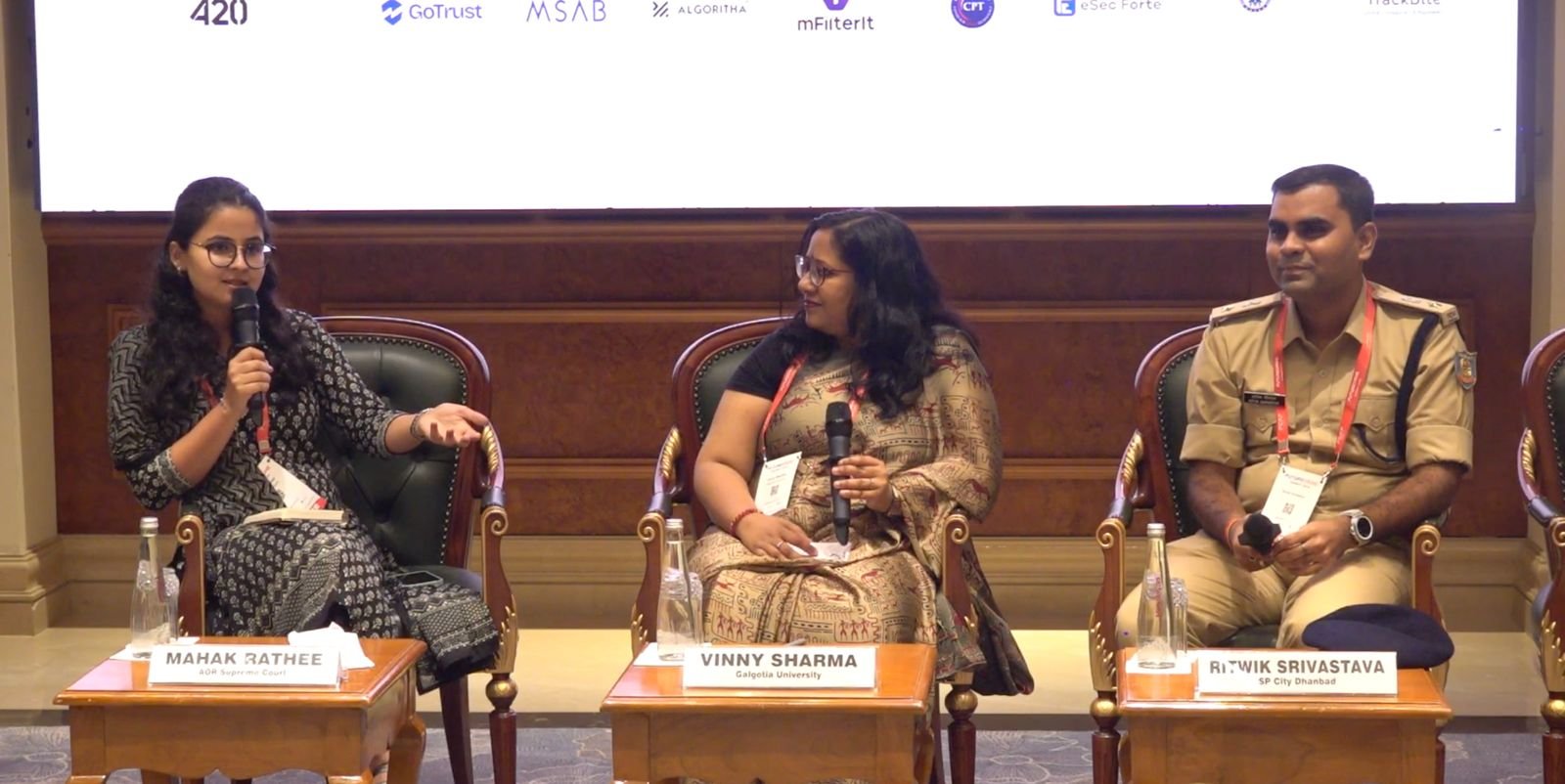
At the FutureCrime Summit 2026, a panel discussion titled “Emerging Cyber Crimes, New Laws and Best Practices in Investigation” examined how rapidly changing forms of digital crime are testing traditional investigative methods and creating new legal and procedural challenges for law-enforcement agencies.
The panel featured Mahak Rathee, Advocate-on-Record, Supreme Court of India; Prof. (Dr.) Vinny Sharma, Galgotias University; and Ritwik Srivastava, SP City, Dhanbad. The Supreme Court’s official Advocate-on-Record directory lists Mahak Rathee as an AOR, while Galgotias University identifies Vinny Sharma as a faculty member associated with forensic science. Jharkhand Police lists Ritwik Srivastava as SP City, Dhanbad.
Their participation brought together legal, forensic-academic and policing perspectives at a time when cyber investigations increasingly require cooperation across all three areas.
Emerging Crimes Test Traditional Investigation
Cybercrime has evolved well beyond conventional hacking or isolated online fraud. Investigators today encounter crimes involving digital payments, social-engineering networks, compromised devices, identity misuse and rapidly changing technological tools.
Such cases often generate large volumes of electronic evidence spread across mobile phones, computers, online platforms and financial systems. Investigators must determine not only what happened, but also how digital evidence can be collected, preserved and connected to individuals in a manner that can withstand judicial scrutiny.
The panel theme reflected this growing complexity. As offenders adapt quickly to new technologies, investigative agencies must continuously update their methods rather than depend solely on procedures designed for conventional crime.
New Laws Reshape Cybercrime Investigations
The legal framework surrounding digital investigations is becoming equally important. Cybercrime cases can involve questions relating to electronic records, admissibility of digital evidence, privacy, intermediary systems and the procedural safeguards that investigators must follow.
Mahak Rathee’s perspective as an Advocate-on-Record of the Supreme Court of India brought the judicial and legal dimension of cyber investigation into the discussion. Her participation highlighted the importance of ensuring that technological sophistication in an investigation is matched by procedural and evidentiary soundness. The Supreme Court currently lists Rathee in its official AOR directory.
Forensics And Policing Must Work Together
Forensic expertise has become increasingly central to investigating technology-enabled crime. Prof. (Dr.) Vinny Sharma of Galgotias University, whose academic work is associated with forensic science, represented the importance of scientific methods and specialist knowledge in interpreting digital evidence.
Ritwik Srivastava, SP City, Dhanbad, brought the operational law-enforcement perspective. Jharkhand Police officially lists him in that position, reflecting the frontline challenges faced by police officers investigating crimes that may cross district, state and digital boundaries.
The broader message of the FutureCrime Summit session was that effective cybercrime investigation increasingly depends on law, technology, forensic science and policing operating together. As cyber offences become more sophisticated, investigative success will depend not only on identifying suspects, but also on preserving reliable evidence, following legally defensible procedures and ensuring that investigators possess the skills required to understand continually evolving digital environments.
Follow for daily updates on cybercrime, corporate fraud, DFIR, hacking, investigations, and digital forensics
